
Uroleucon ambrosiae
(Thomas, 1878)
Brown Ambrosia Aphid
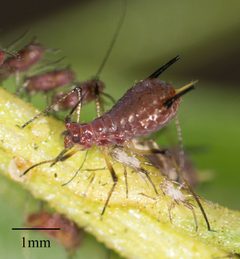
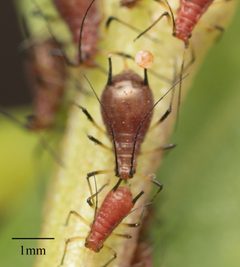
Uroleucon ambrosiae is a medium-sized in the Aphididae, commonly known as the brown ambrosia aphid. Native to North America, it exhibits geographic variation in specificity, with eastern highly specialized on giant ragweed (Ambrosia trifida) while southwestern populations feed more broadly on Asteraceae plants. In Brazil, it has emerged as a significant pest of hydroponically-grown lettuce, where it lettuce mosaic virus and promotes through honeydew . The reproduces parthenogenetically during spring and summer, forming all-female colonies. Its populations serve as important prey for diverse natural enemies including flower fly larvae, lady beetles, lacewings, and parasitic , making it a key component of in both natural and agricultural systems.
Pronunciation
How to pronounce Uroleucon ambrosiae: /ˌjuːɹəˈljuːkɒn æmˈbrəʊzɪiː/
These audio files are automatically generated. While they are not always 100% accurate, they are a good starting point.
Identification
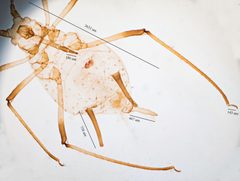
Distinguished from other Uroleucon by its brown coloration and association with Ambrosia and related Asteraceae . Uroleucon species are generally separable by host plant association, geographic distribution, and subtle morphological differences in segment ratios and cornicle length. In the field, confirmed identification requires microscopic examination of diagnostic characters including the shape and length of the ultimate rostral segment, the number of accessory setae on antennal segments, and the structure of the siphunculi. On cup plant (Silphium perfoliatum), it may co-occur with other species but is recognized by its brown color and tendency to form dense colonies on stems and undersides of leaves.
Images
Appearance
Medium-sized with a brown to reddish-brown body coloration. possess the typical aphid : soft-bodied, pear-shaped, with long and a pair of cornicles (siphunculi) projecting from the . The body is relatively elongated compared to some other aphid . Nymphs pass through four instars before reaching adulthood, progressively increasing in size and developing darker pigmentation. Winged forms () may develop under certain conditions, though colonies are typically composed of wingless parthenogenetic females.
Habitat
Primarily associated with plants in the Asteraceae . In natural settings, found on giant ragweed (Ambrosia trifida), common ragweed (Ambrosia artemisiifolia), cup plant (Silphium perfoliatum), black-eyed Susan, coneflower, and sunflower. In agricultural systems, has adapted to hydroponic lettuce in Brazil. Colonies typically establish on stems and leaf undersides of plants, particularly on new growth and flowering stems. Thrives in full sun conditions in gardens, meadows, and agricultural fields.
Distribution
Native to North America, with documented across eastern and southwestern United States showing regional differentiation in use. Eastern populations are highly specific to giant ragweed in the field. Southwestern populations exhibit broader host range, feeding on Ambrosia trifida plus numerous other Asteraceae . In Brazil, established as a pest in hydroponic lettuce production systems. Records from iNaturalist indicate observations across its native range with 110 documented observations.
Seasonality
Active during spring and summer months in temperate regions. In the mid-Atlantic United States, build rapidly on cup plant and other from late spring through early summer, typically peaking in June and July. Parthenogenetic continues through summer until conditions trigger production of sexual forms and in autumn. In greenhouse and hydroponic systems in Brazil, continuous reproduction occurs year-round under controlled conditions, with influenced by temperature rather than .
Diet
Phloem sap feeder specializing on vascular plants in the Asteraceae . Documented include giant ragweed (Ambrosia trifida), common ragweed (Ambrosia artemisiifolia), cup plant (Silphium perfoliatum), black-eyed Susan, coneflower, sunflower, and hydroponic lettuce (Lactuca sativa). Feeding involves piercing plant vascular tissue with stylets and ingesting phloem sap, which is rich in sugars but deficient in . The 's bacterial endosymbiont Buchnera aphidicola supplements this diet by synthesizing essential amino acids, particularly tryptophan and leucine, though U. ambrosiae exhibits lower plasmid amplification of these genes compared to other aphid .
Host Associations
- Ambrosia trifida - primary giant ragweed; principal for eastern
- Ambrosia artemisiifolia - common ragweed
- Silphium perfoliatum - cup plant; supports dense in gardens
- Lactuca sativa - agricultural pest hydroponic lettuce, var. Verônica; major pest in Brazil
- Heterotheca subaxillaris - additional for southwestern
- Tithonia fruticosa - suboptimal used in nutritional studies
- Buchnera aphidicola - obligate endosymbiontbacterial synthesizing
Life Cycle
Hemimetabolous development with four nymphal instars preceding the stage. Duration of nymphal development varies inversely with temperature: approximately 8-10 days at 20-25°C under laboratory conditions. is primarily parthenogenetic (thelytoky) during spring and summer, producing all-female offspring without mating. A single female can produce 1.28 nymphs per day at optimal temperatures, with total highest at constant 20°C. time (T) is longer at 20°C than 25°C, while net reproductive rate (R0) is higher at 20°C. Intrinsic rate of increase (rm) reaches 0.25 at 20-25°C, with population doubling time of 2.77 days. Sexual forms and are produced in autumn to complete the holocycle, though continuous parthenogenetic reproduction occurs in greenhouse environments.
Behavior
Exhibits collective defense termed "collective twitching and kicking response" (CTKR): when the colony is disturbed by visual stimuli (approaching ) or substrate vibrations, aphids perform synchronized twitching and leg-kicking movements. This coordinated defense reduces successful attacks by small parasitic . When feeding, excretes honeydew containing volatile organic compounds that attract natural enemies including flower flies, lady beetles, and lacewings. Under attack by predatory larvae (Aphidoletes aphidomyza), individual aphids may attempt to drop-kick predators off leaves. Eastern demonstrate more efficient probing behavior on their primary Ambrosia trifida compared to southwestern populations, which show more vigorous but less efficient probing on novel hosts.
Ecological Role
Functions as a significant herbivore in natural , particularly in early successional dominated by Ambrosia . Serves as critical prey resource supporting diverse of and including flower fly larvae (Syrphidae), lady beetles (Coccinellidae), green lacewings (Chrysopidae), predatory (Aphidoletes aphidomyza), lynx spiders (Oxyopidae), and parasitic (Praon volucre). Honeydew supports fungi and provides sugar resources for ants and other insects. In agricultural contexts, acts as pest and virus (lettuce mosaic virus) while simultaneously supporting agent that may disperse to other crops. Population on native plants like cup plant generate "predator factories" that enhance landscape-wide pest suppression.
Human Relevance
Agricultural pest in Brazilian hydroponic lettuce production, causing direct feeding damage, transmitting lettuce mosaic virus, and promoting that reduces and marketability. In North American gardens and restoration plantings, generally considered a minor or beneficial presence due to its role in supporting and . Not a significant pest of cultivated crops in its native range. Serves as research organism for studies of - , range evolution, and tritrophic interactions. Used in research, particularly evaluation of Praon volucre for in lettuce systems.
Similar Taxa
- Uroleucon other speciesOther members of Uroleucon share similar and Asteraceae associations; require microscopic examination of antennal segment ratios, rostral segment shape, and siphunculus structure for definitive identification
- Aphis neriiOleander aphid exhibits similar collective defense (CTKR) but is bright yellow rather than brown and specializes on milkweeds and oleander rather than Asteraceae
- Macrosiphum euphorbiaePotato aphid is similar in size and general form but typically green or pinkish, with longer siphunculi, and broader range including Solanaceae
- Myzus persicaeGreen peach aphid is smaller, green or red, with shorter and prominent antennal ; has very broad range and different cornicle shape
More Details
Symbiont Gene Copy Number
Unlike many , U. ambrosiae exhibits low and homogeneous copy number of plasmid-borne genes (leuABCD and trpEG) in its Buchnera endosymbiont across 15 . This may functionally limit tryptophan production rather than enhance it, representing a distinctive nutritional compared to other aphids.
Geographic Host Race Formation
Electrical penetration graph studies reveal that eastern and southwestern U.S. have diverged in -probing , with eastern aphids more efficient on Ambrosia trifida but less vigorous on novel hosts like Heterotheca subaxillaris. This behavioral differentiation indicates ongoing host range evolution and potential incipient speciation.
Temperature Optimization
Laboratory studies indicate constant 20°C is optimal for growth, outperforming both 15°C (too cold) and 25°C (faster development but lower ), as well as fluctuating greenhouse temperatures that increase mortality. This thermal informs management strategies in controlled-environment agriculture.
Sources and further reading
- BugGuide
- GBIF taxonomy match
- iNaturalist taxon
- NCBI Taxonomy
- Catalogue of Life
- Archive — Bug of the Week
- Death to aphids: Brown ambrosia aphid, Uroleucon ambrosiae and other assorted aphids meet flower fly larvae, Syrphidae — Bug of the Week
- Cup plant feeds brown ambrosia aphid, Uroleucon ambrosiae, which in turn provides dinner for lynx spiders, lady beetles, long-legged flies, flower flies, and green lacewings — Bug of the Week
- Fly with a fondness for legs - aphid midges, Aphidoletes aphidomyza — Bug of the Week
- Geographic Variation in Host Specificity Reveals Host Range Evolution in Uroleucon ambrosiae Aphids
- GEOGRAPHIC VARIATION IN HOST SPECIFICITY REVEALS HOST RANGE EVOLUTION INUROLEUCON AMBROSIAEAPHIDS
- Biological aspects and life table of Uroleucon ambrosiae (Thomas, 1878) as a function of temperature
- Quantifying the symbiont contribution to essential amino acids in aphids: the importance of tryptophan for Uroleucon ambrosiae
- Electrical Penetration Graph analysis reveals population differentiation of host‐plant probing behaviors within the aphid species Uroleucon ambrosiae
- Low and homogeneous copy number of plasmid‐borne symbiont genes affecting host nutrition in Buchnera aphidicola of the aphid Uroleucon ambrosiae
- The parasitoid Praon volucre (Hymenoptera: Braconidae: Aphidiinae) as a potential biological control agent of the aphid Uroleucon ambrosiae (Hemiptera: Aphididae) on lettuce in Brazil