
Uroleucon
Mordvilko, 1914
Large Daisy Aphids
Species Guides
21- Uroleucon achilleae(Large Red Yarrow Aphid)
- Uroleucon adenocaulonae
- Uroleucon ambrosiae(Brown Ambrosia Aphid)
- Uroleucon caligatum(Northern Green Goldenrod Aphid)
- Uroleucon cirsii(Large Thistle Aphid)
- Uroleucon erigeronense(Large fleabane daisy aphid)
- Uroleucon eupatoricolens
- Uroleucon helianthicola
- Uroleucon illini
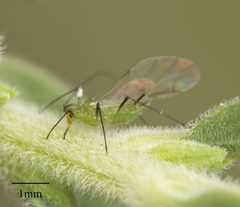
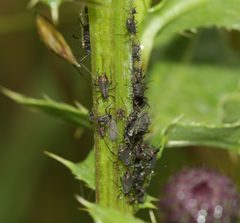
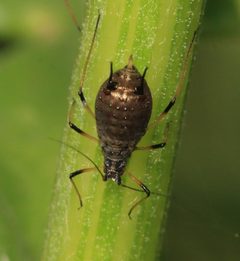
Uroleucon is a of aphids in the Aphididae, commonly known as large daisy aphids. Most feed on plants in the Asteraceae family, with many showing high specificity. The genus includes over 200 described species distributed across multiple subgenera, with species found on host plants ranging from goldenrods and sunflowers to thistles and lettuces. Some species are economically significant as agricultural pests, while others serve as important food sources for natural enemies in garden and agricultural .
Pronunciation
How to pronounce Uroleucon: /ˌjʊərəˈluːkɒn/
These audio files are automatically generated. While they are not always 100% accurate, they are a good starting point.
Identification
Uroleucon are generally larger than many other , with elongated bodies and relatively long legs and . Many species exhibit distinctive coloration, including shades of green, yellow, brown, or red. The siphunculi (cornicles) are typically long and dark, often with swollen or flared apices. Species identification requires examination of microscopic features including antennal segment ratios, cauda shape, and body setae. plant association is often a critical clue for field identification.
Images
Habitat
Found in diverse where plants in the Asteraceae occur, including meadows, prairies, roadsides, agricultural fields, and gardens. show varying degrees of habitat specialization corresponding to their host plant distributions.
Distribution
Widespread across the Northern Hemisphere with records from North America, Europe, Asia, and the Middle East. Individual ranges vary from restricted endemics to broadly distributed .
Seasonality
Activity patterns vary by and climate. In temperate regions, most species are active from spring through fall, with typically as . Some species exhibit parthenogenetic throughout the growing season, with sexual forms appearing in autumn.
Diet
Phloem sap from plants, primarily in the Asteraceae . Feeding can cause plant dehydration, reduced growth, and deformation of stems.
Host Associations
- Asteraceae - primary Most Uroleucon feed on plants in this
- Silphium perfoliatum - Cup plant; of Uroleucon ambrosiae
- Cichorium intybus - Common chicory; of Uroleucon cichorii
- Carthamus tinctorius - Safflower; of Uroleucon compositae and Uroleucon gobonis
- Solidago nemoralis - Gray goldenrod; of Uroleucon nigrotibium
- Rudbeckia laciniata - Cutleaf coneflower; of Uroleucon rudbeckiae
- Grindelia - Gumweed; of multiple Uroleucon
- Achillea - Yarrow; of Uroleucon achilleae and related
Life Cycle
Holocyclic or anholocyclic depending on and climate. typically occurs as in temperate regions. Spring of fundatrices is followed by multiple parthenogenetic . Winged forms (alatae) are produced for , with sexual forms (males and oviparae) appearing in autumn to produce overwintering eggs. Some may persist parthenogenetically year-round in mild climates or greenhouses.
Behavior
Colonies exhibit synchronized defensive including collective twitching and kicking (CTKR) when disturbed by or . This coordinated response reduces successful attacks by small natural enemies. Some show -specific strategies, with between nearby host plants being more common than in certain .
Ecological Role
Important prey for diverse natural enemies including lady beetles, lacewings, flower fly larvae, predatory , parasitic , and spiders. Serve as connectors linking to higher . Some function as agricultural pests, while others contribute to by supporting .
Human Relevance
Some are significant agricultural pests, including Uroleucon cichorii on chicory and endive, and Uroleucon compositae on safflower. Heavy can reduce crop yields and quality. Conversely, colonies support beneficial insects that contribute to biological pest control in gardens and farms.
Similar Taxa
- AphisBoth are , but Uroleucon are generally larger with longer siphunculi and more pronounced cornicle swelling; Aphis species often have shorter, less swollen siphunculi and different associations
- MacrosiphumSimilar in size and , but Macrosiphum typically has longer relative to body length and different siphunculus ; associations often differ
- DactynotusFormerly treated as a separate or synonym; Uroleucon and Dactynotus have been taxonomically conflated, with modern treatments favoring Uroleucon as the valid name
Sources and further reading
- BugGuide
- Wikipedia
- GBIF taxonomy match
- iNaturalist taxon
- NCBI Taxonomy
- Catalogue of Life
- Death to aphids: Brown ambrosia aphid, Uroleucon ambrosiae and other assorted aphids meet flower fly larvae, Syrphidae — Bug of the Week
- Cup plant feeds brown ambrosia aphid, Uroleucon ambrosiae, which in turn provides dinner for lynx spiders, lady beetles, long-legged flies, flower flies, and green lacewings — Bug of the Week
- Archive — Bug of the Week
- Morphological Adaptation to Host Plants in Uroleucon (Homoptera: Aphididae)
- Benefits of Host Plant Specificity in Uroleucon (Homoptera: Aphididae)
- Host plant resistance in safflower (Carthamus tinctorius L.) to aphid, Uroleucon compositae (Theobald)
- Host Range and Biology ofUroleucon(Lambersius)erigeronense(Thomas 1878), and its Synonymy withUroleucon(Lambersius)escalantii(Knowlton) 1928 (Hemiptera: Aphididae)
- Genotypic interactions in an aphid-host plant relationship: Uroleucon rudbeckiae and Rudbeckia laciniata
- Large Chicory aphid (Uroleucon cichorii (Koch, 1855): Sterrnorhyncha: Aphididae) – Invasive Alien Aphid Species in the Fauna of Belarus
- Two new species of the aphid genus Uroleucon (Hemiptera: Aphididae) living on Grindelia in the USA
- Reproductive Performance of a Specialist Herbivore, Uroleucon Nigrotibium (Homoptera), on Its Host and on a Non-Host
- New Achillea-feeding species of the aphid genus Uroleucon (Hemiptera: Aphididae) from Bulgaria
- Geographic Variation in Host Specificity Reveals Host Range Evolution in Uroleucon ambrosiae Aphids
- MORPHOLOGICAL ADAPTATION TO HOST PLANTS IN UROLEUCON (HOMOPTERA: APHIDIDAE)
- Key to the Middle Eastern species of Uroleucon Mordvilko (Aphididae: Homoptera)
- Ecological Adaptation in the Chemosensory Gene Repertoire of the Safflower Aphid, Uroleucon gobonis.
- Draft genome sequence of the obligate bacterial endosymbiont Buchnera aphidicola of the aphid Uroleucon formosanum.
- An integrative strategy used by the aphid Uroleucon formosanum to counter host sesquiterpene lactone defense: Insights from combined genomic and transcriptomic analysis.