
Uroleucon caligatum
(Richards, 1966)
Northern Green Goldenrod Aphid
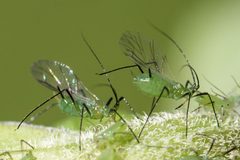
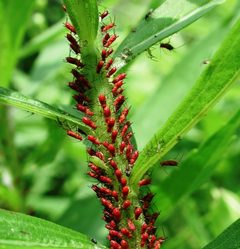
Uroleucon caligatum is a North American in the Aphididae, specialized on goldenrod in the Solidago. The species exhibits significant intraspecific variability in performance across different host plant . Like other Uroleucon species, it likely reproduces parthenogenetically during the growing season. Field studies have demonstrated that plant clone identity strongly affects aphid developmental time, weight, and colony growth.
Pronunciation
How to pronounce Uroleucon caligatum: /ˌjʊərəˈluːkɒn kælɪˈɡeɪtəm/
These audio files are automatically generated. While they are not always 100% accurate, they are a good starting point.
Identification
Distinguished from other Uroleucon by association with Solidago ; precise morphological diagnostic features not available in sources. Related species Uroleucon ambrosiae (brown ambrosia aphid) shares similar but occurs on different host plants in Asteraceae.
Images
Habitat
Associated with goldenrod plants (Solidago spp.) in field and meadow environments.
Distribution
North America; specific range boundaries not detailed in available sources.
Diet
Phloem sap feeder specializing on Solidago (Asteraceae).
Host Associations
- Solidago - primary Multiple of Solidago support variable performance; quality differs significantly among plant .
Life Cycle
Parthenogenetic during spring and summer typical for ; specific details for this not documented.
Ecological Role
Herbivore; affected by plant quality and natural enemies.
Similar Taxa
- Uroleucon ambrosiaeShares and similar , but occurs on different plants including ambrosia and cup plant (Silphium perfoliatum); distinguished by host association.
- Other Uroleucon speciesMany occur on Asteraceae; precise identification requires morphological examination and plant verification.
Sources and further reading
- BugGuide
- iNaturalist taxon
- NCBI Taxonomy
- Death to aphids: Brown ambrosia aphid, Uroleucon ambrosiae and other assorted aphids meet flower fly larvae, Syrphidae — Bug of the Week
- Cup plant feeds brown ambrosia aphid, Uroleucon ambrosiae, which in turn provides dinner for lynx spiders, lady beetles, long-legged flies, flower flies, and green lacewings — Bug of the Week
- Archive — Bug of the Week
- Intraspecific variability in herbivore performance and host quality: a field study of Uroleucon caligatum (Homoptera: Aphididae) and its Solidago hosts (Asteraceae)