
Brochymena lineata
Ruckes, 1939
rough stink bug
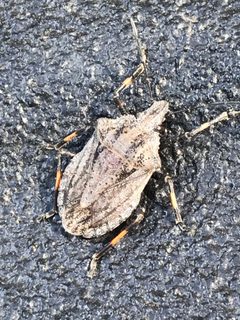
Brochymena lineata is a of rough stink bug in the Pentatomidae, native to North America. Like other members of the Brochymena, it exhibits cryptic coloration that mimics lichen-mottled bark, providing effective camouflage against tree trunks. The species was described by Ruckes in 1939. As with , it is not considered an agricultural or household pest.
Pronunciation
How to pronounce Brochymena lineata: /brəˈkaɪmɪnə lɪniˈeɪtə/
These audio files are automatically generated. While they are not always 100% accurate, they are a good starting point.
Identification
Distinguished from the Brown Marmorated Stink Bug (Halyomorpha halys) by: (1) lacking white bands on the last two segments, and (2) presence of fine teeth along the leading edge of the pronotum. Separation from other Brochymena requires microscopic examination of genitalic structures; field identification to species is generally not possible. The is further distinguished from other native stink bugs by its exceptionally cryptic bark-like appearance and tendency to remain outdoors rather than entering structures.
Images
Habitat
Associated with trees and shrubs where its bark-mimicking camouflage is effective. Overwinters as beneath loose bark or in other sheltered outdoor locations. Does not typically enter human dwellings in large numbers.
Distribution
North America. Specific range within North America not separately documented from ; likely overlaps with broader distribution.
Seasonality
may be observed on warm, sunny winter days when they emerge from hibernation sites. Active primarily in spring and fall around periods of dormancy. One per year in temperate climates.
Life Cycle
laid in small clusters on twigs of trees. Nymphs progress through four instars before reaching adulthood. Development from egg to is prolonged, resulting in a single annually in temperate regions. Overwinters in the adult stage.
Behavior
fly well and may alight on contrasting surfaces such as fences or sidewalks, making them more detectable than when resting on bark. Aggregates with conspecifics under loose bark for winter dormancy. Survives freezing temperatures; individuals have been observed to recover after extended freezing.
Ecological Role
Suspected to feed on plant sap of trees and shrubs. May occasionally be predatory or scavenging on other insects, as reported for the . Serves as prey for sand wasps (Bicyrtes quadrifasciata), birds, and fence lizards. Parasitized by tachinid flies (Trichopoda spp.) and including platygastrid (Trissolcus brochymenae, Telenomus sp.) and the eupelmid wasp Anastatus reduvii.
Human Relevance
Not a pest . Does not invade homes in large unlike the Brown Marmorated Stink Bug. No economic impact on agriculture or forestry documented. Occasionally encountered by entomologists and naturalists due to its effective camouflage.
Similar Taxa
- Brochymena affinisSimilar bark-mimicking appearance; -level identification requires microscopic examination
- Brochymena quadripustulataOverlapping range and nearly identical cryptic ; distinguished by subtle structural differences visible only under magnification
- Halyomorpha halys (Brown Marmorated Stink Bug) frequently confused with Brochymena; distinguished by banded , smooth pronotal margin, and tendency to aggregate in large numbers on buildings
More Details
Taxonomic note
identification within Brochymena is challenging and generally requires examination of dead specimens under a microscope. Brochymena lineata was described by Ruckes in 1939, but field records often report the without species-level determination.
Cold tolerance
Members of this demonstrate remarkable cold hardiness. Anecdotal reports indicate can survive extended freezing and resume activity upon thawing.
Sources and further reading
- BugGuide
- Wikipedia
- GBIF taxonomy match
- iNaturalist taxon
- Ready for Moth Night at UC Davis? | Bug Squad
- Bug Eric: Rough Stink Bugs
- Bug Eric: Wasp Wednesday: Neorileya
- Bug Eric: Indoor Insects of Autumn (part 3 of 4)
- Oklahoma is More than OK for Burying Beetles
- Bug Eric: White-lined Sphinx ("Hummingbird Moth")