
Muscina
Robineau-Desvoidy, 1830
false stable flies
Species Guides
5- Muscina dorsilinea
- Muscina levida(Dark-horned Muscina)
- Muscina pascuorum(Pasture Fly)
- Muscina prolapsa
- Muscina stabulans(False Stable Fly)
Muscina is a of muscid flies comprising approximately 27 with worldwide distribution. The genus includes several species frequently associated with livestock facilities, manure, and human structures. M. stabulans (false stable fly) is the most extensively studied species, serving as a model for biomechanics research and . Members of this genus are notable for their epidemiological significance as mechanical of , forensic utility in post-mortem interval estimation, and facultative predatory by third-instar larvae.
Pronunciation
How to pronounce Muscina: /mʊˈsaɪnə/
These audio files are automatically generated. While they are not always 100% accurate, they are a good starting point.
Identification
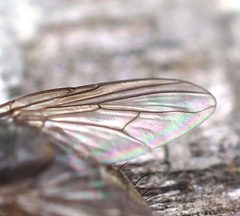
Distinguished from Musca domestica by the pale-tipped scutellum (dark in house flies) and wing venation patterns. M. stabulans and M. levida are larger than house flies with moderately curved fourth ; M. levida further identified by black legs and black palpi. M. pascuorum distinguished by red palpi and strongly curved fourth vein ending before wing tip. M. prolapsa requires expert examination for definitive identification. Separation from other muscid relies on combinations of scutellum coloration, palpal color, leg color, and wing venation.
Images
Appearance
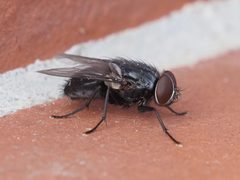
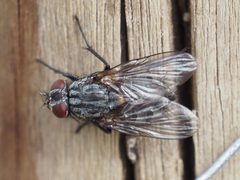
Medium-sized muscid flies, generally 6–12 mm in length. Diagnostic features include a retractable with sponging or sucking mouthparts, and a pale-tipped scutellum. Wing venation shows a moderately curved fourth . vary in size and coloration: M. stabulans and M. levida are larger than the house fly (Musca domestica); M. levida has entirely black legs and black palpi; M. pascuorum has red palpi, a strongly curved fourth vein ending at or before the wing tip, and is larger than M. levida.
Habitat
environments including livestock facilities, poultry farms, barns, and areas with accumulated manure. Frequently found near human structures, particularly outside restrooms. Some (M. pascuorum) associated with woodland fungi. Larval include manure, decaying organic matter, carrion, and decomposing fungi.
Distribution
; documented from all biogeographic regions including North America, South America, Europe, Asia, and Australasia. Specific records from Canada, United States (including Vermont), Brazil (Bahia, Paraná, Rio Grande do Sul, São Paulo), Argentina, and Scandinavia (Denmark, Norway, Sweden).
Seasonality
activity generally peaks in warmer months, though some enter buildings for . M. stabulans shows autumn and winter on carcasses in forensic contexts. M. pascuorum appears on windowsills during autumn and winter in temperate regions.
Diet
feed on liquids using sponging mouthparts, including decaying organic matter, nectar, and bodily fluids. Larvae feed on decaying organic substrates: manure, carrion, compost, and fungi (M. pascuorum). Third-instar larvae of M. stabulans are facultative , consuming first and second instars of Musca domestica.
Life Cycle
Holometabolous development: , three larval instars, pupa, . Eggs retained in female until complete, then deposited via ovipositor on decaying substrates. Larvae have 11 segments; with curved slits indicate instar (1 slit = first instar, 2 = second, 3 = third). typically in cocoon (except M. levida, which does not form a cocoon). Development rate temperature-dependent; optimal range 20–30°C. Laboratory rearing at 24.8°C yields egg-to-adult development with mean generational time of 6.41 weeks.
Behavior
are strong fliers with wing-beat frequency of 150–190 Hz and amplitude of approximately 170°. speed estimated at 2–3 m/s. Antennal sensory input maintains figure-of-eight wing path during flight. Third-instar larvae exhibit facultative on other dipteran larvae. Adults attracted to carrion, , and decaying matter; some overwinter in buildings. M. stabulans larvae can detect and colonize buried carcasses, laying on soil surface with larvae burrowing downward.
Ecological Role
Decomposer of organic matter including manure and carrion; nutrient cycling in agricultural and urban . Facultative of pest flies (Musca domestica) in poultry facilities, capable of significantly reducing house fly . Forensic for post-mortem interval estimation. Mechanical of bacterial and viral between fecal sources and human food or wounds.
Human Relevance
Epidemiologically significant as mechanical of including poliovirus and bacteria; implicated in transmission through contact with and food. : larvae used to estimate time of death, particularly M. stabulans in autumn and winter cases. Rare cause of myiasis in humans (cutaneous and intestinal). Nuisance pest in livestock facilities and human structures; indicator of poor .
Similar Taxa
- Musca domesticaHouse fly lacks pale-tipped scutellum, has different wing venation, and is generally smaller than M. stabulans and M. levida
- Stomoxys calcitransStable fly has for blood-feeding and distinct thoracic coloration; Muscina has sponging mouthparts and different associations
- Pollenia rudisCluster fly enters buildings for but has different wing venation and is of earthworms; distinguished by wing structure and
More Details
Forensic Significance
M. stabulans is particularly important in due to its predictable of carcasses during autumn and winter when other blow flies are less active. Larvae appear from day 1 to 10 post-mortem and predominate in the adipocere-like decomposition stage. Predatory third instars can alter forensic composition by consuming other larvae.
Laboratory Rearing Parameters
Under controlled conditions (24.8°C, 70–80% RH, 12:12 photophase), M. stabulans shows rapid growth with (rm) of 0.637 individuals per individual per week, net reproductive rate (R0) of 75.25, and mean of 312 per female. Females outlive males (34 vs 28 days mean lifespan).
Flight Biomechanics Research
M. stabulans has been extensively studied as a model organism for insect mechanics, with detailed measurements of wing-beat frequency (150–190 Hz), wing area (49 mm²), wing length (9.8 mm), body mass (~45 mg), and power requirements (1.5–2.5 ergs per wing-beat). Research demonstrated the role of antennal sensory input in maintaining stable flight patterns.
Sources and further reading
- BugGuide
- Wikipedia
- GBIF taxonomy match
- iNaturalist taxon
- NCBI Taxonomy
- Catalogue of Life
- Managing External Parasites of Texas Cattle - AgriLife Extension Entomology
- Flies at the window - Muscina pascuorum — Bug of the Week
- Reproduction and survival of Muscina stabulans under laboratory conditions
- The flight of the dipterous fly Muscina stabulans Fallén
- THE DISTRIBUTION IN CANADA OF THE EUROPEAN SCAVENGER FLY, MUSCINA PASCUORUM MG
- The Distribution of Muscina Pascuorum Meigen in America
- The population ecology of Muscina stabulans (Fallén) (Diptera: Muscidae), along an Urban-Rural Gradient of Buenos Aires, Argentina