
Muscina pascuorum
(Meigen, 1826)
Pasture Fly, European Scavenger Fly
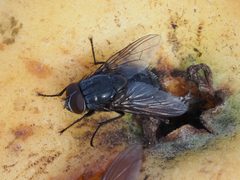
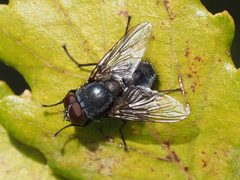
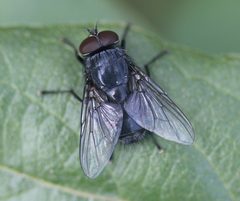
Muscina pascuorum is a muscid fly native to Europe that has become established across North America. The is closely allied to M. stabulans and M. levida. It is known to enter homes in autumn and winter, where accumulate on windowsills. Larvae develop in fungi, particularly woodland mushrooms, rather than in carrion or manure like many related muscids. The specific epithet 'pascuorum' refers to pastures, reflecting its original European association.
Pronunciation
How to pronounce Muscina pascuorum: /mʊˈsiːnə pæˈskwɔːrʊm/
These audio files are automatically generated. While they are not always 100% accurate, they are a good starting point.
Identification
Muscina pascuorum can be distinguished from the common house fly (Musca domestica) and stable fly (Stomoxys calcitrans) by its and seasonality—it appears on windowsills in autumn and winter rather than summer. It resembles M. stabulans and M. levida closely; precise identification requires examination of genitalia and thoracic chaetotaxy. are medium-sized muscid flies with typical gray thoracic stripes.
Images
Habitat
Pasture lands and rural areas; woodland environments with abundant fungi. In autumn, seek shelter in buildings and are commonly found on windowsills. The is associated with forested areas where larvae feed on fungi.
Distribution
Native to Europe (Denmark, Norway, Sweden). Introduced and now widespread across North America: Canada (Ontario, Quebec, British Columbia), and United States from New Hampshire and New York west to Washington, Oregon, and California, and south to Florida, Texas, and New Mexico. First recorded in North America in 1916 at Ottawa, Ontario.
Seasonality
are active in autumn and winter; commonly observed on windowsills during cooler months. Seasonal activity correlates with fungal fruiting in woodlands. Spring from sites occurs as temperatures warm.
Diet
Larvae feed on fungi, particularly woodland mushrooms. feed on nectar and other liquid food sources.
Life Cycle
Larvae develop in fungi, not in carrion or manure. occurs in soil or decaying organic matter. overwinter in buildings and other sheltered locations.
Behavior
enter buildings in autumn seeking shelter, accumulating on windowsills. They are attracted to light and warmth on sunny winter days. Unlike cluster flies (Pollenia rudis), they do not parasitize earthworms.
Ecological Role
Decomposer; larvae contribute to fungal decomposition in forest . may serve as minor when feeding on nectar.
Human Relevance
Considered a nuisance pest when enter homes in autumn and winter. Often mistaken for house flies or cluster flies. Can indicate abundant fungal growth in nearby woodlands. Not known to transmit or infest food products.
Similar Taxa
- Musca domesticaCommon house fly; differs in seasonality (summer peak), larval (manure, decaying organic matter), and association with human structures year-round
- Stomoxys calcitransStable fly; differs in painful biting mouthparts, blood-feeding , and summer activity period
- Muscina stabulansClosely allied ; requires examination of genitalia and chaetotaxy for reliable separation
- Muscina levidaClosely allied ; requires examination of genitalia and chaetotaxy for reliable separation
- Pollenia rudisCluster fly; differs in larger size, golden thoracic hairs, and larvae that develop in earthworms
Sources and further reading
- BugGuide
- Wikipedia
- GBIF taxonomy match
- iNaturalist taxon
- NCBI Taxonomy
- Catalogue of Life
- Encyrtid Holdings | Entomology Research Museum
- Managing External Parasites of Texas Cattle - AgriLife Extension Entomology
- Flies at the window - Muscina pascuorum — Bug of the Week
- Strathmore B-Lines: Surveying Grasslands and Pollinating Insects in the Strathmore Valley - Buglife Blog - Buglife
- National Meadows Day 2022 in Northern Ireland - Buglife Blog - Buglife
- The Distribution of Muscina Pascuorum Meigen in America
- THE DISTRIBUTION IN CANADA OF THE EUROPEAN SCAVENGER FLY, MUSCINA PASCUORUM MG