
Muscina stabulans
(Fallén, 1817)
False Stable Fly
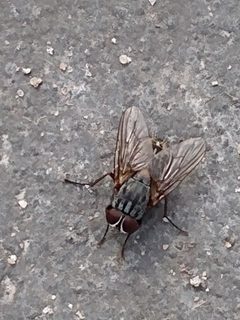
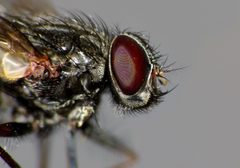
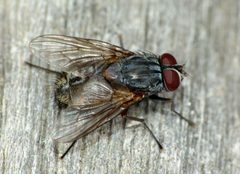
Muscina stabulans, commonly known as the false stable fly, is a muscid fly distributed worldwide. are medium-sized flies averaging 8 mm in length, distinguished by four dark thoracic stripes, partially reddish-brown legs, and a pale spot above the . The exhibits strong synanthropic tendencies, with higher abundance in urban-suburban environments compared to rural areas. It has significant economic and public health importance as a mechanical of , a facultative of house fly larvae in poultry facilities, and a forensic for post-mortem interval estimation. Rare cases of intestinal myiasis in humans have been documented.
Pronunciation
How to pronounce Muscina stabulans: /mʌˈsɪnə stæbjʊˈlænz/
These audio files are automatically generated. While they are not always 100% accurate, they are a good starting point.
Identification
Distinguished from the true stable fly (Stomoxys calcitrans) by non-piercing mouthparts and lack of blood-feeding . Differs from house fly (Musca domestica) by four dark thoracic stripes (vs. four dark stripes but with distinct abdominal pattern in house fly), partially reddish-brown legs, and presence of a pale spot above the . Separated from Muscina pascuorum and M. assimilis by preference and seasonal occurrence patterns. Antennal structure with third joint bearing involved in sensory mechanics.
Images
Habitat
Strongly , preferring urban-suburban environments over rural areas. Found in filthy including latrines, household wastes, livestock manure, wastewater treatment plants, and poultry farms. Occurs in animal housing such as poultry houses. Larvae develop in decomposing organic matter including carrion, excrement, fruit, and fungi. Capable of colonizing buried bodies in shallow ground through several inches of dirt. Shows negative heliophily, preferring shaded over sunny areas.
Distribution
distribution worldwide. Neotropical Region: Argentina (Buenos Aires, Salta, Tucumán, Río Negro provinces), Brazil (Bahia, Paraná, Rio Grande do Sul, São Paulo), Chile (Valdivia). North America: United States. Europe: Original description from Sweden. Atlantic islands: Azores (Corvo, Faial, Flores, São Jorge, São Miguel).
Seasonality
Active year-round with lowest representation in winter. Peak activity and cycles occur during summer months. In temperate regions, autumn and winter activity observed when associated with fungal resources or indoor environments. Hourly activity increases toward afternoon (10:00 am to 4:00 pm).
Diet
Larvae consume decomposing organic matter including fruit, fungi, excrement, and carrion. Third instars are facultative of Musca domestica first and second instar larvae. require protein sources for ovary development; attracted to rotten cow liver over dog faeces. Laboratory colonies maintained on powdered milk, sugar, and fish meal.
Host Associations
- Musca domestica - preyThird instars are facultative of house fly first and second instars; can drastically reduce house fly in poultry farms
- humans - accidental Rare cases of intestinal myiasis documented; mechanical of food-borne
- domestic animals - associateFound in animal housing and livestock manure; producer of traumatic myiasis in animals
- decomposing carcasses - developmental substrateLarval for forensic post-mortem interval estimation; prefers later stages of decomposition
Life Cycle
Rapid developmental rate, especially between 20–30°C. time (T) 6.41 weeks under laboratory conditions at 24.8°C. Net reproductive rate (R0) 75.25; (rm) 0.637 individuals per individual per week. Females anautogenous, requiring protein for development. Oviposition period approximately 55 days with peak between weeks 2–6. Gross oviposition rate approximately 312 eggs per female in laboratory; field estimates of 140–200 eggs per female. Larvae feed through three instars then pupate in moist substrate (65–90% RH). Egg to development time temperature-dependent.
Behavior
Exhibits negative heliophily, preferring shaded microhabitats. Hourly activity peaks in afternoon. urban exploiter with higher abundance at urban-suburban sites (synanthropic index +68.02). Female-biased sex ratio at protein baits. mechanics involve figure-of-8 wing tip path during downward beat, dependent on antennal sensory input; legs held in characteristic attitude during flight. Wing vibration continues when air blown from front, mediated by antennal sensory feedback.
Ecological Role
Facultative of house fly larvae in poultry facilities, providing . Mechanical of food-borne and animal . Forensic for post-mortem interval estimation, colonizing carcasses from 1–10 days post-mortem. Nutrient cycler in decomposition systems. Competitor with other muscid flies in ephemeral resource patches.
Human Relevance
Negative economic impact on dairy farms and poultry industries through competition and transmission. Public health concern as mechanical of gastrointestinal agents. Rare but documented cause of intestinal myiasis in humans, with including abdominal discomfort and bloating. Forensic utility for estimating time since death in criminal investigations. Beneficial role as agent of house flies in poultry operations.
Similar Taxa
- Stomoxys calcitrans (Stable Fly)Similar and general appearance, but S. calcitrans has piercing mouthparts for blood-feeding, painful bite, and different thoracic pattern; M. stabulans lacks biting mouthparts
- Musca domestica (House Fly)Overlapping and appearance; distinguished by four thoracic stripes with pale spot above, partially reddish legs, and abdominal coloration in M. stabulans; M. domestica has distinct abdominal pattern with creamy yellow sides
- Muscina pascuorumCongeneric with similar ; M. pascuorum associated with woodland fungi and autumn-winter indoor occurrence, while M. stabulans prefers filthy and carrion
More Details
Flight Mechanics
Classic 1940 physiological study established that figure-of-8 wing tip path during depends on antennal sensory input, specifically movement of the third antennal joint relative to the second under air stream stimulation. sensory input also involved in maintaining flight pattern.
Laboratory Rearing
Successful laboratory colonies maintained at 24.8°C ± 0.6°C, 70–80% RH, 12:12 photophase. diet: powdered milk:sugar:fish meal (2:2:1). Larval diet: fish meal:sawdust:water (2:2:1) paste. Rapid growth enables quantitative modeling of survival and oviposition patterns.
Sources and further reading
- BugGuide
- Wikipedia
- GBIF taxonomy match
- iNaturalist taxon
- NCBI Taxonomy
- Catalogue of Life
- Managing External Parasites of Texas Cattle - AgriLife Extension Entomology
- Flies at the window - Muscina pascuorum — Bug of the Week
- Reproduction and survival of Muscina stabulans under laboratory conditions
- The flight of the dipterous fly Muscina stabulans Fallén
- The population ecology of Muscina stabulans (Fallén) (Diptera: Muscidae), along an Urban-Rural Gradient of Buenos Aires, Argentina
- A first record of a suspected intestinal myiasis caused by Muscina stabulans (Fallén 1817) (Diptera: Muscidae) in Southern South America.