
Pollenia rudis
(Fabricius, 1794)
common cluster fly, attic fly, loft fly, buckwheat fly
, the common , is a medium-sized blow fly in the Polleniidae. are notable nuisance pests of buildings, in attics and wall voids in large during cold months. The is an obligate of earthworms in its larval stages, with well-documented specificity to certain lumbricid species. Native to Europe, it has been introduced to North America and New Zealand, where it occurs wherever its earthworm hosts are present.
Pronunciation
How to pronounce Pollenia rudis: //pɔˈle.ni.a ˈruː.dɪs//
These audio files are automatically generated. While they are not always 100% accurate, they are a good starting point.
Identification
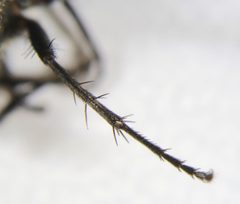
Distinguished from house flies (Musca domestica) by larger size, golden thoracic hairs (when fresh), less prominent thoracic stripes, and overlapping wing tips at rest. Similar to other Pollenia (P. pallida, P. dasylopoda), but P. rudis lacks the broad flattened facial keel of P. pallida females and the black with yellow of P. dasylopoda. Accurate species-level identification of living specimens in the field is difficult; microscopic examination of setal patterns on the and is required. P. rudis and P. pediculata are the most commonly encountered cluster flies in North America.
Images
Appearance
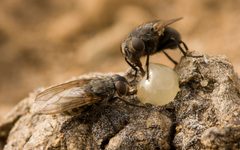
are 9.5–12.7 mm in length, slightly larger than the common house fly. The body is dark gray with a checkered black and silvery-black . Fresh specimens display a conspicuous coating of golden-yellow hairs on the ; these hairs are easily abraded and often missing in older specimens. The thoracic stripes are less prominent than in the house fly. The wing tips overlap when at rest. The basicosta ranges from yellow to light brown, occasionally black. The is yellow to light brown. Diagnostic features include 2–3 rows of setae on the thorax and 6–8 strong frontal bristles. Aristate are present. are oblong, very small, and white. Larvae are white with posterior spiracles.
Habitat
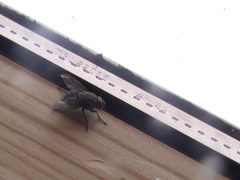
occur in fields and open areas during summer, particularly where soil is well-drained silt-loam with grass cover. adults seek shelter in buildings, especially attics, lofts, wall voids, and window frames; also recorded in tree holes, loose bark, and tunnels in timber. Larval is soil containing suitable earthworm .
Distribution
Native to Europe; introduced to North America (first documented in New York state by 1852), Canada, and New Zealand. Occurs throughout the United States and southern Canada wherever earthworms of the Aporrectodea (Allolobophora) are present. European show more restricted distributions for certain cryptic within the P. rudis complex.
Seasonality
are active outdoors during spring and summer. In autumn, adults seek shelters and may become active indoors on warm winter days. In North America, copulation occurs in spring; in Europe, copulation occurs in autumn with first-instar larvae overwintering inside earthworm .
Host Associations
- Eisenia rosea - preferred Primary in Ontario, Canada; successfully reared in laboratory exclusively on this
- Allolobophora chlorotica - field One of two main documented in European
- Aporrectodea caliginosa - Documented
- Aporrectodea chlorotica - Documented
- Eisenia lucens - Documented
- Lumbricus rubellus - Documented
- Lumbricus terrestris - Documented
Life Cycle
In North America: hatch in 4–6 days; larvae penetrate earthworm through surface, primarily near male genital perforation. Larvae feed internally for approximately two weeks, periodically extending through host body wall to breathe. Mature larvae exit host (usually alive) and pupate in soil within hardened last larval skin; pupal stage lasts 39–45 days. Up to four per year. Complete development from egg to requires 27–39 days at 23°C. In Europe: single generation per year; 10–12 months total development; first-instar larvae overwinter inside earthworm hosts, molting twice over ~20 days in spring, then pupating for 32–45 days (shortened to 7 days at 27°C).
Behavior
are sluggish fliers. Larvae locate by following natural soil pore spaces; penetration is induced by substances in earthworm slime and coelomic fluid. Host location success is severely reduced in disturbed soil lacking natural pores. Larvae can repenetrate hosts after leaving original penetration site. Host earthworms may autotomize parasitized segments as a defense. Adults cluster in large (hundreds to thousands) in shelters. Attracted to white or pale-colored structures that reflect heat for basking.
Ecological Role
Larval of earthworms; impacts on earthworm populations have not been documented. are flower visitors, feeding on nectar and honeydew; potential though this role is unquantified. Dead adults in building voids serve as food for dermestid beetles (Anthrenus scrophulariae), creating secondary pest .
Human Relevance
Major nuisance pest of buildings. enter structures through small exterior openings to overwinter, forming large in attics and wall voids. Do not bite, transmit , or damage structures, textiles, or food. Crushing adults produces greasy stains and odor of buckwheat honey. Unseasonable winter warmth causes adults to become active indoors, flying with loud buzz. Difficult to eradicate once established; prevention through sealing exterior entry points is most effective control. Control of earthworm is impractical and ineffective. Professional extermination most reliable for established .
Similar Taxa
- Pollenia pediculataSecond most common in North America; distinguished by microscopic setal characters
- Pollenia pallidaFemales have broad, flattened facial keel not present in P. rudis
- Pollenia dasylopodaHas black with yellow tint on ; P. rudis lacks this coloration
- Musca domestica (house fly)Smaller size, bright white , prominent thoracic stripes, wing tips not overlapping at rest, lacks golden thoracic hairs
Misconceptions
Often mistaken for house flies due to similar general appearance. Frequently assumed to breed in garbage or carrion like other blow flies; actually an earthworm with completely different . The name 'buckwheat fly' derives from odor when crushed, not from any association with buckwheat plants. Multiple cryptic were formerly confused under the name P. rudis; North American and European 'P. rudis' may represent different species.
More Details
Taxonomic complexity
The P. rudis contains multiple cryptic . Six species are now recognized in North America, differentiated by setal characters. European and North American show differences suggesting possible speciation. The name P. rudis has been applied to what may be P. pseudorudis in some North American literature.
Introduction history
Likely introduced to North America in soil ballast of sailing vessels from Europe; hibernation would have facilitated survival during slow trans-Atlantic voyages. First documented in Geneva, New York by 1852. Earthworm are also European introductions, as native North American earthworms were eliminated by Pleistocene glaciation.
Host specificity mechanism
While P. rudis larvae can be induced to penetrate various earthworm in laboratory conditions using fluids, natural in the field is restricted to specific hosts. Soil conditions strongly influence host- relationship through effects on earthworm ; encysted hosts are more successfully parasitized than active hosts, and of infected segments occurs more frequently in active hosts.
Sources and further reading
- BugGuide
- Wikipedia
- GBIF taxonomy match
- iNaturalist taxon
- NCBI Taxonomy
- Catalogue of Life
- Bug Eric: Fly Day Friday: Cluster Flies
- Bug Eric: January 2013
- Flies at the window - Muscina pascuorum — Bug of the Week
- Bug Eric: Small Milkweed Bug
- Bug Eric: The Monarch Dethroned
- Pensoft Editorial Team | Blog - Part 89
- DEAD POLLENIA RUDIS (FABR.) AS HOSTS OF DERMESTIDS
- REARING AND IMMATURE STAGES OF THE CLUSTER FLY (POLLENIA RUDIS) (DIPTERA: CALLIPHORIDAE) IN ONTARIO
- The taxonomy of the Pollenia rudis species‐group in the Holarctic Region (Diptera: Calliphoridae)
- THE BIOLOGY OF POLLENIA RUDIS, THE CLUSTER FLY (DIPTERA: CALLIPHORIDAE): II. LARVAL FEEDING BEHAVIOUR AND HOST SPECIFICITY
- THE BIOLOGY OF POLLENIA RUDIS, THE CLUSTER FLY (DIPTERA: CALLIPHORIDAE): I. HOST LOCATION BY FIRST-INSTAR LARVAE
- THE BIOLOGY OF POLLENIA RUDIS, THE CLUSTER FLY (DIPTERA: CALLIPHORIDAE): III. THE EFFECT OF SOIL CONDITIONS ON THE HOST–PARASITE RELATIONSHIP
- THE BIOLOGY OF POLLENIA RUDIS, THE CLUSTER FLY (DIPTERA: CALLIPHORIDAE): IV. A PRELIMINARY MODEL OF THE CLUSTER FLY LIFE CYCLE, AND SOME POSSIBLE METHODS OF BIOLOGICAL CONTROL