
Pollenia
Robineau-Desvoidy, 1830
cluster flies, attic flies
Species Guides
6- Pollenia angustigena(Narrow-cheeked Clusterfly)
- Pollenia griseotomentosa(cluster fly)
- Pollenia labialis(cluster fly)
- Pollenia pediculata(Tufted Clusterfly)
- Pollenia rudis(common cluster fly)
- Pollenia vagabunda(cluster fly)
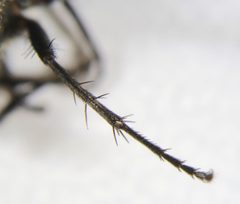
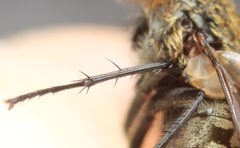
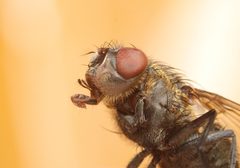
Pollenia is a of blow flies commonly known as cluster flies or attic flies. Unlike typical carrion-feeding blow flies, these insects are or of earthworms and other . are medium-sized flies that frequently enter buildings in autumn to overwinter in sheltered locations, becoming active on warm winter days and emerging in spring. The genus contains approximately six in North America, with Pollenia rudis and P. pediculata being most common. Species identification requires microscopic examination of setae patterns.
Pronunciation
How to pronounce Pollenia: //pɔˈlɛ.ni.a//
These audio files are automatically generated. While they are not always 100% accurate, they are a good starting point.
Identification
Cluster flies resemble overgrown house flies but can be distinguished by golden hairs on the in fresh specimens (though these wear off with age). They lack the bright white of house flies. -level identification within Pollenia requires microscopic examination of setae number, position, and length on various body parts. Pollenia rudis and P. pediculata are the most frequently encountered species in North America; P. vagabunda and P. labialis are more recent European introductions.
Images
Habitat
frequent flowers in spring and summer, particularly Anne's Lace (Daucus carota), where they feed on nectar. They also visit honeydew on leaves. In autumn, they seek shelter in buildings, preferring white or pale-colored structures that reflect heat. They enter through small openings into wall voids, window frames, and attics. Rural areas with earthworm support higher numbers.
Distribution
Native to the Palaearctic region with multiple introduced to North America. Pollenia rudis likely originated in Europe and was introduced with European earthworms. In North America, found across the United States and southern Canada. P. vagabunda and P. labialis were introduced in the 1950s–1960s. P. griseotomentosa has been recorded in Canada (British Columbia, Ontario) and USA (New York, West Virginia).
Seasonality
are active from spring through autumn, with peak activity March–June. They overwinter as adults in sheltered locations, becoming active on unseasonably warm winter days. Multiple per year (up to four), with adults emerging in spring to mate and lay .
Diet
feed on flower nectar and honeydew from aphids and scale insects. Larvae are or of earthworms, entering through the male genital perforation and feeding internally for approximately two weeks. Some may parasitize caterpillars, bees, or other insects.
Life Cycle
Females lay in soil near earthworm burrows in early spring, depositing 2–3 eggs at a time. Larvae hatch in 4–6 days, locate earthworm , and enter through the male genital opening. The maggot feeds internally, periodically puncturing the worm's body wall to expose for respiration. After maturing, the larva exits (usually leaving the worm alive) and pupates in soil. The pupa is enclosed in a hardened capsule formed from the last larval skin. Pupal stage lasts 39–45 days. Up to four per year. Overwinters as .
Behavior
exhibit clustering in autumn, aggregating on sunny building walls before seeking entry to overwinter. They become disoriented and active on warm winter days, often accumulating at windows. Males are not territorial. Adults are capable of squeezing through remarkably small openings to access wall voids. is characterized by a loud, irritating buzz.
Ecological Role
Larvae function as agents of earthworm . serve as of wildflowers including Gilia. Dead adults in buildings provide food and breeding substrate for dermestid beetles such as Anthrenus scrophulariae, creating secondary pest issues.
Human Relevance
Considered a nuisance pest due to in buildings. Do not bite, sting, or transmit to humans or pets. Large numbers can be distressing to occupants; smashing flies leaves greasy stains. Mechanical exclusion through sealing openings is the most effective management. Historical of dermestid beetles in homes have been traced to dead cluster flies in wall spaces.
Similar Taxa
- Musca domestica (house fly)Smaller size, bright white , lacks golden thoracic hairs, associated with filth and human food rather than flowers and buildings
- Bombylius major (Greater Bee Fly)Similar fuzzy appearance and flower-visiting , but has long rigid for hovering at flowers and is a of bees rather than earthworms
- Muscina pascuorumSimilar autumn/winter window-accumulating , but larvae feed on woodland fungi rather than earthworms; requires examination for positive identification
Sources and further reading
- BugGuide
- GBIF taxonomy match
- iNaturalist taxon
- NCBI Taxonomy
- Catalogue of Life
- Bug Eric: Fly Day Friday: Cluster Flies
- Bug Eric: January 2013
- Flies at the window - Muscina pascuorum — Bug of the Week
- Bug Eric: Small Milkweed Bug
- Bug Eric: The Monarch Dethroned
- DEAD POLLENIA RUDIS (FABR.) AS HOSTS OF DERMESTIDS
- Revision of the cluster-flies of the Pollenia vagabunda species-group (Diptera: Calliphoridae)
- The genome sequence of a cluster fly, Pollenia griseotomentosa (Jacentkovský, 1944).
- The genome sequence of a cluster fly, Pollenia pediculata Macquart, 1834.