
Bombylius major
Linnaeus, 1758
Greater Bee Fly, Large Bee Fly, Dark-edged Bee Fly
A widespread bee fly recognized by its -like appearance and distinctive hovering . are active in early spring and serve as , feeding on nectar with an elongated . The species is notable for its unique "yawing" flight and its parasitic larval stage that targets solitary bee nests. Females deposit near burrows using a specialized flicking motion, and larvae develop as external on bee larvae.
Pronunciation
How to pronounce Bombylius major: //bɔmˈbɪli.əs ˈmeɪdʒɔr//
These audio files are automatically generated. While they are not always 100% accurate, they are a good starting point.
Identification
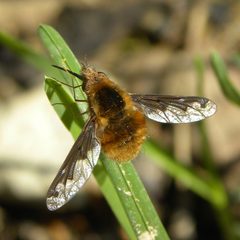
Distinguished from true bees by having only one pair of wings (Diptera characteristic) versus two pairs in Hymenoptera. The long rigid , extremely thin legs, and small size contrast with . Dark wing patches with clear portions and the distinctive hovering pattern separate it from other Bombyliidae. The dark-edged wing margin and horizontal dividing line between dark and clear wing areas are diagnostic. Males can be identified by contiguous ; females by -coating abdominal structures.
Images
Appearance
measure 6.3–12 mm in body length with a wingspan of 8.4–14 mm. The body is densely covered with light-colored hairs over a dark base, creating a fuzzy appearance. Wings display a bold pattern with dark brown patches on the half and a distinct dark brown edge, separated by a clear horizontal border. The is small relative to body size, with very short pointed . A long rigid extends 5.5–7.5 mm from the head. Legs are long, hairy, and slender with sharply curled claws; they dangle visibly during . Males are typically smaller than females and possess that meet at the top of the head. Females often have paler body hairs and possess specialized abdominal structures for coating with sand.
Habitat
Found in diverse environments from arid to moist conditions. Common in gardens, meadows, forest edges, and open sunny areas. Often observed in with abundant spring-blooming flowers and presence of ground-nesting solitary bees. Occupies temperate regions across multiple continents.
Distribution
Widespread across temperate regions of the northern hemisphere including Europe, North America, and parts of Asia. Documented from Belgium, Denmark, and throughout the United Kingdom. Occurs across varied climates within its range.
Seasonality
active primarily from March through June, with peak abundance in April and May. Most commonly observed in spring, beginning to appear in late March and continuing into June. Some observations extend into July in certain regions.
Diet
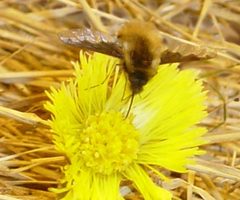
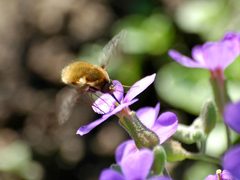
feed on floral nectar using the elongated . Both sexes consume nectar; females additionally ingest pollen, particularly from Siberian squill (Scilla siberica), lesser celandine (Ficaria verna), and willow (Salix caprea). Males consume less pollen than females, with pollen intake decreasing through adult life. The has been observed to selectively visit bluets (Houstonia) at some North American sites.
Host Associations
- Andrena spp. - Larvae are ectoparasitoids of mining bee larvae in nests
- Colletes spp. - Plasterer bee larvae parasitized
- Halictus spp. - Sweat bee larvae parasitized
Life Cycle
Females coat with sand using specialized abdominal chambers, then flick eggs toward nest entrances or deposit them on flowers visited by hosts. Eggs are small (0.5 mm), translucent, and numerous. First instar larvae are planidial—highly mobile with bristles for locomotion and actively seek host larvae. Upon locating a host, the larva attaches externally and feeds as an ectoparasitoid, consuming the host larva slowly over one to two weeks. Third instar becomes -like with greatly increased mass and reduced mobility. occurs within the host nest; the pupa develops hooks, spines, and setae to excavate through soil plugs. Final pupal stages are active, enabling movement to the surface before . Adults typically emerge in spring; some pupae may overwinter for two winters before emergence.
Behavior
Exhibits a distinctive hovering , often appearing to levitate in place. Males are territorial and hover at fixed positions, possibly for mate attraction or territory defense. A unique "yawing" has been documented: rapid around the vertical axis during flight, the function of which remains unknown. are and prefer sunny conditions, hiding in vegetation at night. They dart away from shadows and are attracted to sunlit areas with higher flower visitation rates. Long-distance flower attraction is visually mediated, with preference for blue and violet colors; short-distance attraction relies on olfaction.
Ecological Role
Functions as a across diverse plant , sometimes dominating local pollination networks. Has been documented to pollinate up to two-thirds of flowers in some . Visits plant that attract few other pollinators, including some with specialized floral adaptations for bee fly pollination. As a , regulates of solitary bees. Serves as a food source for , with -mimicry potentially conferring avoidance.
Human Relevance
Harmless to humans; does not bite, sting, or . Frequently mistaken for bees due to appearance, causing unnecessary concern. Valued as an early-season in gardens and natural areas. Larval of solitary bees may be viewed negatively by conservation efforts, though impact on is not well quantified.
Similar Taxa
- Bombus spp. (bumble bees)Superficial resemblance in size and hairiness, but distinguished by single pair of wings, long , and hovering
- Bombylius pygmaeusSmaller with similar appearance and ; B. major is larger with more extensive dark wing markings
- Syrphidae (hoverflies)Similar hovering and mimicry, but have shorter mouthparts and different wing venation
Misconceptions
Long is often mistaken for a stinger or biting mouthpart, leading to fear of the . The species is sometimes perceived as a threat to honey bees, but parasitizes only solitary bees, not social species. -mimic appearance leads to misidentification as a true bee, though it is a fly.
More Details
Genomic Resources
sequenced and published in Wellcome Open Research (2024), providing molecular resources for studying evolution and .
Reproductive Adaptations
The specialized 'dust basket' or 'sand chamber' at the female tip for coating with abrasive particles is a notable morphological facilitating egg deposition into soil burrows.
Sources and further reading
- BugGuide
- Wikipedia
- GBIF taxonomy match
- iNaturalist taxon
- NCBI Taxonomy
- Catalogue of Life
- Why Timing Is Everything in Bumble Bee Colonies | Bug Squad
- Bug Eric: Fly Day Friday: Greater Bee Fly
- Bug Eric: Bee Flies
- Bug Eric: April 2010
- Ground nesting bees beware of the bee fly: Bombyliidae — Bug of the Week
- Danger afoot for ground nesting bees: Look out for bee flies, Bombyliidae — Bug of the Week
- Unusual Flight Behaviour in the Beefly Bombylius major (Diptera: Bombylidae)
- The genome sequence of the dark-edged bee fly, Bombylius major (Linnaeus, 1758).