
Pollenia pediculata
Macquart, 1834
Tufted Clusterfly, cluster fly
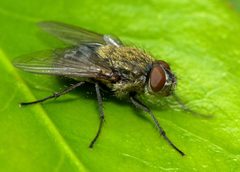
Pollenia pediculata is a of cluster fly in the Polleniidae, distinguished by golden crinkly hairs on the and a tuft of pale hairs at the wing junction. The species is native to the Palaearctic region and has been introduced to multiple continents including North America, South Africa, Australasia, and New Zealand. are important that feed on flowers and are attracted to fish and carrion, though they do not breed in carrion. The species is notable for its winter indoors, earning the "cluster fly."
Pronunciation
How to pronounce Pollenia pediculata: /poʊˈlɛniə pɛˌdɪkjʊˈleɪtə/
These audio files are automatically generated. While they are not always 100% accurate, they are a good starting point.
Identification
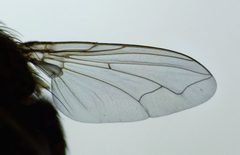
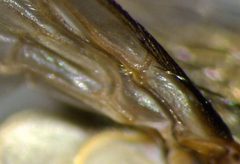
Distinguished from other Pollenia by microscopic examination of setae (number, position, and length of stiff hairs on various body parts). Fresh specimens can be recognized by golden crinkly hairs on the and the pale tuft at the wing junction. Larger than house flies, which have bright white . Often confused with , with which it is the most common cluster fly in North America.
Images
Appearance
Medium-sized fly with golden crinkly hairs on the and a distinctive tuft of pale hairs at the wing junction. Fresh specimens have a glistening quality from the thoracic hairs, though these are easily abraded in older individuals. Overall robust build similar to house flies but larger.
Habitat
Found in association with earthworms in soil . frequent flowers in spring and summer. adults aggregate in sheltered locations including wall voids, window frames, and building interiors. Prefers white or pale-colored structures that reflect heat when basking.
Distribution
Native to the Palaearctic region, widespread across Europe including Britain. Introduced to Nearctic (Canada and USA), Afrotropical (South Africa), Neotropical (Bahamas), and Australasian (New Zealand) regions. Also recorded from India and Pakistan.
Seasonality
active from spring through autumn, with peak activity in spring and summer when found on flowers. Overwinter as adults, becoming active on warm winter days. from sites occurs when weather warms in spring.
Diet
feed on flower nectar and honeydew from aphids and scale insects. Attracted to fish and carrion but do not breed in carrion.
Host Associations
- Eisenia rosea - Larvae are of this earthworm , entering through the male genital perforation or nearby
Life Cycle
. Females deposit in soil in early spring. Larvae hatch in 4-6 days and seek earthworm , entering the worm and feeding internally for approximately two weeks. Larvae pupate in soil; pupal stage lasts 39-45 days. Up to four per year. Overwinters as .
Behavior
aggregate in large numbers indoors during winter, seeking shelter in wall voids and window frames. Bask on sunny sides of buildings in cool weather, preferring white or pale surfaces. Disoriented individuals may enter living spaces on warm winter days, flying with an irritatingly loud buzz. Adults are capable of squeezing through small openings to access shelter.
Ecological Role
Important of wildflowers. Larvae act as regulating earthworm . contribute to nutrient cycling through feeding on honeydew.
Human Relevance
Considered a nuisance pest due to winter in buildings. Does not harm people or pets and carries no known . Smashing individuals leaves greasy stains. One of the most common cluster flies encountered in North America alongside P. rudis.
Similar Taxa
- Pollenia rudisMost common cluster fly co-occurring in North America; distinguished by microscopic setal characters
- House fly (Musca domestica)Smaller size, bright white , lacks golden thoracic hairs
- Pollenia vagabundaRecent European introduction (1950s-60s), distinguished by microscopic characters
- Pollenia labialisRecent European introduction (1950s-60s), distinguished by microscopic characters
More Details
Genome sequencing
assembly completed from a female specimen collected in Wytham Woods, Oxford, England, comprising two haplotypes (1,156.86 Mb and 1,222.48 Mb) with 99.79% of haplotype 1 scaffolded into 6 chromosomal pseudomolecules.
Sources and further reading
- BugGuide
- Wikipedia
- GBIF taxonomy match
- iNaturalist taxon
- NCBI Taxonomy
- Catalogue of Life
- Bug Eric: Fly Day Friday: Cluster Flies
- Bug Eric: January 2013
- Bug Eric: Small Milkweed Bug
- Bug Eric: The Monarch Dethroned
- Flies at the window - Muscina pascuorum — Bug of the Week
- The genome sequence of a cluster fly, Pollenia pediculata Macquart, 1834.