
Pollenia vagabunda
(Meigen, 1826)
cluster fly
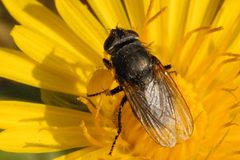
Pollenia vagabunda is a cluster fly in the Polleniidae, widespread across Europe and introduced to North America, where it was first recorded in 1958. Unlike carrion-associated blow flies, this has a tied to earthworms and other rather than decomposition. are known to overwinter in buildings and have been documented on carrion, though not tied to specific decomposition stages. The species has also been recorded in Algeria and shows potential forensic relevance.
Pronunciation
How to pronounce Pollenia vagabunda: //pɒˈlɛniə ˌvæɡəˈbʌndə//
These audio files are automatically generated. While they are not always 100% accurate, they are a good starting point.
Identification
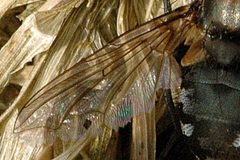
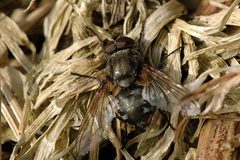
Differentiated from other Pollenia by minute characteristics of setae (stiff hairs) on the and other body parts, including number, position, and length. Fresh specimens display a coating of golden hairs on the thorax that is easily abraded in older individuals. Distinguished from house flies (Musca domestica) by larger size and lack of bright white ; from other blow flies by non-carrion and clustering .
Images
Habitat
Semi-urban environments; agricultural and urban areas where act as . Overwinters inside buildings, entering through cracks and holes in autumn to aggregate in dark crevices and corners. Larval is soil, where are located.
Distribution
Native to Europe with widespread distribution; introduced to North America (first recorded 1958, ranging from east coast to British Columbia). Recorded in North Morocco and Algeria (first confirmed record from Blida, 2020).
Seasonality
active in spring and summer, commonly seen on flowers. Overwinter as adults inside buildings, becoming active on warm winter days. Emerges from sites in spring seeking outside access.
Diet
feed on nectar and honeydew from aphids and scale insects. Larvae are internal or of earthworms (Lumbricidae); may parasitize other organisms including caterpillars, bees, and potentially larvae ( found in corn stems infested by Sesamia nonagrioides).
Life Cycle
Females deposit on soil in spring; larvae hatch in 4-6 days and actively seek . Larvae enter earthworms through male genital perforation or nearby, feeding internally for approximately two weeks while periodically breaching the host body wall to breathe. Mature larvae exit host and pupate in soil; pupal stage lasts 39-45 days. Up to four . may overwinter inside buildings.
Behavior
aggregate in large numbers in building crevices and wall voids for , sometimes accumulating by the hundreds in older homes. On warm winter days, disoriented individuals may enter living spaces. Males and females visit flowers for nectar; adults are accomplished .
Ecological Role
serve as in agricultural and urban . Larvae function as or of earthworms and potentially other , though range remains incompletely documented. Documented as a forensic on carcasses in Algeria, appearing during bloated, decay, and dry decomposition stages.
Human Relevance
Considered a nuisance pest due to in buildings; does not bite, transmit , or damage structures. Smashing individuals leaves greasy stains. First recorded in North America in 1958, representing a relatively recent introduction. Forensic relevance established in North Africa as a carrion-associated .
Similar Taxa
- Pollenia rudisMost common cluster fly in North America; historically confused with P. vagabunda before -level recognition. Both share golden thoracic hairs and building- , but differentiated by setal characters.
- Pollenia pediculataCommon cluster fly in North America with similar ; distinguished by microscopic setal characteristics.
- Pollenia labialisAnother European introduction to North America (1960s); similar in appearance and , requiring examination of setae for separation.
- Musca domesticaHouse flies are smaller with bright white , lack golden thoracic hairs, and have different seasonal activity patterns.
Sources and further reading
- BugGuide
- Wikipedia
- GBIF taxonomy match
- iNaturalist taxon
- NCBI Taxonomy
- Catalogue of Life
- Bug Eric: Fly Day Friday: Cluster Flies
- Bug Eric: January 2013
- Bug Eric: Small Milkweed Bug
- Bug Eric: The Monarch Dethroned
- Flies at the window - Muscina pascuorum — Bug of the Week
- Revision of the cluster-flies of the Pollenia vagabunda species-group (Diptera: Calliphoridae)
- Molecular identification of the potentially forensically relevant cluster flies Pollenia rudis (Fabricius) and Pollenia vagabunda (Meigen) (Diptera: Polleniidae) - non-recorded species in Algeria.