
Muscina dorsilinea
(Wulp, 1896)
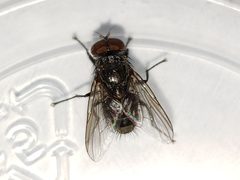
Muscina dorsilinea is a of true fly in the Muscidae, first described by Frederik Maurits van der Wulp in 1896. It belongs to a commonly known as house flies or dump flies, which are frequently associated with decaying organic matter and animal waste. The species is poorly documented in scientific literature, with minimal specific information available beyond its taxonomic classification. Like other Muscina species, it likely plays a role in decomposition and nutrient cycling in environments where organic waste accumulates.
Pronunciation
How to pronounce Muscina dorsilinea: /mʊˈsiːnə ˈdɔr.sɪˌlaɪ.niə/
These audio files are automatically generated. While they are not always 100% accurate, they are a good starting point.
Images
Similar Taxa
- Muscina pascuorumBoth are Muscina that may be found in similar ; M. pascuorum has been documented feeding on woodland fungi and entering homes in autumn and winter, not confirmed for M. dorsilinea
- Muscina assimilisClosely related congeneric often found in similar ecological settings; M. assimilis has been recorded in home invasions alongside other Muscina species
- Musca domesticaShares Muscidae and 'house fly'; M. domestica is far more abundant and well-studied, with confirmed associations with livestock and human dwellings
More Details
Data Deficiency
Muscina dorsilinea is extremely poorly represented in scientific literature. Only two observations are recorded in iNaturalist, and no peer-reviewed studies specifically addressing its , , or could be located. Most information about the Muscina derives from studies of other , particularly M. pascuorum and M. stabulans.
Taxonomic Note
The was originally described by Dutch entomologist Frederik Maurits van der Wulp in 1896. It is currently accepted as valid by Catalogue of Life and GBIF, with no known synonyms.