
Platypalpus
Macquart, 1827
dance fly, hybotid dance fly
Species Guides
10- Platypalpus aequalis
- Platypalpus discifer(hybotid dance fly)
- Platypalpus flammifer(dance fly)
- Platypalpus harpiger
- Platypalpus holosericus
- Platypalpus impexus
- Platypalpus melleus
- Platypalpus mesogrammus(hybotid dance fly)
- Platypalpus tersus
Platypalpus is a large of hybotid dance flies comprising at least 580 described worldwide, with over 200 species in Europe alone. These small predatory flies are characterized by their compact bodies, enlarged that occupy most of the , and front legs adapted for seizing prey. are active that feed on small insects, while larvae occupy diverse microhabitats including leaf litter, soil, and aquatic environments. The genus has been documented in agricultural , particularly cereal crops and greenhouses, where they may contribute to pest regulation.
Pronunciation
How to pronounce Platypalpus: /ˌplætɪˈpælpəs/
These audio files are automatically generated. While they are not always 100% accurate, they are a good starting point.
Identification
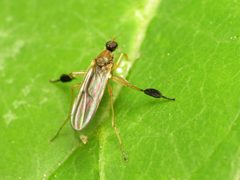
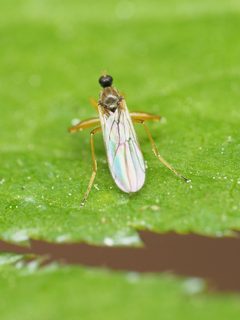
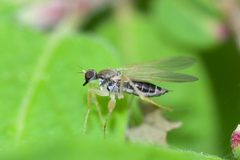
Platypalpus are small (typically 3–5 mm), with a distinctive 'pinhead' appearance due to their spherical being proportionally small compared to the body. The are large and occupy most of the head. The front legs are often modified for prey capture, with enlarged in some species. Males of certain species possess modifications to the hind legs, possibly for grasping females during mating. Body form is compact and somewhat resembling small robber flies (Asilidae), but distinguished by the hybotid head structure and leg proportions.
Images
Habitat
Diverse microhabitats including tree trunks, ground surfaces, foliage, water surfaces, and protected structures such as walls near garbage containers. Documented in cereal crops (winter wheat, winter and summer barley) throughout the growing season. Some complete their in greenhouses. Larvae occupy leaf litter, , fungi, roots, aquatic or semiaquatic environments, and other decaying organic matter.
Distribution
Worldwide, with highest diversity in Europe (over 200 ). In North America, the P. juvenis occurs from the Canadian Arctic treeline south to montane regions of New Hampshire, Oregon, and Colorado. Documented in Morocco with multiple species, and present in Inner Mongolia, China. Greenhouse established in Europe under reduced conditions.
Seasonality
particularly abundant in spring. Activity increases continuously through daylight hours, peaking in late afternoon or early evening. Present in cereal crops nearly throughout the entire growth period.
Diet
are predatory, feeding on small insects. Documented prey includes frit flies (), wheat (Contarinia tritici, Sitodiplosis mosellana), and thrips larvae (Thysanoptera). Aphids and are not killed. rate estimated at 2.4 prey individuals per per day for common . Larvae are , though specific prey items are poorly documented.
Life Cycle
with , larva, and stages. Larvae develop in diverse substrates including soil, leaf litter, decaying organic matter, and aquatic or semiaquatic environments. At least one documented from an owl's nest. Development can be completed in greenhouse environments. Specific details on egg laying, larval instars, and are poorly documented for most species.
Behavior
seize prey with front legs, then inflict a lethal bite with the . Extraoral digestion occurs as are injected and liquefied tissues are drawn back in. Males of many form mating swarms over prominent objects, with individuals bouncing or 'dancing' in mid-air—giving rise to the 'dance flies'. Courtship involves complex aerial maneuvers. Activity patterns show increase, with peak foraging in late afternoon or early evening.
Ecological Role
in multiple including natural and agricultural systems. Documented as potential regulators of pest in cereal crops and greenhouses. Contribution to of frit flies, wheat , and thrips has been proposed, though quantitative ecosystem impacts remain understudied.
Human Relevance
Of no major economic consequence, but recognized as potentially beneficial in . Presence documented in greenhouses with reduced use, suggesting compatibility with programs. Rarely encountered by the general public due to small size. Not known to bite humans or transmit .
Similar Taxa
- TachypezaAlso a hybotid dance fly with similar 'pinhead' appearance and predatory habits; distinguished by subtle differences in wing venation and leg structure
- HybosHybotid with similar body plan and predatory ; males lack the hind leg modifications seen in some Platypalpus
- EmpisHistorically classified together in Empididae; Empis typically have more elongated bodies and different wing venation patterns
- Asilidae (robber flies)Similar predatory and general appearance, but robber flies are larger, have a more prominent mystax (facial beard of bristles), and different wing venation
Sources and further reading
- BugGuide
- Wikipedia
- GBIF taxonomy match
- iNaturalist taxon
- NCBI Taxonomy
- Catalogue of Life
- Bug Eric: May 2015
- Bug Eric: Hybotid Dance Flies
- A Revision of the Platypalpus juvenis Complex in North America (Diptera: Empididae)
- Twelve new species of Platypalpus Macquart (Diptera: Hybotidae) from Morocco, with additional new records
- Fliegen der Gattung Platypalpus (Diptera, Empididae) — bisher wenig beachtete Prädatoren im Getreidebestand
- Zum Vorkommen räuberischer Fliegen aus der Familie Hypotidae (Dipt., Empidoidea) in Gewächshäusern sowie zur prädatorischen Leistung zweier Fliegenarten der Gattung Platypalpus Marquart
- The Hybotidae of the Our Planet Reviewed in Corsica 2019-2021 survey, with the description of three new species of Platypalpus and Tachydromia (Diptera, Empidoidea)
- The genus Platypalpus Macquart (Diptera, Hybotidae, Tachydromiinae) from Inner Mongolia, China, with the description of four new species.