
Hybos
Meigen, 1803
dance flies
Species Guides
1- Hybos reversus(dance fly)
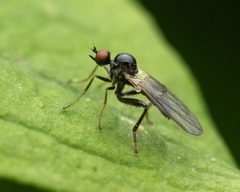
Hybos is a of small predatory dance flies in the Hybotidae, comprising approximately 242 described globally. The genus is distinguished by morphological features including short Rs, long cup, separated in most species, a spine-like , and notably thickened hind bearing bristles. Species occur across the Palaearctic and Oriental realms, with highest diversity in Asia. are active of small flying insects, while larvae are soil-dwelling and predate on .
Pronunciation
How to pronounce Hybos: /ˈhɪbɒs/
These audio files are automatically generated. While they are not always 100% accurate, they are a good starting point.
Identification
Hybos are small flies, typically 3.5–5.5 mm in body length, with dark coloration and black legs. Key diagnostic features include: spherical that appears small relative to body; that occupy most of the head and are separated in most species (though contiguous in some such as H. culiciformis); prominent spine-like ; distinctly swollen and bristly hind with bristles; linear hind tibia; short Rs and long cup in wing venation. Some species exhibit red and a humped . Males of some species possess modified hind legs possibly related to mating grasp.
Images
Habitat
frequent woodland edges, hedgerows, and occasionally reed-beds. In Asian localities, collected from humid montane forests with 85–90% relative humidity, at elevations between 770–1434 m. Some have been observed on tree trunks, ground surfaces, foliage, and near human structures such as refuse areas where prey insects congregate.
Distribution
with 242 described : 28 in the Palaearctic Realm and 191 in the . European records include widespread occurrence across Britain, Portugal, Spain, France, Germany, Scandinavia, and eastward through Estonia, Latvia, Ukraine, Belarus, Russia, Kazakhstan, Mongolia, Georgia, Armenia, Azerbaijan, Turkey, and Middle Asia. Asian distribution includes China (Fujian, Guangxi, Guizhou, Henan, Sichuan, Zhejiang, Yunnan, Hainan, Guangdong), Thailand, Japan, Taiwan, and Southeast Asia. North American records present but less documented.
Seasonality
active primarily during spring through autumn; in Britain, H. culiciformis observed from June to September. In tropical and subtropical Asian localities, collections peak during rainy season (April–August).
Diet
are predatory, seizing small flying insects with modified front legs and subduing prey with a piercing ; extraoral digestion via injected precedes consumption of liquefied tissues. Larvae are predatory on soil .
Behavior
are visual with acute vision facilitated by large . Prey capture involves grasping with front legs, which may exhibit enlarged in some , followed by deployment. Mating includes male swarming in some related hybotids, though specific Hybos swarm behavior is not well documented. Larvae occupy soil, leaf litter, , fungi, or root zones; some species have aquatic or semiaquatic larval stages.
Ecological Role
and larval stages function as in terrestrial and soil , contributing to regulation of small insect .
Human Relevance
No direct economic significance; not considered pests. Occasionally encountered in natural history observations and biodiversity surveys. H. culiciformis sequenced as first representative of Hybotidae, contributing to dipteran phylogenomic resources.
Similar Taxa
- PlatypalpusBoth are hybotid with predatory habits and small size; Platypalpus lacks the conspicuously swollen hind characteristic of Hybos and typically has different leg modifications.
- TachypezaAnother hybotid resembling small robber flies; Tachypeza often associated with specific microhabitats like tree trunks and lack the hind femoral swelling of Hybos.
- EmpisFormerly classified together in Empididae; Empis generally have more elongated bodies, different wing venation, and lack the distinctive hind femoral of Hybos.
Sources and further reading
- BugGuide
- Wikipedia
- GBIF taxonomy match
- iNaturalist taxon
- NCBI Taxonomy
- Catalogue of Life
- Lions in South Africa | Beetles In The Bush
- Bug Eric: May 2015
- New data on the genus Hybos Meigen (Diptera: Hybotidae) from the Palaearctic Region
- The genome sequence of the hybotid fly, Hybos culiciformis (Fabricius, 1775) (Diptera: Hybotidae).
- New species and records of Hybos Meigen (Diptera, Empidoidea) from Huaping National Nature Reserve, China.
- New species and records of the genus Hybos Meigen (Diptera, Empidoidea, Hybotinae) from Wuyishan National Park, China.
- The complete mitochondrial genome of Hybos grossipes (Linnaeus, 1767) (Diptera: Empididae).