
Hybotidae
Macquart, 1823
typical dance flies, hybotid dance flies
Subfamily Guides
5Hybotidae is a of small predatory flies within the superfamily Empidoidea, comprising over 1,600 described worldwide. Formerly treated as a of Empididae, Hybotidae is now recognized as a distinct family based on morphological and phylogenetic evidence. are generally predatory on small , while larvae occupy diverse microhabitats including leaf litter, , fungi, roots, and aquatic or semiaquatic environments. The family exhibits notable morphological diversity, with some species displaying specialized leg modifications for prey capture and mating.
Pronunciation
How to pronounce Hybotidae: /haɪˈbɒtɪdiː/
These audio files are automatically generated. While they are not always 100% accurate, they are a good starting point.
Identification
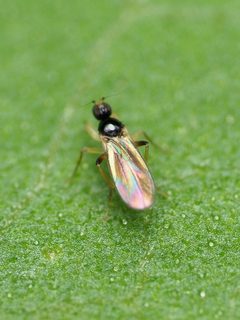
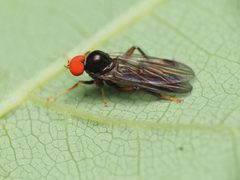
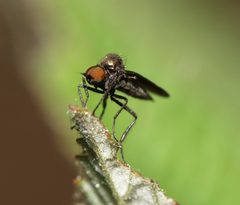
Hybotidae can be distinguished from the related Dolichopodidae by wing venation: the R4+5 is always simple, with the ending near or at M1/M1+2 or near R4+5/R5. Additionally, the origin of vein Rs is positioned at a distance from the humeral crossvein (h) equal to or longer than the length of h. Male terminalia are rotated dextrally between 45° and 90°, excluding segment 7. Members are typically small (3–4 mm), often dark-colored, with spherical that appear disproportionately small relative to the body. Some have enlarged on the front legs, and males of certain species possess modified hind legs.
Images
Habitat
occupy diverse microhabitats including tree trunks, ground surfaces, foliage, water surfaces, and the vicinity of insect swarms. Specific feeding vary by ; for example, Tachydromia species run on tree bark in complex patterns. Larvae are found in leaf litter, , fungi, roots, and aquatic or semiaquatic environments, with at least one record from an owl's nest.
Distribution
Worldwide distribution with records from Nearctic, Palearctic, Neotropical, and other biogeographic regions. The Lactistomyia was historically restricted to the Neotropical region but has been recorded from the Palearctic (Korea), representing an unusual trans-Pacific distribution. Chile 27 across 10 genera.
Seasonality
are particularly abundant in spring in temperate regions.
Diet
are predatory, seizing prey with modified front legs and using a to inject for extraoral digestion. Some visit flowers for nectarivory or palynivory. Larvae of most species appear to be .
Life Cycle
Larvae undergo development in diverse substrates including leaf litter, , fungi, roots, and aquatic or semiaquatic environments. Specific details are poorly documented for most .
Behavior
are known as "dance flies" due to the mating swarms formed by males, who gather in clouds over prominent objects and appear to bounce or "dance" in mid-air. Some , such as Tachydromia, exhibit distinctive running patterns on tree bark. Prey capture involves seizing with front legs, followed by extraoral digestion. Males of some species have modified hind legs, possibly aiding in grasping females during mating.
Ecological Role
Predatory hybotids function as of small in various , including agricultural systems such as winter wheat fields. They contribute to invertebrate dynamics in managed and natural .
Human Relevance
Of no known economic consequence; considered beneficial as general in agricultural and natural . No significant pest status or direct human impact documented.
Similar Taxa
- EmpididaeFormerly included Hybotidae as a ; distinguished by wing venation differences including R4+5 structure and position of Rs origin relative to humeral crossvein.
- DolichopodidaeShares rotated male terminalia and some wing characteristics, but differs in R4+5 always being simple in Hybotidae and the point at origin of Rs being at distance from humeral crossvein equal to or longer than h.
More Details
Taxonomic History
Hybotidae was elevated from status within Empididae to rank based on phylogenetic studies showing it represents a lineage more basal than the main radiation of Empididae and Dolichopodidae, though not as ancient as Atelestidae. The family is largely monophyletic, with subfamilies Hybotinae and Tachydromiinae representing clear clades; the status of Ocydromiinae as a natural group remains less certain.
Research Limitations
and of most hybotid remain poorly known due to their lack of economic importance and the scarcity of specimens for many . studies have been initiated to assess diversity, revealing potential for substantial undiscovered diversity in some regions.
Sources and further reading
- BugGuide
- Wikipedia
- GBIF taxonomy match
- iNaturalist taxon
- NCBI Taxonomy
- Catalogue of Life
- Bug Eric: Hybotid Dance Flies
- Bug Eric: May 2015
- How to Describe a New Species: Getting into the “Spuh Nov” Club
- A catalog of the Hybotidae of Chile (Diptera: Empidoidea)
- Revision of the Neotropical genus Lactistomyia Melander (Diptera, Hybotidae, Hybotinae)
- First new species of the Neotropical genus Lactistomyia Melander, 1902 (Diptera, Hybotidae) from the Palearctic Region.
- The genome sequence of the hybotid fly, Hybos culiciformis (Fabricius, 1775) (Diptera: Hybotidae).
- Community Composition of Predatory Hybotidae (Diptera: Empidoidea) in Winter Wheat Management Systems.