
Hybos reversus
Walker, 1849
dance fly
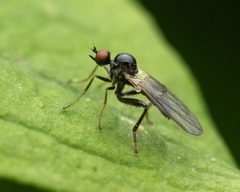
Hybos reversus is a of dance fly in the Hybotidae, originally described by Francis Walker in 1849. Like other hybotids, are predatory and seize prey with their forelegs. The species is part of a diverse group of small, predatory flies once classified within Empididae but now recognized as a distinct family. Larval remains poorly documented, as is typical for most hybotid species.
Pronunciation
How to pronounce Hybos reversus: /ˈhɪbɒs rɪˈvɜːrsəs/
These audio files are automatically generated. While they are not always 100% accurate, they are a good starting point.
Identification
Distinguished from similar small predatory flies by combination of: minute spherical with dominating head capsule; compact body form; and forelegs adapted for prey seizure. Separated from Empididae (sensu stricto) by hybotid characters including wing venation details and genitalic structure, though field identification to level requires examination. May be confused with small Asilidae or certain Hemiptera by untrained observers.
Images
Appearance
Small predatory fly, approximately 4-5 mm in body length. spherical and disproportionately small relative to body, with large occupying most of the head surface. Body compact with relatively short, stout legs; forelegs may show slight modification for prey capture. Wings clear with typical dipteran venation. Overall appearance somewhat resembling a small robber fly (Asilidae) or, to the unfamiliar observer, possibly mistaken for a true (Hemiptera).
Habitat
Specific preferences for H. reversus are not documented. Based on -level patterns, likely associated with wooded or shrubby environments where can access prey on vegetation, tree trunks, or ground surfaces. Some related occupy riparian zones or moist microhabitats.
Distribution
Original description by Walker (1849) suggests Palearctic distribution, likely including Europe. The has been reported from multiple regions based on taxonomic databases, though precise modern distribution records require verification. GBIF and related databases indicate occurrences across parts of Europe and potentially Asia.
Seasonality
activity period not specifically documented. Related hybotid in temperate regions typically show spring and early summer activity peaks, with some species active into autumn.
Life Cycle
(holometabolous). Larval stage poorly known; based on -level information, larvae of most hybotids are , occupying terrestrial or semiaquatic microhabitats including leaf litter, soil, decaying organic matter, or moist substrates. Specific larval for H. reversus undescribed.
Behavior
are predatory, seizing small prey with modified forelegs. Prey is subdued with a piercing ; extraoral digestion occurs via injected , with liquefied tissues then imbibed. Mating includes male swarming in some related , though specific swarming behavior for H. reversus is not documented.
Ecological Role
function as small in , likely contributing to regulation of of small flies and other minute arthropods. Larval ecological role presumably similar where , though quantitative impacts unknown.
Human Relevance
No direct economic or medical significance. Not known as pest, , or agent. Of interest primarily to dipteran systematists and students of predatory fly .
Similar Taxa
- Hybos other speciesCongeneric share minute , compact body, and predatory foreleg ; require genitalic examination for definitive separation.
- Platypalpus speciesRelated hybotid with similar overall gestalt; distinguished by details of leg chaetotaxy, wing venation, and male genitalia.
- Tachypeza speciesAnother hybotid of similar size and habitus; Tachypeza often associated with tree trunks and may show subtle differences in body proportions.
- Small Asilidae (robber flies)Convergent predatory ; Asilidae have more prominent mystax (facial bristles), larger size on average, and different wing venation with more complete anal .
More Details
Taxonomic history
The Hybotidae was long treated as Hybotinae within Empididae. European have been more consistent in recognizing family-level status, while North American practice has been slower to adopt this change. The elevation of Hybotidae reflects recognition of substantial morphological and phylogenetic divergence from core Empididae.
Research status
As noted in sources regarding related hybotids, most in this are of no economic consequence and consequently receive minimal research attention. Basic information—including larval , specific prey range, and detailed —remains unknown for the majority of Hybotidae species, including H. reversus.