
Hybotinae
Macquart, 1823
dance flies
Tribe Guides
5- Bicellariini
- Euhybus(dance flies)
- Hybos(dance flies)
- Syndyas
- Syneches(hybotid dance flies)
Hybotinae is a globally widespread of hybotid flies, commonly known as dance flies. are predatory and frequently observed in mating swarms where males perform characteristic 'dancing' movements. The subfamily has undergone taxonomic revision, with Hybotinae elevated to rank (Hybotidae) by some European authorities, though this classification remains inconsistently adopted. The group includes at least 12 and is particularly diverse in the .
Pronunciation
How to pronounce Hybotinae: //haɪˈbɒtɪniː//
These audio files are automatically generated. While they are not always 100% accurate, they are a good starting point.
Identification
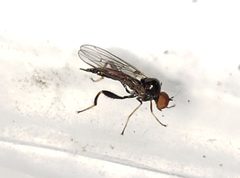
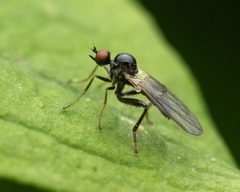
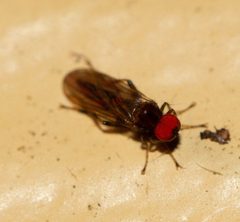
Distinguished from Empididae (sensu stricto) by wing venation characters, particularly the short Rs and elongated cup. The combination of small spherical , large separated , and spine-like is diagnostic. Males in mating swarms exhibit characteristic 'dancing' —bouncing over prominent objects. Some restricted to specific microhabitats such as tree trunks, ground surfaces, foliage, or water surfaces.
Images
Habitat
Diverse microhabitats including tree trunks, ground litter, foliage, water surfaces, and swarms of other flies. Some , occurring near human structures such as dumpsters and protected walls where prey insects aggregate. Larvae occupy varied : aquatic or semiaquatic environments, leaf litter, , fungi, roots, and decaying organic matter.
Distribution
distribution. Particularly -rich in the (182+ species of Hybos alone), with substantial representation in the Palaearctic (28+ species). Documented from North America, Europe, North Africa (first records from Morocco in 2022), China, and throughout the Neotropics.
Seasonality
most abundant in spring in temperate regions. Mating swarms typically observed during daylight hours.
Diet
are predatory, seizing prey with modified front legs. Prey includes small flies and other insects attracted to organic matter or swarming in . Extraoral digestion employed: injects to liquefy prey tissues, which are then imbibed. Larvae , though specific prey unknown for most .
Life Cycle
Holometabolous. Larvae , occupying aquatic, semiaquatic, or terrestrial microhabitats. occurs in substrate. timed to coincide with favorable conditions for mating swarm formation.
Behavior
form characteristic mating swarms where males perform 'dancing' —bouncing vertically in mid-air over prominent objects. Males use modified hind legs to grasp females during mating. Adults are visual hunters with acute vision adapted for detecting prey. Some exhibit microhabitat specificity, remaining faithful to particular substrates such as tree trunks or water surfaces.
Ecological Role
of small insects in diverse microhabitats. Contribute to regulation of of other dipterans and small arthropods. Larvae function as predators in soil, litter, and aquatic .
Human Relevance
No significant economic importance. Occasionally encountered in near human structures. Of interest to dipterists due to taxonomic complexity and behavioral characteristics.
Similar Taxa
- Empididae (sensu stricto)Formerly classified together; distinguished by wing venation (Hybotinae with short Rs and elongated cup) and .
- Asilidae (robber flies)Similar predatory habit and body form; distinguished by larger size, different wing venation, and lack of characteristic 'dancing' swarms.
- Dolichopodidae (long-legged flies)Similar small size and predatory ; distinguished by extremely long legs relative to body and metallic coloration in most .
Misconceptions
The 'dance fly' is sometimes applied broadly to Empidoidea, though it specifically refers to the swarming of Hybotinae and related groups. The taxonomic status remains unsettled: European authorities widely recognize Hybotidae as a distinct , while North American sources often retain Hybotinae as a of Empididae.
More Details
Taxonomic instability
Classification of Hybotinae has shifted repeatedly. The group was historically treated as a of Empididae, but is now recognized as the Hybotidae by many European dipterists. This elevation is inconsistently adopted in North American literature.
Genus-level diversity
The includes at least 12 : Acarterus, Afrohybos, Chillcottomyia, Euhybus, Hybos, Lactistomyia, Lamachella, Neohybos, Parahybos, Smithybos, Stenoproctus, Syndyas, and Syneches. The genus Hybos is particularly diverse with 233+ worldwide.
Research limitations
and of most remain poorly known due to lack of economic importance. Most research focuses on and species description rather than or .
Sources and further reading
- BugGuide
- Wikipedia
- iNaturalist taxon
- NCBI Taxonomy
- Catalogue of Life
- Bug Eric: May 2015
- Bug Eric: Hybotid Dance Flies
- Revision of the Neotropical genus Lactistomyia Melander (Diptera, Hybotidae, Hybotinae)
- The genus Euhybus Coquillett (Diptera: Hybotinae) from China, with descriptions of five new species
- New species and records of the genus Hybos Meigen (Diptera, Empidoidea, Hybotinae) from Wuyishan National Park, China
- Moroccan Hybotinae (Diptera: Hybotidae): first record of the subfamily and rare genera with an emphasis on their distribution