
Tachypeza
Meigen, 1830
Species Guides
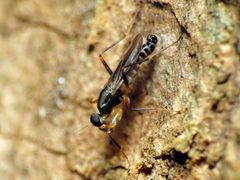
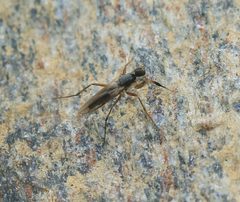
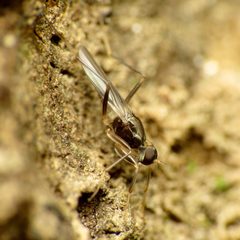
1Tachypeza is a of small predatory flies in the Hybotidae, commonly known as dance flies. Members resemble diminutive robber flies and are characterized by disproportionately small, spherical with large . The genus includes approximately 50 described distributed across multiple continents. are predatory, seizing prey with modified front legs and employing extraoral digestion.
Pronunciation
How to pronounce Tachypeza: /ˌtæ.kɪˈpiː.zə/
These audio files are automatically generated. While they are not always 100% accurate, they are a good starting point.
Identification
Tachypeza are distinguished from other hybotid by their notably small, rounded relative to body size, earning them the informal nickname "pinhead flies." The occupy most of the head surface. Body length is approximately 4 millimeters. Front legs may show modification for prey capture, with enlarged in some species. Males of some species possess modified hind legs, possibly for grasping females during mating.
Images
Habitat
occupy diverse microhabitats including tree trunks, ground surfaces, foliage, and water surfaces. One observation records individuals on interior walls of protected structures near refuse containers, suggesting attraction to areas with concentrated prey insects.
Distribution
Records from Denmark, Norway, and Sweden. The has broader global distribution with described from Europe, North America, Asia (including Vietnam, Malaysia, and Thailand), and Australia.
Seasonality
are particularly abundant in spring.
Diet
are predatory, feeding on small insects and other arthropods. Prey is seized with front legs, subdued with a bite, and digested externally through injection of before consumption of liquefied tissues.
Life Cycle
Larvae of most dance flies appear to be . Developmental include aquatic or semiaquatic environments, leaf litter, , fungi, roots, and decaying organic matter. One record documents larvae from an owl's nest.
Behavior
are visual with keen eyesight. Males of many form mating swarms over prominent objects, with individuals bouncing or "dancing" in mid-air—a that gives the group its .
Ecological Role
Predatory flies that contribute to regulation of small . Larval stages occupy diverse detrital and aquatic microhabitats.
Human Relevance
Of no known economic consequence. Occasionally encountered in settings such as refuse areas where prey insects congregate.
Similar Taxa
- PlatypalpusAnother hybotid with similar small size and predatory habits; distinguished by different proportions and leg modifications.
- HybosHybotid with overlapping ; Tachypeza distinguished by more extreme size reduction.
- EmpididaeFormerly classified together; hybotids including Tachypeza now separated based on morphological and behavioral differences, though they share predatory habits and swarm mating .