
Empis
Linnaeus, 1758
dance fly
Species Guides
7- Empis clausa(dance fly)
- Empis geneatis(dance fly)
- Empis leptogastra(dance fly)
- Empis poeciloptera
- Empis snoddyi
- Empis spectabilis(dance fly)
- Empis tridentata
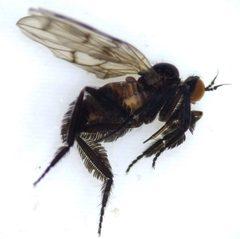
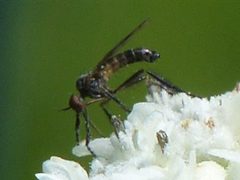
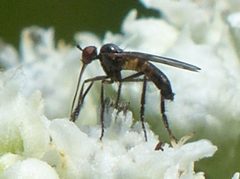
Empis is a of dance flies in the Empididae, established by Linnaeus in 1758. The genus contains numerous across several subgenera, including Enolempis. Males of some species exhibit distinctive morphological modifications, such as enlarged teeth on the hind leg , which are sexually dimorphic and not present in females. The genus is notable for complex mating including swarming and exchange.
Pronunciation
How to pronounce Empis: /ˈɛm.pɪs/
These audio files are automatically generated. While they are not always 100% accurate, they are a good starting point.
Identification
Identification to level requires examination of male genitalia structures and wing venation characters. The chioptera group can be distinguished by the combination of small size, black coloration, complete M1 , forked R4+5, and unstriped mesoscutum. Males of some subgenera (e.g., Enolempis) can be recognized by the distinctive hind leg armature with enlarged femoral teeth. Dichotomous keys are available but may not include all diagnostic characters; examination of reference collections and online image resources may be necessary for accurate identification.
Images
Habitat
Sweeping vegetation near rivers and streams; areas sampled by in various vegetated . Specific collection records include riparian vegetation at 580 m elevation and lowland areas around 100 m.
Distribution
Widespread across the Palaearctic region, with records from Portugal, Spain, Bulgaria, Slovakia, Italy, Switzerland, Romania, Austria, France, and Czechia. The has a broad geographic range consistent with the Empididae.
Behavior
Males form dancing swarms to attract females. Males capture small Diptera as and transfer these prey items to females prior to copulation. Male-male competition occurs for access to prey items used as nuptial gifts. Females exercise mate choice based on gift quality and male dancing performance. Specific dance patterns and prey handling differ among .
Similar Taxa
- Other Empididae generaMany empidid share similar body plans and require careful examination of wing venation, leg structure, and male genitalia for separation; Empis is distinguished by specific combinations of these characters including the structure of the male terminalia.
More Details
Taxonomic complexity
The Empis is taxonomically complex with numerous and several recognized subgenera. The subgenus Enolempis alone contains over fifty species, making species-level identification challenging without specialized keys and reference material.
Sexual dimorphism in identification
The prominent hind leg modifications found in males of some Empis are not present in females, meaning that males and females of the same species may appear quite different and could be mistaken for different if this dimorphism is not recognized.
Sources and further reading
- BugGuide
- Wikipedia
- iNaturalist taxon
- NCBI Taxonomy
- Catalogue of Life
- Bug Eric: Looking Ahead to 2022
- The mating behaviour ofEmpis barbatoidesMelander andEmpis popliteaLoew (Diptera: Empididae)
- Morphology, biology, phenology and occurrence of the genus Empis Linnaeus (Empididae, Diptera) in Poland
- New West Palaearctic Species of Empis chioptera Group (Diptera: Empididae).