
Empidinae
dance flies
Genus Guides
4- Empis(dance fly)
- Hilara(Balloon Flies)
- Lamprempis
- Rhamphomyia(dance flies)
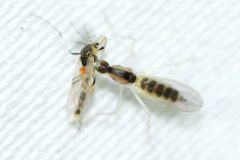
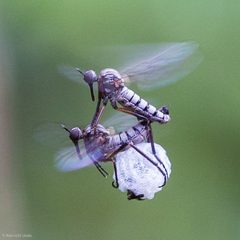
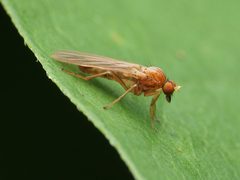
Empidinae, commonly called dance flies, are a of predatory empidoid flies. Males of many form mating swarms near visual markers, often presenting captured prey to females as during courtship. The subfamily exhibits diverse mating systems, including and sex-role reversal where females swarm and males choose mates. Many species are effective of flowering plants, particularly in alpine and subalpine where they can achieve pollination effectiveness comparable to honeybees.
Pronunciation
How to pronounce Empidinae: //ˌɛmpɪˈdɪniː//
These audio files are automatically generated. While they are not always 100% accurate, they are a good starting point.
Identification
Empidinae are distinguished from other Empididae by the presence of a forked R4+5 wing in many , though this character varies. The subfamily includes the large Empis and Rhamphomyia, historically separated by R4+5 forking; Empis typically has the vein forked near the tip while Rhamphomyia does not. is pronounced in many species, with males displaying secondary sexual characters including pinnate leg , darkened or enlarged wings, and inflatable abdominal air sacs.
Images
Habitat
Occurs across diverse from coastal areas to alpine zones. In mountain , abundance increases with elevation, becoming among flower-visiting insects above 1500 m. Coastal occur in Australia and New Zealand. High arctic species occupy tundra environments.
Distribution
Worldwide distribution with exceptional diversity in the Neotropical region, where twelve of fourteen recognized occur and seven are . Present in temperate Chile and Argentina, the wider Neotropics, North America, Europe, Africa, Asia, Australia, and New Zealand.
Diet
Predatory on small insects. Females of many obtain food exclusively through prey transfer from males during mating and do not hunt independently. Both sexes visit flowers for nectar, with many species acting as .
Life Cycle
Larvae pass through three instars (characteristic of lineage).
Behavior
Males form mating swarms at assembly stations controlled by visual markers. Courtship involves presentation of —captured prey or inedible objects including secreted balloons—to females. Males use large in the upper to detect and approach females, performing a 'holding ' display. In some , sex roles are reversed with female swarming and male mate choice. Arctic species show behavioral and morphological adaptations to reduced flight activity, including reduced male eye specialization in non-flying species.
Ecological Role
Major in alpine and subalpine plant , contributing substantially to plant-pollinator network stability in mountain . Large Empis can match honeybee pollination effectiveness for some plant species. Predatory contributes to insect .
Human Relevance
Contribute to pollination of wild plants in montane . Potential to climate change due to broad altitudinal distribution and ability to access floral unavailable to other .
Similar Taxa
- Empididae (other subfamilies)Empidinae distinguished by R4+5 wing venation patterns and the presence of derived mating including presentation; other lack the combination of swarm-based mating with prey transfer courtship.
Sources and further reading
- BugGuide
- Wikipedia
- iNaturalist taxon
- NCBI Taxonomy
- Catalogue of Life
- Revision of Opeatocerata Melander, 1928 (Diptera: Empididae: Empidinae)
- Origine de la diversité des insectes pollinisateurs d'altitude : le cas des diptères Empidinae dans le Parc National du Mercantour
- Revision of the genus Macrostomus Wiedemann (Diptera, Empididae, Empidinae). III. The limbipennis species-group
- SEXUAL SELECTION AND THE EVOLUTION OF DANCE FLY MATING SYSTEMS (DIPTERA: EMPIDIDAE; EMPIDINAE)
- THE FEEDING AND MATING BEHAVIOUR OF THE SPECIALIZED EMPIDINAE (DIPTERA); OBSERVATIONS ON FOUR SPECIES OFRHAMPHOMYIAIN THE HIGH ARCTIC AND A GENERAL DISCUSSION
- Thinempis, a new genus from Australia and New Zealand (Diptera: Empididae), with notes on the tribal classification of the Empidinae
- The Empis (Coptophlebia) hyalea-group from Thailand, with a discussion of the worldwide distribution of this species group (Diptera: Empididae: Empidinae)
- Rhamphempis, a New Genus of Empidini (Diptera: Empididae: Empidinae) of the New World, with Descriptions of Five New Species from French Guiana and the Eastern United States
- New Species of Empidinae (Diptera) from San Rossore National Park, Italy, with the First Report on Leg Polymorphism in the Genus Hilara Meigen and Their DNA Barcoding Evidence.
- Tropicohilara, a New Genus of Hilarini (Diptera: Empididae: Empidinae) from Brazil, with Descriptions of Six New Species.