
Tachydromiinae
Tribe Guides
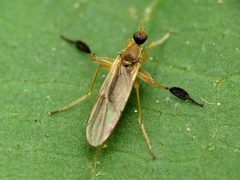
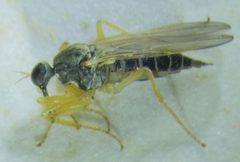
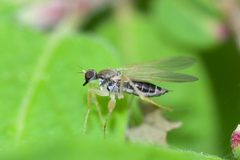
3Tachydromiinae is a of Hybotidae (Diptera) comprising small predatory flies. Members are generally 1–2 mm in length and exhibit fast-running on vegetation and other surfaces. The subfamily is globally distributed with notable disjunct patterns, including found in both southern Africa and Central Asia. Three tribes are recognized: Symballophthalmini, Drapetini, and Tachydromiini.
Pronunciation
How to pronounce Tachydromiinae: //ˌtækɪˈdroʊmi.aɪniː//
These audio files are automatically generated. While they are not always 100% accurate, they are a good starting point.
Identification
Tachydromiinae can be distinguished from other Empidoidea by small body size (typically 1–2 mm) and characteristic wing venation patterns. Within the , Drapetini exhibit distinctive features such as without ommatrichia and specific wing configurations (e.g., vein M1 anteriorly arched and parallel to R4+5 in some ). Female Drapetidini show modified abdominal structure where tergite 10 appears reduced or to and/or sternite 10.
Images
Habitat
Diverse terrestrial including leaf surfaces, tree trunks, stones, and sandy substrates. Some inhabit specialized environments: Andean-related habitats, eastern South American biomes (cerrado, Caatinga, Pantanal, Atlantic Forest), and mangrove .
Distribution
Widespread globally. Documented from South Africa (Northern Cape Province), Turkmenistan, Iran (Hormozgan Province), Singapore, Inner Mongolia (China), and throughout South America including Andean regions and eastern Brazil. Some exhibit unusual disjunct distributions between southern Africa and Central Asia.
Diet
Predatory.
Behavior
exhibit fast-running habits on vegetation, tree trunks, stones, and other surfaces.
Ecological Role
Predatory flies, likely functioning as of small arthropods in terrestrial .
Similar Taxa
- Other EmpidoideaTachydromiinae distinguished by small size, specific wing venation patterns, and running rather than aerial typical of some related groups.
- Other Hybotidae subfamiliesTachydromiinae separated by tribal-level characters including structure, wing venation, and female abdominal .
More Details
Tribal classification
Three tribes recognized: Symballophthalmini ( Symballophthalmus), Drapetini (multiple genera including Crossopalpus, Drapetis, Elaphropeza, Stilpon), and Tachydromiini (genera including Tachydromia, Platypalpus, Tachypeza).
Fossil record
Extinct documented from Cretaceous and Cenomanian amber deposits including Taimyr Amber (Santonian, Cenomanian), Canadian amber (Campanian), Burmese amber (Cenomanian), Baltic amber (Eocene), and Oise amber (Ypresian).
Sources and further reading
- BugGuide
- Wikipedia
- iNaturalist taxon
- NCBI Taxonomy
- Catalogue of Life
- A New Genus of Tachydromiinae from South Africa and Turkmenistan (Diptera: Empidoidea: Hybotidae)
- New species and new records of hybotid dance flies (Diptera: Hybotidae: Tachydromiinae) from Iranian mangrove habitats
- New South American species of Crossopalpus Bigot (Diptera: Hybotidae: Tachydromiinae), including biogeographical insights and a reinterpretation of female abdominal tergite 10 in Drapetidini
- The genus Platypalpus Macquart (Diptera, Hybotidae, Tachydromiinae) from Inner Mongolia, China, with the description of four new species.