
Larinus
Germar, E.F., 1823
Species Guides
5- Larinus carlinae(Canada thistle bud weevil)
- Larinus curtus(Yellow Starthistle Flower Weevil)
- Larinus minutus(lesser knapweed flower weevil)
- Larinus obtusus(Blunt Knapweed Flower Weevil)
- Larinus turbinatus(Turbine Cylindrical Weevil)
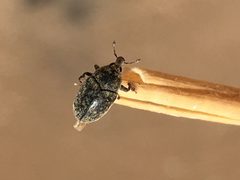
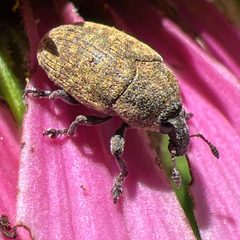
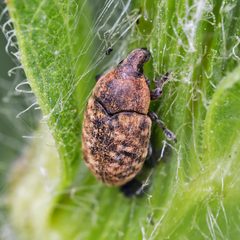
Larinus is a of true weevils ( Curculionidae) comprising approximately 180 , with the highest diversity in the Palaearctic region, particularly Turkey where over 50 species occur. These beetles are characterized by stocky, rounded bodies and are primarily associated with plants in the family Asteraceae. Several species have been introduced to North America as agents against thistles, though some have demonstrated non-target effects on native thistle species.
Pronunciation
How to pronounce Larinus: /ˈla.rɪ.nus/
These audio files are automatically generated. While they are not always 100% accurate, they are a good starting point.
Identification
Distinguished from the related Lixus by the stockier body shape and shorter rostrum. The combination of a transverse pronotum strongly narrowed toward the front, antennal furrows that do not extend to the rostrum tip, and short, rounded separates Larinus from similar weevil genera. -level identification requires examination of genitalia and other fine morphological details.
Images
Habitat
Primarily associated with open supporting Asteraceae plants, including grasslands, meadows, agricultural areas, and disturbed sites. Some inhabit fragmented thistle patches. Four species develop in plant stems and construct distinctive pupal chambers called trehala.
Distribution
Predominantly Palaearctic distribution with highest in Turkey (50+ in eastern Turkey). Some species introduced to North America as agents. Individual species have more restricted ranges, such as Larinus latus in Greece and Larinus vulpes in Ukraine.
Seasonality
of emerge in late May, with peak activity typically in June. Larval development occurs through summer months, with in July-August. New adults emerge in late August. Some species are with one generation per year.
Diet
Larvae feed internally on flower (capitula) of Asteraceae, consuming , achenes, and receptacle tissue. feed on leaves, stems, flowers, buds, peduncles, and possibly pollen of plants. Some are oligophagous on specific Echinops species.
Host Associations
- Asteraceae - primary Larvae develop in flower ; feed on vegetative and reproductive tissues
- Onopordum thistles - Larinus latus specific
- Echinops ruthenicus - Larinus vulpes
- Echinops sphaerocephalus - Larinus vulpes
- Cirsium thistles - Several including introduced agents
- Carduus thistles - for introduced
Life Cycle
(one per year) in studied . overwinter and emerge in spring. Mating occurs on plants. Females deposit in flower or buds. Larvae develop endophagously within capitula, consuming reproductive tissues. occurs within the flower head in a pupation , or in stem chambers in some species. Adults of new generation emerge in late summer. mortality and net may cause substantial adult losses (approximately 48% in Larinus latus).
Behavior
move both within and between plant patches to maintain integrity. Some exhibit K-selected traits with relatively stable populations. Oviposition site selection is critical; inappropriate placement on capitula can lead to establishment failure. Larvae of some species construct defensive chambers or shields. Four species (L. maculatus, L. hedenborgi, L. rudicollis, L. capsulatus) construct unusual sweet pupal chambers called trehala in plant stems, which have been used as human food.
Ecological Role
Herbivores that regulate of their Asteraceae, particularly thistles. Several serve as agents for weeds, capable of reducing thistle populations by 90% or more within 10 years. However, some introduced species pose threats to native North American thistles, including . Subject to , , and both inter- and for larval resources.
Human Relevance
Several introduced deliberately as agents against agricultural weeds, particularly thistles in North America. The trehala pupal chambers produced by four stem-inhabiting species have been harvested and consumed as food by humans. Some species have become subjects of conservation concern due to non-target effects on native flora. One species (Larinus hedenborgi) has been studied for potential medicinal properties of its cocoon extracts.
Similar Taxa
- LixusRelated with more elongate body and longer rostrum; Larinus distinguished by stockier build and shorter rostrum
- RhinocyllusAnother thistle-feeding weevil used in ; Rhinocyllus conicus has a longer snout compared to Larinus
More Details
Biological Control History
Larinus planus (thistle bud weevil) was first detected in North America in Maugansville, Maryland in 1971, apparently established in the 1960s. Larinus latus was studied in Greece as a potential agent for Australian Onopordum thistles.
Non-Target Effects
Introduced Larinus have demonstrated broader ranges than initially anticipated, incorporating native North American thistles into their diet and threatening species including federally endangered thistles.
Trehala Construction
Four Larinus (L. maculatus, L. hedenborgi, L. rudicollis, L. capsulatus) are unique in constructing sweet, edible pupal chambers called trehala within plant stems.
Sources and further reading
- BugGuide
- Wikipedia
- GBIF taxonomy match
- iNaturalist taxon
- NCBI Taxonomy
- Catalogue of Life
- Eaters of thistles: Thistle tortoise beetle, Cassida rubiginosa, and Canada thistle bud weevil, Larinus planus — Bug of the Week
- Dr. Jekyll and Mr. Hyde wage war on thistles: Thistle head weevils, Rhinocyllus conicus — Bug of the Week
- Archive — Bug of the Week
- New Distribution Record of Larinus planus (Coleoptera: Curculionidae) in Tennessee
- Figures 4–5 from: Skuhrovec J, Volovnik S, Gosik R (2017) Description of the immature stages of Larinus vulpes and notes on its biology (Coleoptera, Curculionidae, Lixinae). ZooKeys 679: 107-137. https://doi.org/10.3897/zookeys.679.12560
- Life history of the Onopordum capitulum weevil Larinus latus (Coleoptera: Curculionidae)
- Figures 2–3 from: Skuhrovec J, Volovnik S, Gosik R (2017) Description of the immature stages of Larinus vulpes and notes on its biology (Coleoptera, Curculionidae, Lixinae). ZooKeys 679: 107-137. https://doi.org/10.3897/zookeys.679.12560
- Figures 13–15 from: Skuhrovec J, Volovnik S, Gosik R (2017) Description of the immature stages of Larinus vulpes and notes on its biology (Coleoptera, Curculionidae, Lixinae). ZooKeys 679: 107-137. https://doi.org/10.3897/zookeys.679.12560
- Figure 1 from: Skuhrovec J, Volovnik S, Gosik R (2017) Description of the immature stages of Larinus vulpes and notes on its biology (Coleoptera, Curculionidae, Lixinae). ZooKeys 679: 107-137. https://doi.org/10.3897/zookeys.679.12560
- Taxonomic review of the stem-inhabiting trehala-constructing Larinus Dejean, 1821 (Coleoptera: Curculionidae): New species, systematics and ecology
- A new weevil species, Larinus atillai sp. nov. (Coleoptera: Curculionidae) from western Turkey
- Figure 7–9 from: Skuhrovec J, Volovnik S, Gosik R (2017) Description of the immature stages of Larinus vulpes and notes on its biology (Coleoptera, Curculionidae, Lixinae). ZooKeys 679: 107-137. https://doi.org/10.3897/zookeys.679.12560
- Lack of host races in Larinus latus Herbst (Coleoptera: Curculionidae) on Onopordum (Asteraceae: Cardueae): Biological control in Australia
- Description of the immature stages of Larinus vulpes and notes on its biology (Coleoptera, Curculionidae, Lixinae)
- The Effects of Cocoons of Larinus Hedenborgi (Coleoptera: Curculionidae) Extracts on Inflammation and Clinical Outcomes in Patients With Coronavirus Disease 2019: A Double-Blinded Randomized Controlled Clinical Trial.