
Larinus minutus
Gyllenhal, 1836
lesser knapweed flower weevil
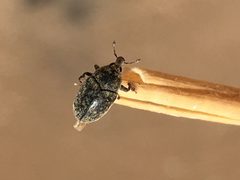
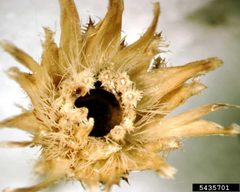
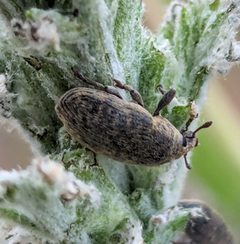
Larinus minutus is a small true weevil used as a agent against knapweeds, particularly diffuse knapweed (Centaurea diffusa) and spotted knapweed (Centaurea maculosa). Native to southern Europe and the Mediterranean, it was first released in the United States in 1991 and is now established throughout the western United States. feed on knapweed foliage and flowers, while larvae develop within flower and consume developing seeds, often destroying 100% of seeds in infested heads.
Pronunciation
How to pronounce Larinus minutus: //ˈlær.ɪ.nəs mɪˈnuː.təs//
These audio files are automatically generated. While they are not always 100% accurate, they are a good starting point.
Identification
Distinguished from other Larinus by its small size, association with diffuse and spotted knapweed, and specific timing of in mid-May. Differs from Larinus planus (Canada thistle bud weevil) by plant preference and geographic distribution. The long snout distinguishes it from Rhinocyllus conicus, which has a short snout and attacks thistles rather than knapweeds.
Images
Habitat
Associated with stands of diffuse knapweed and spotted knapweed in open, disturbed including rangelands, roadsides, and agricultural margins. Thrives in warm, dry areas of the western United States. Overwinters in soft soil or debris near plants.
Distribution
Native to southern Europe and the Mediterranean region. Introduced to North America beginning in 1991 from Greece. Now established throughout the western United States, particularly in warm, dry regions. Present in British Columbia, Canada, and the conterminous 48 United States.
Seasonality
with distinct seasonal activity. Overwintered emerge by mid-May. Oviposition begins late June and continues through summer. New adults emerge by late July. Adults remain active throughout summer with a maximum lifespan of approximately 14 weeks. During warm periods exceeding 30°C, adults become inactive and hide under flowers or plant parts.
Diet
feed on knapweed leaves prior to flowering, then switch to feeding on flowers after they develop. Larvae feed exclusively on developing seeds within knapweed flower , destroying 100% of seeds in diffuse knapweed and 25–100% of seeds in spotted knapweed.
Host Associations
- Centaurea diffusa - primary diffuse knapweed; preferred
- Centaurea maculosa - primary spotted knapweed; taxonomic synonym Centaurea stoebe
- Centaurea stoebe - primary taxonomic synonym for spotted knapweed
- Urophora affinis - intraguild consume this gall-forming fly, another biocontrol agent
- Urophora quadrifasciata - intraguild consume this gall-forming fly, another biocontrol agent
Life Cycle
. deposited in open knapweed flowers; females lay up to 130 eggs. Larvae emerge and burrow into flower , feeding on developing achenes. occurs within the seed head. emerge by late July, feed through summer, then overwinter in soil or debris near plants. One larva typically destroys all seeds within an infested flower head.
Behavior
exhibit thermoregulatory , hiding under plant parts and becoming inactive during periods exceeding 30°C. Females deposit directly into open knapweed flowers. Adults have been observed consuming other biocontrol agents (Urophora gall flies) that develop within the same flower , representing intraguild . No evidence of plant-mediated competition between larval and adult feeding stages.
Ecological Role
agent that reduces knapweed through dual feeding damage: larval seed eliminates reproductive output, while defoliation reduces plant vigor. Has been shown to reduce diffuse knapweed at multiple sites, though less successful against spotted knapweed. Intraguild predation on other biocontrol agents may complicate its ecological impact.
Human Relevance
Intentionally introduced to North America in 1991 as a agent for knapweeds that damage rangelands and natural . Approved for release in the United States and Canada following specificity testing demonstrating narrow host range limited primarily to Centaurea in subgenera Acrolophus, Calcitrapa, and Jacea. Has not been shown to attack native North American flora.
Similar Taxa
- Larinus planusSimilar size and , but attacks Canada thistle (Cirsium arvense) rather than knapweeds; has been reported to attack native thistles
- Larinus curtusRelated used for yellow starthistle control; distinct preference and geographic origin
- Rhinocyllus conicusThistle head weevil with short snout versus long snout of Larinus; attacks Carduus and Cirsium thistles rather than Centaurea knapweeds
More Details
Intraguild predation
L. minutus directly consumes larvae of the gall-forming flies Urophora affinis and Urophora quadrifasciata, which are also released as biocontrol agents for knapweed. This represents an unexpected ecological interaction between introduced control agents.
Biocontrol efficacy variation
Effectiveness varies by site and target : successful in reducing diffuse knapweed , but less effective against spotted knapweed. The dual life-history stages (larval seed and defoliation) allow the species to impact plants across different environmental conditions.
Sources and further reading
- BugGuide
- Wikipedia
- GBIF taxonomy match
- iNaturalist taxon
- NCBI Taxonomy
- Catalogue of Life
- Eaters of thistles: Thistle tortoise beetle, Cassida rubiginosa, and Canada thistle bud weevil, Larinus planus — Bug of the Week
- Dr. Jekyll and Mr. Hyde wage war on thistles: Thistle head weevils, Rhinocyllus conicus — Bug of the Week
- Different Jaws for Different Jobs | Beetles In The Bush
- sawfly | Blog
- distribution | Blog
- citizen scientist | Blog
- Influences of two life‐history stages of the weevil, Larinus minutus , on its host plant Centaurea diffusa
- Notes on the biology of Larinus minutus Gyllenhal (Col., Curculionidae), an agent for biological control of diffuse and spotted knapweeds
- Host specificity of Larinus minutus Gyll. (Col., Curculionidae), an agent introduced for the biological control of diffuse and spotted knapweed in North America
- A field experiment to determine host specificity of Larinus curtus Hochhut (Col., Curculionidae) and Urophora sirunaseva Hg. (Dipt., Tephritidae), candidates for the biological control of Centaurea solstitialis L. (Asteraceae), and Larinus minutus Gyllenhal, a candidate for biological control of C. maculosa Lam. and C. diffusa Lam.