
Urophora quadrifasciata
Meigen, 1826
Four-barred Knapweed Gall Fly
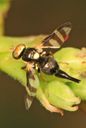
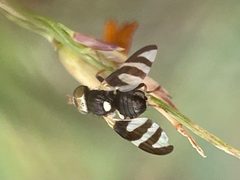
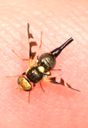
Urophora quadrifasciata is a tephritid fly native to Europe and parts of Asia, introduced to North America and Australia as a agent for knapweed (Centaurea spp.). Larvae develop in flower of knapweeds, forming galls that reduce seed production. The species has become established in western North America following intentional releases in the early 1970s, though at some sites declined due to competition with the related Urophora affinis.
Pronunciation
How to pronounce Urophora quadrifasciata: /ˌjʊərəˈfɔːrə ˌkwɒdrɪfæsiˈɑːtə/
These audio files are automatically generated. While they are not always 100% accurate, they are a good starting point.
Identification
can be distinguished from the congeneric Urophora affinis by subtle morphological differences used in recognition during courtship; males attempt copulation with both and non-conspecific females but are rejected by non-conspecific females. Differences in male genitalia are important for female recognition. Larval galls in knapweed flower require examination for definitive identification.
Images
Habitat
Found in association with knapweed (Centaurea spp.) patches; specifically associated with spotted knapweed (Centaurea maculosa, also known as C. biebersteinii) and diffuse knapweed (Centaurea diffusa). plant patch size influences , with inverse relationships between gall rates and patch size observed in some regions.
Distribution
Native to Europe, Kazakhstan, North Africa, and Iran. Introduced to North America (western Canada and United States, including Montana, British Columbia, and Michigan) and Australia. In North America, has occurred from initial release sites, with spread documented from British Columbia into the northwestern United States and southeasterly into Montana.
Diet
Larvae feed on developing seeds and tissues within knapweed flower (capitula), inducing gall formation. feeding habits not documented in available sources.
Host Associations
- Centaurea maculosa (spotted knapweed) - larval plantPrimary target for introductions in North America
- Centaurea diffusa (diffuse knapweed) - larval plant plant shared with Urophora affinis, leading to
- Centaurea stoebe - larval plantTarget for
Life Cycle
Larvae overwinter within galls in knapweed capitula. Development occurs within flower , with timing synchronized with plant . with Urophora affinis can affect success when both emerge synchronously and compete for oviposition sites.
Behavior
Females oviposit into knapweed flower , preferring larger unopened heads than those selected by Urophora affinis. Males engage in courtship that includes attempted copulation with both and heterospecific females; recognition occurs during precopulatory displays based on morphological and subtle behavioral cues. is directed, with documented northeastward spread along the Keweenaw Peninsula in Michigan.
Ecological Role
Acts as a agent for knapweed by reducing seed production through larval gall formation. Subject to by Pteromalus sp. (Hymenoptera: Pteromalidae), which can limit effectiveness. Engages in with Urophora affinis for oviposition sites, with competitive outcomes varying by site and year.
Human Relevance
Intentionally introduced to North America and Australia for of spotted and diffuse knapweed, weeds that degrade rangeland and natural . Effectiveness varies by region due to competition with Urophora affinis, , and patch size effects. Not considered an agricultural pest.
Similar Taxa
- Urophora affinisCo-occurs on knapweed ; distinguished by oviposition into smaller flower , earlier timing, and subtle morphological and behavioral differences in courtship. U. affinis can competitively exclude U. quadrifasciata at some sites through interference competition that reduces host plant flower head growth.
More Details
Interspecific competition
U. quadrifasciata and U. affinis compete for oviposition sites on shared Centaurea diffusa . Heavy attack by U. affinis can slow flower growth, preventing heads from reaching sizes acceptable to U. quadrifasciata and reducing its reproductive success. This mechanism contributed to declines of U. quadrifasciata at some British Columbia sites beginning in 1976.
Patch size effects
are influenced by plant patch size. Larger patches support higher absolute densities but reduced per capita performance due to for oviposition sites. Smaller patches may offer better individual despite lower total sizes.
Parasitism
in Michigan are attacked by the Pteromalus sp. (Hymenoptera: Pteromalidae), which may limit effectiveness as a agent.
Sources and further reading
- BugGuide
- Wikipedia
- GBIF taxonomy match
- iNaturalist taxon
- NCBI Taxonomy
- Platystomatidae | Beetles In The Bush
- Bug Eric: Harlequin Bug
- Bug Eric: Wasp Wednesday: Bicyrtes
- Influence of Centaurea biebersteinii patch size on Urophora quadrifasciata (Dipt. Tephritidae) in Michigan, USA
- Reproductive isolation between Urophora affinis and U. quadrifasciata (Diptera: Tephritidae) in British Columbia
- Interspecific competition between Urophora affinis and U. quadrifasciata (Diptera: Tephritidae) for ovipositional sites on diffuse knapweed (Centaurea diffusa: Compositae)
- Distribution of Urophora affinis and U. quadrifasciata, Two Flies Introduced for Biological Control of Spotted Knapweed (Centaurea maculosa) in Montana
- Distribution of <i>Urophora Affinis</i> and <i>U. Quadrifasciata</i> (Diptera: Tephritidae) for Biological Control of Spotted Knapweed <i>(Centaurea Maculosa)</i> and Diffuse Knapweed <i>(Centaurea Diffusa)</i> in Michigan
- Attack of <i>Urophora Quadrifasciata</i> (Meig.) (Diiptera: Tephritidae) A Biological Control Agent for Spotted Knapweed (<i>Centaurea Maculosa</i> Lamarck) and Diffuse Knapweed (<i>C. Diffusa</i> Lamarck) (Asteraceae) by a Parasitoid, <i>Pteromalus</i> Sp. (Hymenoptera: Pteromalidae) in Michigan