
Urophora
Robineau-Desvoidy, 1830
thistle gall flies, gall flies
Species Guides
6- Urophora affinis(Knapweed Gall Fly)
- Urophora cardui(Canada thistle gall fly)
- Urophora jaceana
- Urophora quadrifasciata(Four-barred Knapweed Gall Fly)
- Urophora sirunaseva(Yellow Starthistle Gall Fly)
- Urophora stylata(Bull Thistle Gall Fly)
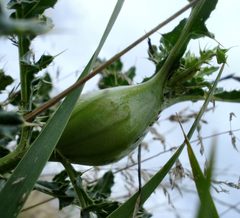
Urophora is a of tephritid flies distributed across the Palaearctic Region, with exhibiting close associations with Asteraceae plants. Larvae of many species induce galls on stems or other plant parts of thistles and related plants. The genus includes at least 13 species in Karaman Province, Türkiye alone, with new species continuing to be documented. Urophora cardui, a well-studied species, forms multi-chambered stem galls on Cirsium spp. and serves as for multiple .
Pronunciation
How to pronounce Urophora: //juːˈrɒfərə//
These audio files are automatically generated. While they are not always 100% accurate, they are a good starting point.
Identification
identification requires examination of wing venation patterns and . The is distinguished from other tephritid genera by characters of the aculeus and wing pattern. Within the genus, species differ in details of wing markings and aculeus structure. Urophora cardui specifically is identified by its association with Cirsium stem galls, though flies are difficult to distinguish from without detailed morphological examination.
Images
Appearance
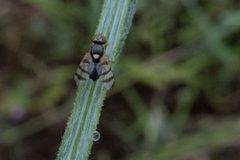
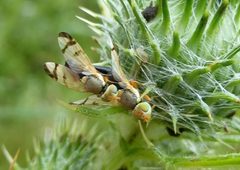
Small to medium-sized tephritid flies. Wing patterns and (ovipositor structures) provide diagnostic characters for identification. High-resolution examination of external features, wings, and aculei is required for accurate species-level identification.
Habitat
Associated with Asteraceae plants, particularly thistles (Cirsium spp.) and related . Larval consists of plant tissue galls formed on stems or other plant parts. habitat includes areas with plant , including roadsides, urban periphery, and natural or semi-natural vegetation.
Distribution
Widely distributed across the Palaearctic Region. Documented from Karaman Province, Türkiye (13 ); Finland (U. cardui, spreading from Helsinki since 1981); and North America (U. cardui introduced, established in North Dakota).
Host Associations
Life Cycle
Larvae develop within plant galls induced on Asteraceae. In U. cardui, larvae develop within multi-chambered stem galls on Cirsium spp. Gall formation begins before or during larval development. occurs within galls. timing varies with climate; in Finland, and correlate strongly with summer warmth.
Behavior
U. cardui exhibits climate-correlated : range expansion up to 16 km in warm summers, with range contraction following cold summers. Larvae parasitized by E. serratulae promote gall growth, resulting in larger galls that benefit both and surviving larvae. Gall size correlates with number of chambers and parasitization rates.
Ecological Role
Gall induction creates structure on plants. Serves as host for , supporting parasitoid diversity. Interactions with parasitoids influence gall size and plant tissue allocation. U. cardui has been evaluated as a agent for thistles.
Human Relevance
U. cardui has been introduced to North America as a potential agent for Canada thistle (Cirsium arvense). The is monitored for its and spread in regions where established. Taxonomic study of the contributes to understanding of Palaearctic tephritid diversity.
Similar Taxa
- Other TephritidaeWing patterns similar; distinguished by and gall association
- Other gall-inducing DipteraSimilar gall ; distinguished by gall structure (multi-chambered in Urophora) and
More Details
Genome resources
sequence available for Urophora cardui (Linnaeus 1758), published 2025
Faunistic documentation
Recent surveys in Türkiye (2023-2024) increased documented in Karaman Province from 7 to 13 , indicating ongoing discovery of diversity
Sources and further reading
- BugGuide
- iNaturalist taxon
- NCBI Taxonomy
- Catalogue of Life
- Distribution and dispersal of <i>Urophora cardui</i> (Diptera, Tephritidae) in Finland in 1985-1991
- Figure 10 from: Zwölfer H, Böheim M, Beck E (2015) Eurytoma serratulae and E. robusta (Hymenoptera, Eurytomidae): complementary host exploitation strategies of coexisting parasitoids and their impact on the host Urophora cardui. Journal of Hymenoptera Research 42: 47-62. https://doi.org/10.3897/JHR.42.8847
- Figure 9 from: Zwölfer H, Böheim M, Beck E (2015) Eurytoma serratulae and E. robusta (Hymenoptera, Eurytomidae): complementary host exploitation strategies of coexisting parasitoids and their impact on the host Urophora cardui. Journal of Hymenoptera Research 42: 47-62. https://doi.org/10.3897/JHR.42.8847
- The genus Urophora Robineau-Desvoidy, 1830 (Diptera Tephritidae) in Karaman Province, Türkiye: new records and distribution data
- The genome sequence of the thistle gall fly, Urophora cardui (Linnaeus 1758).
- Predatory and Parasitic Insects Associated with Urophora cardui L. (Diptera: Tephritidae) Galls on Canada Thistle, Cirsium arvense L. (Asterales, Asteraceae) in North Dakota.