
Urophora affinis
(Frauenfeld, 1857)
Knapweed Gall Fly
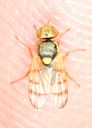
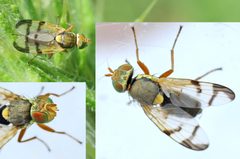
Urophora affinis is a tephritid fruit fly native to Eurasia that was introduced to North America as a agent for spotted knapweed (Centaurea maculosa) and diffuse knapweed (C. diffusa). The forms galls in knapweed seed , where larvae develop and reduce seed production by up to 95%. First released in Montana in 1973, it has established but remains concentrated near release sites with limited ability. The fly is multivoltine, with emerging in June and larvae in seed heads.
Pronunciation
How to pronounce Urophora affinis: /ˌjʊrəˈfɔrə əˈfɪnɪs/
These audio files are automatically generated. While they are not always 100% accurate, they are a good starting point.
Identification
Urophora affinis can be distinguished from the similar U. quadrifasciata by oviposition : U. affinis targets smaller, unopened flower of diffuse knapweed, while U. quadrifasciata requires larger, more developed heads. Males of both discriminate between and non-conspecific females based on morphological and subtle behavioral differences. Differences in male genitalia are important for female recognition of mates.
Images
Habitat
Associated with knapweed-infested areas, particularly spotted knapweed (Centaurea maculosa) and diffuse knapweed (C. diffusa) stands. remain concentrated within 5-8 km of release sites even where well-established, indicating limited from introduction points.
Distribution
Native range: France and Germany east to Ukraine and southwest Russia, Italy, Balkans, Turkey, and Iran. Introduced to North America: released in Montana, USA during 1973-1977; established in Montana by 1973. Also released in Canada. Found at 40 of 88 surveyed sites in Montana in 1984-1985. U. quadrifasciata, released in British Columbia in 1972, dispersed into Montana from the northwest and was found at 84 sites, suggesting U. affinis has more restricted .
Seasonality
Multivoltine with emerging in June. Larvae overwinter in knapweed flower . Multiple per year possible depending on climate and plant .
Diet
Larvae feed internally within galls formed in knapweed seed , consuming developing seeds and floral tissues. Specific feeding habits not documented.
Host Associations
- Centaurea maculosa - spotted knapweed; primary target for in North America
- Centaurea diffusa - diffuse knapweed; in both native and introduced ranges
Life Cycle
Multivoltine. emerge in June and oviposit on knapweed seed . Females produce approximately 120 . Larvae develop within galls in seed heads and overwinter as larvae. occurs within the gall. Development is slowed in heavily attacked flower heads, which can affect subsequent and .
Behavior
Females oviposit into unopened knapweed flower , preferring smaller heads than the U. quadrifasciata. Heavy attack by U. affinis can slow flower head growth, reducing availability of suitably sized heads for U. quadrifasciata. exhibit limited , with remaining concentrated near release sites. Courting males do not distinguish males from females until attempted copulation, but do discriminate against non-conspecific females. Some males attempt copulation with non-conspecific females, which are consistently rejected.
Ecological Role
agent for knapweeds (Centaurea maculosa and C. diffusa). Reduces seed production by up to 95%, though this level of reduction is insufficient for effective management alone. Serves as prey for deer mice (Peromyscus maniculatus), which heavily prey upon larvae. Subject to intraguild by introduced weevils Larinus minutus and Bangasternus fausti, which consume developing U. affinis larvae in cage experiments.
Human Relevance
Introduced deliberately as a biocontrol agent for spotted and diffuse knapweed in the United States and Canada. First established in Montana in 1973. Considered insufficient alone for effective knapweed management, leading to introduction of additional biocontrol agents including weevils. Not a pest of economic crops.
Similar Taxa
- Urophora quadrifasciataOverlapping distribution and use on diffuse knapweed. Distinguished by oviposition preference for larger flower , temporal differences in , and slight differences in microhabitat use on host plants. U. quadrifasciata declined at some sites due to competition with U. affinis, which can slow flower head growth below sizes acceptable to U. quadrifasciata.
More Details
Interspecific Competition
U. affinis competes with U. quadrifasciata for oviposition sites on diffuse knapweed. In 1978 at Ned's Creek, British Columbia, synchronous when C. diffusa were acceptable only to U. affinis led to heavy attack that slowed flower head growth, leaving few heads large enough for U. quadrifasciata. This competitive effect was not observed on lightly attacked or unattacked plants and may have contributed to U. quadrifasciata declines at some sites beginning in 1976.
Biocontrol Limitations
Despite reducing knapweed seed production by up to 95%, U. affinis is insufficient for effective management of spotted or diffuse knapweed. larvae suffer heavy by deer mice. Additional biocontrol agents including Larinus minutus and Bangasternus fausti were introduced; these weevils not only attack knapweed seed but also consume developing U. affinis larvae and reduce U. affinis .
Sources and further reading
- BugGuide
- Wikipedia
- GBIF taxonomy match
- iNaturalist taxon
- NCBI Taxonomy
- Catalogue of Life
- Meet 'Mantis Master Keeper' Andrew Pfeifer | Bug Squad
- Saving the Rusty-Patched Bumble Bee | Bug Squad
- Take 2 on tropical tiger moths: Spotted oleander caterpillar moth, Empyreuma affinis — Bug of the Week
- Mason bees in peril when parasitic wasps arrive – Leucospid wasp, Leucospis affinis — Bug of the Week
- A Tick that Feeds on Birds May Increase the Range of Lyme Disease
- Genetic Analysis Guides Conservation of Endangered Bumble Bee
- Reproductive isolation between Urophora affinis and U. quadrifasciata (Diptera: Tephritidae) in British Columbia
- Interspecific competition between Urophora affinis and U. quadrifasciata (Diptera: Tephritidae) for ovipositional sites on diffuse knapweed (Centaurea diffusa: Compositae)
- Distribution of Urophora affinis and U. quadrifasciata, Two Flies Introduced for Biological Control of Spotted Knapweed (Centaurea maculosa) in Montana