
Urophora stylata
(Fabricius, 1775)
Bull Thistle Gall Fly
Urophora stylata is a tephritid fruit fly whose larvae induce galls in thistle seedheads. The has been widely introduced outside its native range as a biocontrol agent targeting thistles, particularly Cirsium vulgare. Field studies demonstrate spill-over attack on non-target when primary seedheads are scarce.
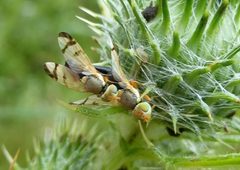
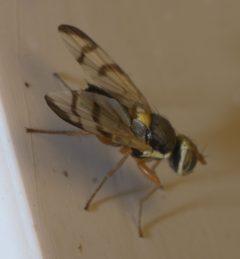
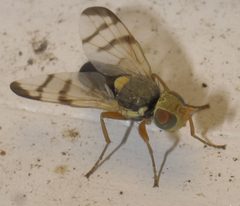
Pronunciation
How to pronounce Urophora stylata: /ˌjʊrəˈfɔrə staɪˈlɑːtə/
These audio files are automatically generated. While they are not always 100% accurate, they are a good starting point.
Images
Habitat
Pasture systems with thistle presence; specifically observed in sheep and beef production pastures in New Zealand. Native range not documented in sources.
Distribution
Native to Europe, extending east to Japan. Introduced to India, Pakistan, Australia, North America, and New Zealand (released 1998).
Seasonality
activity observed in summer (New Zealand survey conducted summer 2018).
Host Associations
- Cirsium vulgare - Primary larval Scotch thistle; target of biocontrol introductions
- Cirsium arvense - Non-target larval Californian thistle; documented spill-over attack at 6 locations in New Zealand
- Cirsium palustre - Non-target larval Marsh thistle; documented spill-over attack at 1 location in New Zealand
- Carduus - Larval Documented in literature but specific not identified in sources
Life Cycle
Larval development occurs within thistle seedheads, forming galls. Specific developmental stages and timing not documented in sources.
Behavior
Spill-over attack on non-target occurs when primary seedheads are limited; attack intensity positively correlated between target and non-target hosts.
Ecological Role
Biocontrol agent for thistle weed management; potential non-target effects on native or economically neutral thistle .
Human Relevance
Intentionally introduced to multiple countries for of thistles. Documented non-target attack raises questions about specificity in management applications.
More Details
Host specificity concerns
New Zealand field survey (2018) found attack on Cirsium arvense correlated with attack intensity on C. vulgare, suggesting ecological rather than physiological expansion. This indicates spill-over is driven by host availability rather than host range evolution.