
Rhinocyllus conicus
(Froelich, 1792)
thistle head weevil, nodding thistle receptacle weevil
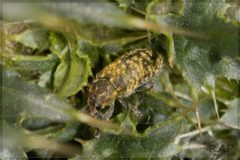
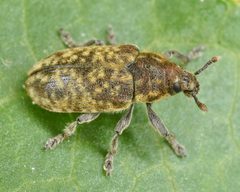
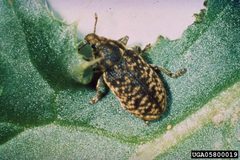
Rhinocyllus conicus is a small true weevil native to Eurasia and North Africa, introduced to North America in 1969 as a agent for thistles. are black with yellowish mottled hairs, up to 6 mm long, with a short snout. Females lay on thistle flower , which larvae enter to feed on developing seeds and flower parts, preventing seed production. While effective at controlling invasive thistles like musk thistle, the weevil was found to attack native North American thistles as well, leading to cancellation of its distribution permits in 2000.
Pronunciation
How to pronounce Rhinocyllus conicus: /rʷaɪnɵˈkɪləs ˈkoʊnɪkəs/
These audio files are automatically generated. While they are not always 100% accurate, they are a good starting point.
Identification
Distinguished from similar thistle-feeding weevils by its short snout and small size (up to 6 mm). Larinus planus (thistle bud weevil) has a noticeably longer snout. are covered in a distinctive black and yellowish mottled coat of hairs.
Images
Habitat
Associated with thistle plants, particularly in flower of Carduus, Cirsium, Onopordum, and Silybum . Found in agricultural lands, meadows, and disturbed areas where thistles grow.
Distribution
Native to Eurasia and North Africa. Introduced to North America beginning in 1969 (Canada 1968, then Virginia, California, Montana 1969). Now widely established throughout the United States.
Seasonality
active during thistle flowering period; larval development occurs within flower . Overwinters successfully in introduced range.
Diet
Larvae feed on developing seeds and flower parts inside thistle flower . feed on thistle foliage, causing defoliation.
Host Associations
- Carduus nutans - primary - musk thistle target
- Carduus thoermeri - no differential effects on weevil compared to C. macrocephalus
- Carduus macrocephalus - no differential effects on weevil compared to C. thoermeri
- Carduus acanthoides - spiny plumeless thistle
- Cirsium vinaceum - non-target Sacramento Mountains thistle, federally threatened
- Cirsium - -level includes multiple native North American
- Onopordum - -level
- Silybum - -level
Life Cycle
Females lay over 100 on or near bracts of thistle flower , covering eggs with masticated plant tissue for protection. Larvae emerge, burrow into flower heads, and feed on flower parts and developing seeds. Larvae deposit and chewed plant tissue on chamber walls, creating a rigid protective shell for . Pupation takes up to two weeks; remain in chamber for additional weeks before tunneling out. One-year .
Behavior
mate on plants. Females use floral scent cues for host recognition, responding to volatile organic compounds. When simultaneously exposed to and native thistle scents, females show indifferent response but exhibit longer searching time on native thistle volatiles. Larvae preferentially attack primary flowers over secondary and later flowers. Some larvae tunnel through upper stems instead of chambering in flower .
Ecological Role
agent for thistles, capable of reducing by 90% or more in 10 years. However, poses threat to native thistle diversity through non-target attacks, including federally threatened and . Competes with other biocontrol agents such as Urophora solstitialis.
Human Relevance
Controversial biocontrol agent: initially hailed for controlling thistles, later recognized as threat to native flora. USDA cancelled interstate movement permits in 2000; further releases prohibited in many areas. Remains widely established and continues to impact both invasive and native thistles.
Similar Taxa
- Larinus planusalso introduced for thistle biocontrol, but distinguished by longer snout
- Urophora solstitialiscompeting biocontrol agent on same ; gallfly rather than weevil
Sources and further reading
- BugGuide
- Wikipedia
- GBIF taxonomy match
- iNaturalist taxon
- NCBI Taxonomy
- Catalogue of Life
- Bembicid Holdings | Entomology Research Museum
- Dr. Jekyll and Mr. Hyde wage war on thistles: Thistle head weevils, Rhinocyllus conicus — Bug of the Week
- Archive — Bug of the Week
- Dispersal ofRhinocyllus conicusfor Biocontrol of Musk Thistle
- Host recognition by Rhinocyllus conicus of floral scents from invasive and threatened thistles
- Two Species of Musk Thistle (Carduusspp.) as Hosts ofRhinocyllus conicus
- Re-test of Rhinocyllus conicus host specificity, and the prediction of ecological risk in biological control
- Oviposition response of the biocontrol agent Rhinocyllus conicus to resource distribution in its invasive host, Carduus nutans
- Host Utilization of Native Cirsium Thistles (Asteraceae) by the Introduced Weevil Rhinocyllus conicus (Coleoptera: Curculionidae) in California
- Seasonal Model of the Interaction Between Rhinocyllus conicus (Coleoptera: Curculionidae) and Its Weed Host, Carduus thoermeri (Campanulatae: Asteraceae)
- Interspecific competition between <i>Rhinocyllus conicus</i> and <i>Urophora soistitialis</i> L on nodding thistle in Canterbury