
Larinus curtus
Hochhuth, 1851
Yellow Starthistle Flower Weevil
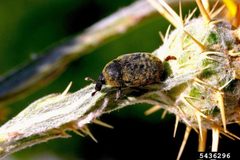
Larinus curtus is a small weevil native to southern Europe and the Mediterranean region, introduced to the United States in 1992 as a agent for the weed yellow starthistle (Centaurea solstitialis). are dark brown to black with light-colored mottled hairs and measure approximately 6 mm in length. The is , with larvae developing inside flower where they feed on developing seeds, achieving average seed reduction rates of 96% per infested head. While adults feed on flowers and pollen, the larval stage provides the primary biocontrol impact.
Pronunciation
How to pronounce Larinus curtus: //ˈlæ.rɪ.nəs ˈkɜr.təs//
These audio files are automatically generated. While they are not always 100% accurate, they are a good starting point.
Identification
Distinguished from similar thistle-feeding weevils by its association with yellow starthistle (Centaurea solstitialis) rather than other thistle . Differs from the thistle head weevil (Rhinocyllus conicus) and Canada thistle bud weevil (Larinus planus) by plant specificity and geographic origin. The short snout relative to some and specific association with yellow starthistle aid in field identification.
Images
Appearance
weevils are dark brown to black with light-colored mottled hairs covering the body. Body length is approximately 6 mm. The possesses the characteristic elongated snout (rostrum) typical of the Curculionidae. Females deposit , milky white, oval-shaped at the bases of open yellow starthistle flowers.
Habitat
Associated with yellow starthistle (Centaurea solstitialis) in grassland and rangeland . In its native range, occurs in Mediterranean climates of southern Europe. In the introduced range, established in the Pacific Northwest and other regions where yellow starthistle occurs.
Distribution
Native to southern Italy, southern Europe, the Middle East, and the Caucasus region. Introduced to the United States in 1992; now established throughout the Pacific Northwest in relatively low densities.
Seasonality
emerge from in spring. -laying occurs over approximately 6-8 weeks during the flowering period of yellow starthistle. New adults emerge in late summer and enter diapause for winter. One per year ().
Diet
Specialized feeder on yellow starthistle (Centaurea solstitialis). feed on flowers and pollen. Larvae develop within seed , feeding on developing seeds and pappus. Laboratory studies indicate minimal oviposition on safflower (Carthamus tinctorius) with no successful larval development; field reports of adult feeding on safflower flowers have been documented but larval establishment has not been confirmed.
Host Associations
- Centaurea solstitialis - primary yellow starthistle; required for larval development
- Carthamus tinctorius - tested safflower; observed feeding in field, no confirmed larval development
Life Cycle
(one per year). emerge from sites in spring. Females lay at bases of open flowers. Larvae hatch within days, enter flower , and develop through three instars feeding on seeds. occurs within the seed head. New adults emerge in late summer, feed briefly, then enter for winter. Average approximately 30-50 eggs per female under laboratory conditions.
Behavior
exhibit strong fidelity to yellow starthistle. Females deposit directly into flower . Larvae are capable of destroying all seeds within a single flower head. Adults feed on floral tissues but cause minimal direct damage to plant vigor compared to larval seed .
Ecological Role
agent that reduces seed production of yellow starthistle, potentially limiting spread and of this noxious weed in rangelands and agricultural areas. The 96% average seed reduction per infested flower significantly impacts plant reproductive output.
Human Relevance
Introduced intentionally to the United States in 1992 as a agent for yellow starthistle, an weed causing significant agricultural and ecological damage. Established contribute to integrated weed management programs, though densities remain relatively low in the Pacific Northwest. Concerns about potential non-target effects on native thistles and related crops (particularly safflower) have been investigated through specificity testing.
Similar Taxa
- Larinus planusSimilar size and ; distinguished by association with Canada thistle (Cirsium arvense) rather than yellow starthistle
- Rhinocyllus conicusAnother European weevil introduced for thistle biocontrol; differs in attacking multiple thistle including native North American thistles, with broader range and longer snout
Sources and further reading
- BugGuide
- Wikipedia
- GBIF taxonomy match
- iNaturalist taxon
- Catalogue of Life
- Eaters of thistles: Thistle tortoise beetle, Cassida rubiginosa, and Canada thistle bud weevil, Larinus planus — Bug of the Week
- Dr. Jekyll and Mr. Hyde wage war on thistles: Thistle head weevils, Rhinocyllus conicus — Bug of the Week
- Archive — Bug of the Week
- Biology of Larinus curtus Hochhut (Coleoptera: Curculionidae), a European Weevil for Biological Control of Yellow Starthistle Centaurea solstitialis L (Asteraceae), in the United States
- A field experiment to determine host specificity of Larinus curtus Hochhut (Col., Curculionidae) and Urophora sirunaseva Hg. (Dipt., Tephritidae), candidates for the biological control of Centaurea solstitialis L. (Asteraceae), and Larinus minutus Gyllenhal, a candidate for biological control of C. maculosa Lam. and C. diffusa Lam.