
Larinus obtusus
Gyllenhal, 1835
Blunt Knapweed Flower Weevil
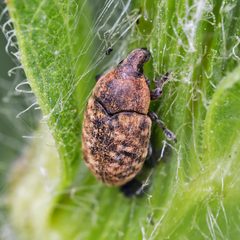
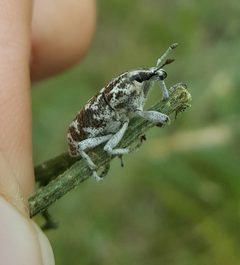
Larinus obtusus is a small true weevil in the Curculionidae, commonly known as the blunt knapweed flower weevil. It is native to Europe and the Middle East and has been introduced to North America as a agent against knapweeds (Centaurea ), particularly spotted knapweed. The species is closely related to Larinus minutus, with which it shares similar and ecological role.

Pronunciation
How to pronounce Larinus obtusus: /ˈla.rɪ.nus ɔbˈtuː.sus/
These audio files are automatically generated. While they are not always 100% accurate, they are a good starting point.
Identification
The blunt knapweed flower weevil is distinguished from its Larinus minutus by subtle morphological differences that may require expert examination; the two are currently considered separate but could be synonymized with further research. The large, bulbous snout and small dark brown body (5–7 mm) are characteristic. Confirmation of identity typically requires comparison with voucher specimens or identification.
Images
Habitat
Associated with knapweed (Centaurea) plants in open, disturbed including grasslands, rangelands, and areas invaded by spotted knapweed. In its native range, occupies similar habitats in Europe and the Middle East where native knapweeds occur.
Distribution
Native to Europe and the Middle East. Introduced to North America, first released in Boulder, Colorado in 1991. Now established in much of the northwestern United States including British Columbia, Canada, and the conterminous 48 United States. Distribution records include Vermont and other northwestern states, though abundance in many areas remains unknown.
Seasonality
Active throughout the summer months. and activity coincide with knapweed flowering periods.
Diet
feed on knapweed foliage. Larvae feed on developing seeds inside knapweed flower , causing the majority of damage to the plant.
Host Associations
- Centaurea maculosa - Primary Spotted knapweed; main target of biocontrol introductions
- Centaurea - Various knapweed
Life Cycle
Females lay yellow in opened knapweed flower . Larvae emerge and feed on developing seeds within the flower head for approximately 17 days. Larvae then construct a cocoon from seed remnants and pupate within it for about nine days. feed on foliage but cause less damage than larvae. Average lifespan is approximately 94 days for males and 58 days for females.
Behavior
are active during summer when plants are flowering. Females oviposit into opened flower . Larval feeding destroys developing seeds, preventing host plant .
Ecological Role
herbivore of knapweeds. As a agent, it reduces seed production of spotted knapweed, potentially decreasing spread. The occupies a narrow as a seed of Centaurea species.
Human Relevance
Used as a agent against noxious knapweeds in North America, particularly spotted knapweed (Centaurea maculosa). First introduced to the United States in 1991 in Colorado. Considered effective at reducing knapweed seed production, though its overall abundance and impact in established areas is not well documented.
Similar Taxa
- Larinus minutusVery similar , size, and ecological role as a knapweed ; also used for biocontrol. Currently considered a separate but may be synonymized with further research.
More Details
Taxonomic uncertainty
Larinus obtusus is quite similar to Larinus minutus, and the two are currently maintained as separate pending further research.
Biocontrol history
First introduced to the United States in 1991 in the Boulder, Colorado area; established now occur across much of the northwestern United States.
Sources and further reading
- BugGuide
- Wikipedia
- GBIF taxonomy match
- iNaturalist taxon
- NCBI Taxonomy
- Catalogue of Life
- Eaters of thistles: Thistle tortoise beetle, Cassida rubiginosa, and Canada thistle bud weevil, Larinus planus — Bug of the Week
- Saving Nutella: New Guide Details IPM for Weevil Pests in Hazelnut
- Dr. Jekyll and Mr. Hyde wage war on thistles: Thistle head weevils, Rhinocyllus conicus — Bug of the Week
- Two New Beetle Species Identified at NEON Field Site in Hawai'i
- Miridae | Beetles In The Bush