
Larinus turbinatus
Gyllenhal, 1835
Turbine Cylindrical Weevil
Larinus turbinatus is a true weevil in the Curculionidae, native to the western Palaearctic. The name refers to its cone-shaped snout. It is oligophagous on thistles, particularly Carduus and Cirsium species. Females lay in flower buds, and larvae develop within the flower , typically resulting in one surviving larva per flower due to . The species has been introduced to the United States.
Pronunciation
How to pronounce Larinus turbinatus: /ˈlarɪnəs ˌtɜːrbɪˈneɪtəs/
These audio files are automatically generated. While they are not always 100% accurate, they are a good starting point.
Identification
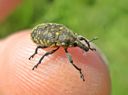
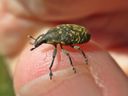
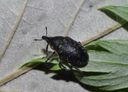
Larinus turbinatus can be confused with Larinus carlinae due to similar size. It is distinguished by its robust, short, straight rostrum that tapers conically to the apex, with a lateroventral ridge and longitudinal groove. The female's and rostrum are darker than the male's. The pronotum is strongly punctured with tapering lateral margins, and the are wider than the pronotum with a rounded apex.
Images
Habitat
Open, warm slopes, grassland, wet meadows, and pastures where thistles are present. The is warmth-loving and associated with thistle plants.
Distribution
Native to the western Palaearctic: southern and central Europe (Albania, Austria, Bosnia and Herzegovina, Bulgaria, Croatia, Czech Republic, France, Germany, Greece, Hungary, Italy, Republic of Moldova, Poland, Portugal, Romania, Slovakia, Slovenia, Spain, Switzerland, Ukraine, Yugoslavia), Caucasus, western Russia, Asia Minor, Central Asia, Siberia, and North Africa. Introduced to the United States.
Diet
Oligophagous on thistles (Asteraceae, tribe Cardueae), primarily Carduus and Cirsium including Marsh Thistle (Cirsium palustre), Creeping Thistle (Cirsium arvense), Musk Thistle (Carduus nutans), and Cabbage Thistle (Cirsium oleraceum). Occasionally observed on Silybum, Onopordum, and Centaurea species.
Host Associations
- Cirsium palustre - Marsh Thistle
- Cirsium arvense - Creeping Thistle
- Carduus nutans - Musk Thistle
- Cirsium oleraceum - Cabbage Thistle
- Silybum - occasionally
- Onopordum - occasionally
- Centaurea - occasionally
Life Cycle
Females lay five to six per day, each in a separate flower bud. Multiple females may oviposit on the same flower . Larvae hatch and compete within the flower; stronger larvae kill weaker ones, typically leaving one larva per flower in the final instar. occurs within the thistle blossom.
Behavior
. feed on thistle vegetation. Females deposit in flower buds using the rostrum to prepare the site. Larvae exhibit and within flower .
Ecological Role
Herbivore specializing on thistles. Acts as a agent for thistle , though may also impact native thistles. Larval feeding destroys developing seeds, reducing thistle reproductive success.
Human Relevance
Used as a agent for thistles in agricultural and natural settings. Introduced in North America may impact native thistle .
Similar Taxa
- Larinus carlinaeSimilar size; distinguished by rostrum shape and other morphological features
- Larinus planusSimilar as a thistle-feeding weevil; distinguished by rostrum length and shape
More Details
Etymology
name Larinus derives from ancient Greek λαρίνος (fat), referring to the rounded body shape. name turbinatus is Latin for cone-shaped, referring to the shape of the snout.
Biological Control Context
Like other Larinus , L. turbinatus has been evaluated for of thistles. Its introduction to new regions requires careful consideration of potential non-target effects on native thistle species, as documented with related species such as Rhinocyllus conicus and Larinus planus.
Sources and further reading
- BugGuide
- Wikipedia
- GBIF taxonomy match
- iNaturalist taxon
- NCBI Taxonomy
- Catalogue of Life
- Eaters of thistles: Thistle tortoise beetle, Cassida rubiginosa, and Canada thistle bud weevil, Larinus planus — Bug of the Week
- Dr. Jekyll and Mr. Hyde wage war on thistles: Thistle head weevils, Rhinocyllus conicus — Bug of the Week
- Archive — Bug of the Week