
Eremobatidae
Kraepelin, 1901
Straight-faced Windscorpions, Sun Spiders, Wind Scorpions, Solpugids
Subfamily Guides
2- Eremobatinae(Eremobatine solifuges)
- Therobatinae
Eremobatidae is a of solifuges (camel spiders/wind scorpions) to North America, first described by Karl Kraepelin in 1901. The family contains eight and approximately 187 distributed across western North America and Central America. These arachnids are characterized by their exceptional speed, large used for capturing prey, and to arid environments. They are non-venomous that rely on mechanical force to subdue prey.
Pronunciation
How to pronounce Eremobatidae: /ˌɛɹɪmoʊˈbeɪtɪˌdiː/
These audio files are automatically generated. While they are not always 100% accurate, they are a good starting point.
Identification
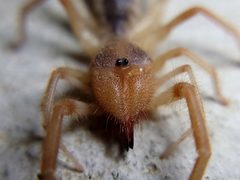
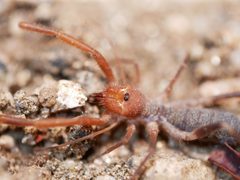
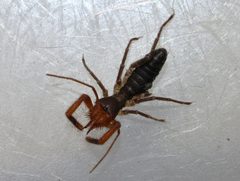
Eremobatidae can be distinguished from the other North American solifuge , Ammotrechidae, by their straighter, less curved and different arrangement. Eremobatids typically have a more robust cheliceral structure compared to ammotrechids. The family is to North America, which helps separate it from other solifuge families found elsewhere. Within the family, are distinguished by cheliceral , tarsal segmentation, and other subtle morphological features. identification requires examination of genitalia and detailed cheliceral .
Images
Appearance
Members of Eremobatidae possess large, powerful (jaws) that can comprise nearly one-third of body length in some . The chelicerae consist of a fixed upper portion and an articulated lower joint, functioning like pliers or nutcrackers. They have eight legs, but run using only six legs with the first pair held forward as sensory appendages. The are long, stout, and tipped with suctorial organs for climbing vertical surfaces and pinning prey. Body covered in fine hairs for insulation against desert heat, with longer setae serving as touch sensors. Malleoli (racket organs) on the underside of hind legs function as . North American species rarely exceed one inch in body length. are relatively small compared to other solifuge .
Habitat
Arid and semi-arid environments including deserts, scrublands, and dry grasslands. Found in sandy soils, rocky areas, and under debris such as boards, flat stones, and cow patties. Some excavate burrows to escape daytime heat. Often associated with juniper-oak-pinyon woodlands, sand dune , and alkaline flats. species frequently found around outdoor lights where they prey on fallen insects.
Distribution
to North America. Distributed across western North America from the southwestern United States (California, Arizona, New Mexico, Texas) through the Great Basin and into the Great Plains, extending south into Central America. Center of diversity in the Chihuahuan Desert with east-to-west diversification pattern. in the Eremocosta show post-glacial range expansion into the Mojave Desert.
Seasonality
Most are and active during warmer months. Activity peaks during summer nights when temperatures remain elevated. Some species active by day (hence 'sun spider' ), but majority are strictly nocturnal. Can be found year-round in suitable , with most commonly encountered during spring through fall.
Diet
feeding on a wide variety of arthropods. Documented prey includes , spiders, orthopterans (grasshoppers, crickets), lepidopterans (), and coleopterans (beetles). Smaller, soft-bodied prey items appear preferred when available. Juveniles and hunt actively, using to capture and subdue prey through mechanical force rather than venom.
Life Cycle
Solitary existence with brief mating encounters. Females dig nest burrows in soil for deposition. Mating involves complex courtship with male tapping displays, female acceptance postures, and sperm transfer via male cheliceral . Post-copulatory mate guarding by males documented in some to reduce sexual risk. Development includes egg, post-embryonic stages, and . Lifespan appears dedicated to finding mates and .
Behavior
Exceptionally fast runners, capable of sprinting at approximately 53 cm/second for short bursts. Highly agile, able to change direction rapidly while running. foraging with some activity. Uses and first pair of legs as sensory appendages, waving constantly to detect prey and obstacles. Malleoli on hind legs used to detect chemical cues from substrate and locate subterranean prey. When cornered, may rear up and wave appendages menacingly while opening jaws. Courtship involves male grasping female mid-body, massaging with jaws, and stroking with pedipalps. Some exhibit 'attack phase' during courtship that resembles cannibalistic .
Ecological Role
controlling of soil-dwelling arthropods, particularly and other insects. Serve as prey for larger arthropods, reptiles, and birds. Contribute to nutrient cycling through consumption and fragmentation of prey. In desert , they are significant components of and .
Human Relevance
Generally harmless to humans despite fearsome appearance; non-venomous and bites require provocation. Occasionally enter human dwellings, particularly around outdoor lights. Subject of extensive urban legends and misinformation, particularly regarding size, speed, and danger to humans and livestock. Popularly known as 'camel spiders' due to Persian Gulf military encounters, though this name applies broadly to Solifugae. Not recommended as pets due to frenetic lifestyle and specialized needs.
Similar Taxa
- AmmotrechidaeOther North American solifuge ; distinguished by more curved and different
- SolpugidaeOld World of solifuges; not found in North America
Misconceptions
Contrary to popular belief, Eremobatidae do not reach dinner-plate size (North American species rarely exceed one inch), do not run at 25 mph (actual sprint speed approximately 53 cm/second), do not scream while running (they are silent), do not eat camel stomachs or sleeping soldiers' , and are not venomous. These myths originated from Persian Gulf military encounters and viral internet images. The is strictly to North America and cannot be found in the Middle East.
More Details
Research Significance
Recent genomic studies using SNP data from museum specimens have revealed cryptic and biogeographic patterns of post-glacial range expansion, demonstrating the value of collections-based research for difficult-to-collect organisms.
Taxonomic History
established by Kraepelin in 1901. Currently contains eight accepted : Chanbria, Eremobates, Eremochelis, Eremocosta, Eremorhax, Eremothera, Hemerotrecha, and Horribates.
Sources and further reading
- BugGuide
- Wikipedia
- GBIF taxonomy match
- iNaturalist taxon
- NCBI Taxonomy
- Catalogue of Life
- Insect FAQs | Entomology Research Museum
- Bug Eric: Desert Demon, the Solifuge
- Bug Eric: August 2010
- Mantispidae | Beetles In The Bush
- July | 2024 | Beetles In The Bush
- Observations on hunting behavior of juvenile Chanbria (Solifugae: Eremobatidae)
- Mating behaviour of Eremobates pallipes (Say, 1823) (Arachnida: Solifugae: Eremobatidae)
- Diet and Feeding Behavior of the Solpugid, EremobatesPalpisetulosus (Solpugida: Eremobatidae)
- Historical biogeography and the evolution of habitat preference in the North American camel spider family, Eremobatidae (Arachnida:Solifugae)
- Diversification and post-glacial range expansion of giant North American camel spiders in genus Eremocosta (Solifugae: Eremobatidae)