
Eremobatinae
Kraepelin, 1901
Eremobatine solifuges, Eremobatine sun spiders
Genus Guides
5- Eremobates(sun spiders)
- Eremocosta
- Eremorhax(camel spiders)
- Eremothera
- Horribates
Eremobatinae is a of solifuges (sun spiders or camel spiders) within the Eremobatidae, first described by Kraepelin in 1901. Members of this subfamily are primarily found in arid and semi-arid regions of North America, with the highest diversity in the southwestern United States and Mexico. They are characterized by specific morphological features of the and that distinguish them from the other eremobatid subfamily, Therobatinae. The subfamily includes numerous and represents one of the most -rich lineages of solifuges in the New World.
Pronunciation
How to pronounce Eremobatinae: /ˌɛrɛmoʊˈbætɪnaɪ/
These audio files are automatically generated. While they are not always 100% accurate, they are a good starting point.
Identification
Distinguished from Therobatinae (the other eremobatid ) primarily by male cheliceral and structure. Eremobatinae males typically have flagella with specific branching patterns or forms that differ from the simpler or differently structured flagella of Therobatinae. The arrangement of spines on the pedipalp and the structure of the malleoli (racquet organs) on the surface of the hind legs provide additional diagnostic characters. Identification to and requires examination of these structures under magnification.
Images
Appearance
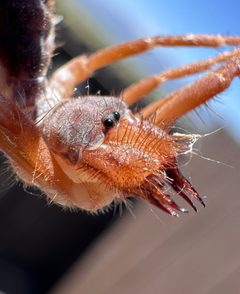
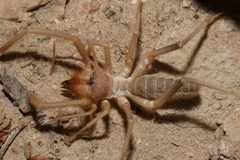
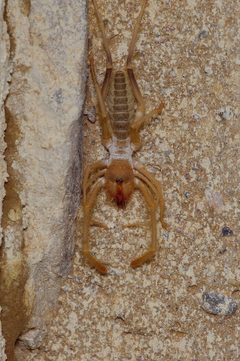
Eremobatinae solifuges possess the general solifuge body plan: a compact, flattened , large forward-projecting , and a segmented . Distinctive features include with a specific arrangement of spines and setae, and particular configurations of the cheliceral . The of the male chelicera, a diagnostic structure for solifuge , exhibits forms characteristic of this . Body size varies considerably among , with some reaching substantial lengths. Coloration generally ranges from pale yellow to dark brown, often matching substrate tones of their desert .
Habitat
Predominantly occupies arid and semi-arid environments including deserts, scrublands, and dry grasslands. Found in rocky areas, sandy soils, and under surface debris. Many are or utilize existing burrows and crevices for shelter from extreme temperatures and desiccation.
Distribution
Primarily North American, with the greatest diversity in the southwestern United States (Arizona, New Mexico, Texas, California, Nevada, Utah) and Mexico. The extends northward into the Great Basin and southern Canada, and southward through the Mexican plateau and Baja California. Some have more restricted ranges associated with specific desert systems.
Seasonality
Activity patterns vary by and locality. Most active during warmer months, with peak surface activity in spring and summer in temperate regions. Some species exhibit or activity patterns to avoid extreme daytime temperatures. In subtropical areas, activity may extend across more of the year.
Behavior
Fast-moving, active that chase down prey rather than constructing webs or using ambush tactics. Capable of rapid bursts of speed across hot substrates. Seek shelter during extreme heat or cold, often occupying temporary retreats under rocks or in soil crevices. Males engage in complex courtship involving cheliceral contact with females.
Ecological Role
in of arid . Contribute to of smaller arthropods including insects, other arachnids, and potentially small vertebrates. Serve as prey for larger arthropods, reptiles, birds, and small mammals.
Human Relevance
Occasionally encountered by humans in desert regions, sometimes generating alarm due to their size, speed, and formidable appearance. Bites can be painful but are not medically significant; they lack venom. Misidentification as venomous "camel spiders" or confusion with other arachnids occurs frequently. Of interest to arachnologists and desert ecologists.
Similar Taxa
- TherobatinaeThe other within Eremobatidae; distinguished by differences in male cheliceral structure and . Therobatinae often occupy similar but tend to have different geographic distributions and morphological details.
- AmmotrechidaeAnother of New World solifuges; distinguished by differences in tarsal segmentation, malleolus structure, and cheliceral . Ammotrechidae often have more elongated bodies and different preferences.
Misconceptions
Frequently misidentified as highly venomous "camel spiders" capable of killing humans or camels—this is false; solifuges lack venom glands entirely. Their speed and aggressive defensive when cornered contribute to exaggerated fears. They do not feed on the stomachs of sleeping camels or disembowel large prey.
More Details
Taxonomic history
The has undergone significant revision, with many originally described in broad now split into more narrowly defined genera based on and characters. The work of Jack O. Brookhart and Paula Cushing has substantially clarified relationships within the group.
Research significance
Eremobatinae represents an important model system for studying arachnid evolution in arid environments, with extensive work on boundaries, hybridization, and the function of sexually selected structures like the cheliceral .