
Hesperotettix viridis
(Thomas, 1872)
snakeweed grasshopper, meadow purple-striped grasshopper, green-streak grasshopper
Species Guides
4- Hesperotettix viridis brevipennis
- Hesperotettix viridis nevadensis
- Hesperotettix viridis pratensis(Purple-striped Grasshopper)
- Hesperotettix viridis viridis(Snakeweed Grasshopper)
Hesperotettix viridis is a medium-sized, spur-throated grasshopper in the Acrididae, native to North America. It is an oligophagous specialized on composite plants (Asteraceae), particularly snakeweeds (Gutierrezia spp.), goldenrods (Solidago spp.), and rabbitbrushes. show -associated genetic differentiation, with distinct lineages adapted to different host plants. The species has been investigated as a potential agent for snakeweeds. Four are recognized, varying in wing length and geographic distribution.
Pronunciation
How to pronounce Hesperotettix viridis: /hɛˌspɛɹoʊˈtɛtɪks ˈvɪrɪdɪs/
These audio files are automatically generated. While they are not always 100% accurate, they are a good starting point.
Identification
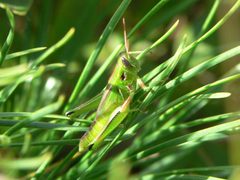
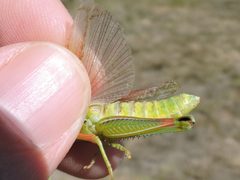
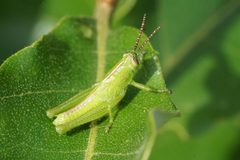
Distinguished from the similar Hypochlora alba (cudweed grasshopper) by: medium green vs. pale green coloration; black with pale annuli vs. green antennae; hind medium green with black spots/chevrons vs. pale green with brown spots. Distinguished from other Hesperotettix by plant association and male genitalia structure. Nymphs identifiable by green body with fuscous spots, cream carina on pronotum, and color pattern of antennae and hind legs.
Images
Habitat
Grasslands, sagebrush shrub associations, and abandoned fields where plants occur. Distribution is patchy and closely tied to presence of specific host plants, particularly snakeweeds (Gutierrezia), goldenrods (Solidago), and rabbitbrushes. In the West, often found in mixedgrass prairie and sagebrush steppe; in the East, less common and more restricted to suitable host plant patches. Elevation range from lowlands to at least 7,600 feet resident , with individuals occasionally found up to 11,500 feet.
Distribution
North America; widespread in western United States and Canada, patchier in eastern portions. Documented in 11 U.S. states and 3 Canadian provinces. Specific records from Wyoming, Colorado, New Mexico, Kansas, Nebraska, North Dakota, South Dakota, Montana, Arkansas, Illinois, Indiana, and northeastern Mexico. Distribution limited by plant availability, creating discontinuous .
Seasonality
hatch in intermediate period, two to three weeks after early-hatching like Ageneotettix deorum. Hatching mid-June in northern mixedgrass prairie (Wyoming), six weeks earlier in New Mexico. Nymphal development approximately 55 days (44-46 days in some Colorado ). present from late July through early October. One annually; eggs overwinter in soil in embryonic (stage 19).
Diet
Oligophagous feeder specializing on Asteraceae forbs, particularly snakeweeds (Gutierrezia sarothrae, G. microcephala), threadleaf snakeweed, goldenrods (Solidago mollis), rabbitbrushes (Ericameria, Chrysothamnus), and other composites. Documented to feed on at least 34 forb across its range. Prefers snakeweeds to rabbitbrush and burroweed based on food preference tests. Consumes leaves, stem cortex, and flower buds. Feeds in short bouts of less than three minutes, primarily during daylight hours. Also ingests trace amounts of grasses, flower petals, pollen, fungi, and arthropods.
Host Associations
- Gutierrezia sarothrae - primary broom snakeweed
- Gutierrezia microcephala - primary threadleaf snakeweed; study in New Mexico fed almost exclusively on this
- Solidago mollis - primary velvet goldenrod; -associated genetic lineage documented
- Ericameria nauseosus - secondary rabbitbrush
- Chrysothamnus viscidiflorus - secondary rabbitbrush
- Artemisia ludoviciana - secondary western ragweed, eaten in lesser amounts
Life Cycle
(hemimetabolous). laid in soil at approximately 1 inch depth, enclosed in tough-walled pod 5/8 to 3/4 inch long containing 8-12 tan eggs (4.3-4.9 mm long). Eggs enter at embryonic stage 19 and overwinter. Hatching begins mid-June in northern , earlier in southern locations. Five nymphal instars required to reach adulthood; nymphal period averages 55 days in field (longer than ground-dwelling grasshoppers due to cooler temperatures in elevated perches). emerge in late July to August and persist until October. One per year.
Behavior
Phytophilous spending most of active life on plants. Roosts -up on stems during night. After sunrise, basks by turning side perpendicular to sun rays while maintaining vertical position on plant; later basks horizontally on ground surface with hindleg lowered. Feeds in short bouts, continuously sampling different plants; tenure on individual plants typically less than one day. Abandons plants more quickly when growing in dense stands and when plants have prior feeding damage; remains longer on protected, high-quality plants. When disturbed, jumps 2-8 inches between stems or up to 2 feet to ground, then immediately returns to host plant. Does not drop to ground to evade . At high temperatures (>100°F), moves to shady side of plant stem. Mating observed in early morning (6:46-9:25 a.m.); oviposition at base of host plant in bare ground or shortgrass clumps, with female holding upright plant and working ovipositor into soil over 75+ minutes.
Ecological Role
herbivore that can significantly impact plant . Feeding reduces shoot water content, nitrogen content, and edible of host plants over the growing season. In New Mexico, high densities cause substantial mortality of snakeweed seedlings and one-year-old plants; older plants tolerate damage better but may die prematurely with heavy defoliation. Acts as natural agent of snakeweeds, which are competitive, low-forage-value plants that can poison livestock. Equalizes cumulative feeding damage across host plant population through selective foraging on less-damaged plants. Provides food source for ; specific not documented in sources.
Human Relevance
Investigated as agent for snakeweeds (Gutierrezia spp.), which reduce forage quality, compete with desirable plants for soil moisture, and can cause livestock abortion when ingested. Studies in New Mexico demonstrated feasibility of using this to suppress broom snakeweed . Not considered an agricultural pest; feeds on plants with little or no forage value. No significant negative economic impacts reported.
Similar Taxa
- Hypochlora albaBoth are green, spur-throated grasshoppers found in similar . H. viridis is medium green with black (pale annuli), H. alba is pale green with green antennae. H. viridis has hind medium green with black spots/chevrons; H. alba has hind femur pale green with brown spots. H. alba is monophagous on Artemisia ludoviciana; H. viridis is oligophagous on multiple Asteraceae.
- Hesperotettix speciosusCongeneric spur-throated grasshopper with similar . Distinguished by different plant associations and male genitalia structure.
- Melanoplus speciesOther spur-throated grasshoppers in same . Distinguished by color pattern, wing length, and plant specificity; most Melanoplus are more .
More Details
Genetic differentiation
show significant -associated genetic divergence. AFLP marker studies reveal two distinct host-associated clades with 71% bootstrap support, with host plant accounting for 20% of total genetic variance while locality accounted for 0%. Significant genetic differentiation exists between Solidago-feeders and Gutierrezia-feeders even in sympatry. scan detected host-related divergent selection, with 35% of outlier loci repeatedly associated with host differences in Solidago- vs. Gutierrezia-feeding comparisons. mtDNA shows star-shaped with no host or geographic structure, suggesting recent population expansion from single glacial refugium followed by host-associated divergence.
Subspecies
Four recognized: H. v. viridis (Thomas, 1872) - snakeweed ; H. v. pratensis Scudder, 1897 - purple-striped grasshopper; H. v. brevipennis (Thomas, 1874); H. v. nevadensis - short-winged snakeweed grasshopper. Subspecies vary in wing length and geographic distribution.
Foraging ecology
Mark-recapture studies demonstrate that H. viridis uses information from recent feeding history to assess plant quality. Animals confined on high-quality plants subsequently show different foraging than those on low-quality plants. Chemical deterrents (nicotine sulfate) reduce tenure time, but grasshoppers still prefer protected plants over naturally depleted ones, indicating that gradual food depletion is more important than chemical defenses in foraging decisions.
Sources and further reading
- BugGuide
- Wikipedia
- GBIF taxonomy match
- iNaturalist taxon
- NCBI Taxonomy
- Catalogue of Life
- Snakeweed Grasshopper
- Grasshoppers of Colorado
- Grasshoppers of Colorado
- Cudweed Grasshopper
- Species Records and Accounts
- Grasshoppers of Colorado
- Local Food Depletion and the Foraging Behavior of a Specialist Grasshopper, Hesperotettix Viridis
- Comparative genome scan detects host‐related divergent selection in the grasshopper Hesperotettix viridis
- Host plant‐associated genetic differentiation in the snakeweed grasshopper, Hesperotettix viridis (Orthoptera: Acrididae)
- Performance Tradeoffs for Two Hosts within and between Populations of the Oligophagous Grasshopper Hesperotettix viridis (Acrididae)
- Divergent host plant adaptation drives the evolution of sexual isolation in the grasshopper Hesperotettix viridis (Orthoptera: Acrididae) in the absence of reinforcement