
Hypochlora alba
(Dodge, 1876)
Cudweed Grasshopper, Mugwort Grasshopper, Sage Grasshopper
Hypochlora alba is a short-winged, monophagous in the Acrididae. It is the only known grasshopper capable of surviving on cudweed sagewort (Artemisia ludoviciana), a plant whose pubescent leaves deter other grasshoppers. The species is found in grasslands east of the Rocky Mountains, where its distribution closely tracks that of its plant. It is primarily flightless, with females occasionally producing long-winged forms. The species has been studied as a model for herbivore-plant interactions and phytophilous .
Pronunciation
How to pronounce Hypochlora alba: /haɪpoʊˈklɔrə ˈælbə/
These audio files are automatically generated. While they are not always 100% accurate, they are a good starting point.
Identification
Distinguished from the similar green Hesperotettix viridis by: (1) pale green vs. medium green body color; (2) green with brown spots or suffusions in older instars vs. black antennae with pale annuli; (3) hind pale green with brown spots or medium green vs. medium green with black spots (instars I–II) or black chevrons (instars III–V). The combination of short wings, pale green coloration with brown spotting, and exclusive association with Artemisia ludoviciana confirms identification. Male genitalia distinctive: bulbous at base with finger-like apex.
Images
Appearance
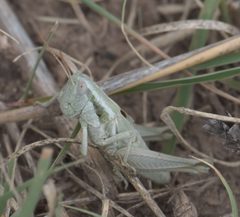
Medium-sized, short-winged grasshopper with pale green coloration that matches its plant. Body covered with many small brown spots visible under magnification. Broad green band runs behind the on the side of the , continuing onto the lateral lobe of the pronotum and sides of the meso- and . Dry, pinned specimens turn dull yellowish-tan. Male broad at base, slender apically; short and slender; subgenital plate bears . Females rarely possess long wings extending 2–3 mm beyond . Nymphs pale green with brown spots; green with pale annuli on segments (blue in first instar); hind pale green and spotted brown or medium green; hind tibia pale green.
Habitat
Grasslands east of the Rocky Mountains, particularly mixedgrass prairie, tallgrass prairie, and sand prairies. Occupancy depends on presence of plant Artemisia ludoviciana, which grows in patches of 10–50 square yards, often in well-watered situations such as sandy loam slopes and ravine bottoms. In Colorado, not found above 6,000 feet elevation despite host plant occurring at higher altitudes.
Distribution
North America east of the Rocky Mountains. Documented in 11 U.S. states and 3 Canadian provinces. GBIF records include Colorado, Nebraska, and South Dakota. Distribution is irregular and patchy, closely tracking but not fully coextensive with plant range; host plant extends farther in all directions and to higher elevations.
Seasonality
Late-developing . Hatching begins approximately one month after Ageneotettix deorum, typically starting May 15 in eastern Kansas, June 1 in southeastern North Dakota and northern Colorado. Hatching continues for approximately one month. Nymphal period lasts 44–46 days. appear from late July through early October, with peak activity in August and September.
Diet
Feeds primarily and almost exclusively on Artemisia ludoviciana (cudweed sagewort, white sagebrush). Trace amounts of other Artemisia documented: A. frigida and A. cana observed in Montana, A. glauca in Kansas. Trace amounts of six grasses and nine forbs found in crop contents from Kansas, Nebraska, and North Dakota, likely incidental ingestion. The only species known to survive on A. ludoviciana; species cannot digest its pubescent leaves efficiently.
Host Associations
- Artemisia ludoviciana - primary Exclusive plant; monophagous specialization
- Artemisia frigida - secondary Observed feeding in Montana
- Artemisia cana - secondary Observed feeding in Montana
- Artemisia glauca - secondary Trace amounts in crop contents, Kansas
Life Cycle
Hemimetabolous development with five nymphal instars for both sexes. laid in soil in interspersed bare areas of grassland; female holds upright plant while ovipositing with hindlegs raised. Egg pod slightly curved, 5/8 to 3/4 inch long, containing 8–12 tan eggs 3.8–4.9 mm long, oriented nearly vertically in soil. Embryonic occurs; eggs overwinter at depth of approximately 1 inch. One annually.
Behavior
Strictly phytophilous: nymphs and spend nearly entire lives on plant. Rests vertically -up on main stems at heights of 8–12 inches before sunrise; occasionally rests horizontally on top leaves. Basks by turning side perpendicular to sun rays and lowering associated hindleg, typically for approximately two hours after sunrise. Feeds on young leaves from edge to midvein, with younger nymphs (instars I–III) gouging tissue from upper, less hairy leaf surfaces, leaving thin areas and holes; older instars and adults feed on leaf edges. When disturbed, jumps 2–8 inches between host plant stems, retaining vertical orientation; occasionally jumps to ground but immediately returns to host. Does not drop to ground to evade (unlike Chorthippus curtipennis). At temperatures above 100°F, moves to shady side of stem while maintaining vertical head-up posture. Limited : daily displacement 0–10 feet, with some individuals remaining on same plant for entire day; one fifth instar observed on same plant for five consecutive days.
Ecological Role
herbivore tightly linked to Artemisia ludoviciana. Serves as model organism for studying monophagy and plant-insect ; uniquely adapted to process pubescent leaves that deter other grasshoppers. indicate stable persistence in plant patches; contributes to forb-feeding guild in tallgrass and mixedgrass prairies. Fourth most abundant in Konza Prairie tallgrass prairie studies (1982–1986), comprising 7% of 8,100 collected grasshoppers and ranking second among forb-feeders.
Human Relevance
Minor economic importance. plant Artemisia ludoviciana has fair to good forage value for sheep and fair for cattle in New Mexico, less value farther north; serves to bind soil and prevent erosion. causes minor visible damage to host plant leaves at typical densities (six per square yard in patches), but does not threaten rangeland productivity. No significant pest status; specialized diet prevents crop damage. Studied for insights into digestive adaptations of herbivores.
Similar Taxa
- Hesperotettix viridisBoth are green, spur-throated, phytophilous grasshoppers. Distinguished by body shade (medium vs. pale green), coloration (black with pale annuli vs. green with brown spots), and hind patterning (black spots/chevrons vs. brown spots).
- Melanoplus lakinusBoth are short-winged Melanoplinae with limited . H. alba distinguished by pale green coloration, exclusive Artemisia association, and geographic restriction east of Rockies; M. lakinus is brown with fuscous and yellow markings, feeds on Chenopodiaceae, and ranges in western North America.
More Details
Sensilla morphology
and mouthparts possess specialized structures documented in morphological studies (Chapman & Chapman, 1982), presumably related to plant detection and handling of pubescent leaves.
Research significance
Cited in comparative studies of movement; Smith & Grodowitz (1987) documented displacement patterns, showing H. alba has shorter daily movement than other short-winged due to faithful occupation of plants.
Sources and further reading
- BugGuide
- Wikipedia
- GBIF taxonomy match
- iNaturalist taxon
- NCBI Taxonomy
- Catalogue of Life
- Cudweed Grasshopper
- Snakeweed Grasshopper
- Grasshoppers of Colorado
- Grasshoppers of Colorado
- Grasshoppers of Colorado
- Lakin Grasshopper
- Morphology and Distribution of Sensilla on the Antennae and Mouthparts of Hypochlora alba (Orthoptera: Acrididae)