
Hypochlora
Brunner von Wattenwyl, 1893
Cudweed Grasshoppers
Species Guides
1- Hypochlora alba(Cudweed Grasshopper)
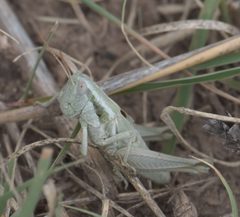
Hypochlora is a of spur-throated grasshoppers in the Acrididae, containing the single described Hypochlora alba. The genus is characterized by specialized association with Artemisia plants, particularly cudweed sagewort (Artemisia ludoviciana). Members exhibit distinctive pale green coloration matching their host vegetation, short-winged flightless , and unique dietary specialization that distinguishes them from related genera.
Pronunciation
How to pronounce Hypochlora: /ˌhaɪpoʊˈklɒrə/
These audio files are automatically generated. While they are not always 100% accurate, they are a good starting point.
Identification
The sole Hypochlora alba is a medium-sized, short-winged, pale green with many small brown spots covering the body. A characteristic broad green band runs behind the on the side of the and continues onto the lateral lobe of the pronotum and the sides of the meso and . Dry, pinned specimens turn dull yellowish tan. The male is broad at the base and slender apically, the is short and slender, and the subgenital plate bears an . Females are typically short-winged but infrequently possess long wings extending 2–3 mm beyond the . Nymphs have pale green heads and with pale annuli on segments, pale green pronotum with carina, and pale green hind tibiae.
Images
Habitat
Grasslands east of the Rocky Mountains, particularly mixedgrass prairie, tallgrass prairie, and sand prairie. Distribution is irregular and closely tied to patches of the plant cudweed sagewort (Artemisia ludoviciana), which grows in sandy loam slopes, ravine bottoms, and well-watered situations. In Colorado, found at elevations up to 6,000 feet but not higher.
Distribution
North American grasslands east of the Rocky Mountains, recorded from 11 U.S. states (including Colorado, Nebraska, South Dakota, Kansas, Wyoming, North Dakota, Montana) and 3 Canadian provinces. Distribution is patchy and correlates with plant availability rather than continuous across the range.
Seasonality
Late-developing . Hatching begins approximately one month after Ageneotettix deorum, starting as early as May 15 in eastern Kansas, June 1 in southeastern North Dakota and northern Colorado. Hatching continues for approximately one month. Nymphal development lasts 44–46 days. present from late July through early October, with observations in Colorado from July 31 to October 4.
Diet
Specialized feeder primarily on young leaves of cudweed sagewort (Artemisia ludoviciana). Also consumes other Artemisia in lesser amounts including A. frigida, A. cana, and A. glauca. Trace amounts of grasses (blue grama, buffalograss, needle-and-thread, western wheatgrass, sand dropseed, prairie sandreed) and forbs (western ragweed, leadplant, common yarrow, wild indigo) have been found in crop contents. The only species known to survive on cudweed sagewort, which has pubescent leaves that interfere with digestion by species.
Life Cycle
laid in soil in interspersed bare areas of grassland. Female drills into soil while holding upright plant, with oviposition taking approximately 75 minutes; egg pod is slightly curved, 5/8 to 3/4 inch long, containing 8–12 tan eggs 3.8–4.9 mm long. Eggs oriented nearly vertically in ground. Five nymphal instars required for both sexes to reach adulthood. Overwinters as eggs in . One annually.
Behavior
Phytophilous spending almost all time on plant. Nymphs and rest vertically -up on main stems of cudweed at heights of 5–12 inches, occasionally on top leaves in horizontal position. Basks after sunrise by turning side perpendicular to sun's rays and lowering hindleg to expose , continuing for approximately two hours before feeding. When disturbed, jumps 2–8 inches between stems retaining vertical orientation; occasionally jumps up to 2 feet to ground but immediately returns to host plant. Does not drop to ground to evade . Moves to shady side of stem when air temperatures exceed 100°F. Limited ability due to short wings; females with long wings observed rarely (six specimens in South Dakota 1924–1931) suggesting occasional capability.
Ecological Role
herbivore tightly linked to Artemisia ludoviciana patches. correlates with plant distribution, reaching six young per square yard in dense cudweed patches versus 0.8 per square yard in general area. Functions as part of forb-feeding in prairie . Host plant has fair to good forage value for sheep and fair for cattle in New Mexico, with soil-binding and erosion prevention functions in northern states.
Human Relevance
Minor economic impact. At densities of six young per square yard causes visible but minor damage to cudweed sagewort, consuming leaf sections from edge to midvein. Not considered a significant agricultural pest. plant has mixed forage value for livestock and ecological value for soil stabilization. Potential for prairie health due to specialized host association.
Similar Taxa
- Hesperotettix viridisBoth are spur-throated grasshoppers with green coloration. H. viridis is medium green versus pale green in Hypochlora alba; has black with pale annuli versus green antennae in H. alba; and has hind medium green with black spots or chevrons versus pale green with brown spots in H. alba.
Sources and further reading
- BugGuide
- Wikipedia
- GBIF taxonomy match
- iNaturalist taxon
- NCBI Taxonomy
- Catalogue of Life
- Cudweed Grasshopper
- Snakeweed Grasshopper
- Grasshoppers of Colorado
- Grasshoppers of Colorado
- Grasshoppers of Colorado
- Grasshoppers of Colorado
- A high-quality draft genome assembly of the Neotropical butterfly, Batesia hypochlora (Nymphalidae: Biblidinae)
- Morphology and Distribution of Sensilla on the Antennae and Mouthparts of Hypochlora alba (Orthoptera: Acrididae)
- A high-quality draft genome assembly of the Neotropical butterfly, Batesia hypochlora (Nymphalidae: Biblidinae)