
Hesperotettix viridis brevipennis
(Thomas, 1874)
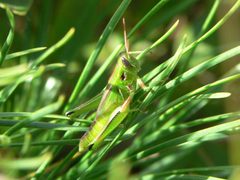
Hesperotettix viridis brevipennis is a of the snakeweed grasshopper, a medium-sized, green, spurthroated in the Acrididae. As a subspecies of H. viridis, it shares the ' general as an oligophagous forb-feeder specializing on composite plants, particularly snakeweeds (Gutierrezia spp.) and related shrubs. The subspecific epithet "brevipennis" refers to its short-winged condition, distinguishing it from other of H. viridis. It occurs in the northwestern United States and extends into the Midwest and northeastern Mexico.
Pronunciation
How to pronounce Hesperotettix viridis brevipennis: //ˌhɛspɛroʊˈtɛtɪks ˈvɪrɪdɪs ˌbrɛvɪˈpɛnɪs//
These audio files are automatically generated. While they are not always 100% accurate, they are a good starting point.
Identification
Distinguished from other H. viridis by short wings that do not reach the end of the (females) or only slightly exceed it (males), versus long wings in the nominate . The subspecific name "brevipennis" (short-winged) directly indicates this diagnostic trait. Otherwise shares characteristics: medium green body, light line from occiput onto pronotal disk, pink and green fore and mid , green hind femora with cream and fuscous chevrons and pink annulus, light blue hind tibiae. Male subgenital plate has large truncated preapical .
Images
Habitat
Inhabits grasslands, sagebrush and other shrub associations, and abandoned fields where plants occur. Distribution is patchy and tied to presence of composite shrubs, particularly snakeweeds (Gutierrezia spp.) and rabbitbrush (Chrysothamnus/Ericameria spp.).
Distribution
Northwestern United States; also recorded from Arkansas, Illinois, Indiana, and northeastern Mexico. Distribution is discontinuous and follows plant occurrence.
Seasonality
Hatching occurs in intermediate period, approximately two to three weeks after early-hatching ; in northern mixedgrass prairie, hatching mid-June. Nymphal development approximately 55 days. present from late July through September, with reproductive activity continuing until early September in northern .
Diet
Feeds primarily on composite forbs, especially snakeweeds (Gutierrezia spp.) including broom snakeweed and threadleaf snakeweed. Also consumes rabbitbrush (Chrysothamnus/Ericameria spp.), western ragweed (Ambrosia psilostachya), Missouri goldenrod (Solidago missouriensis), and other Asteraceae. Trace amounts of grasses, flower petals, pollen, fungi, and arthropods occasionally ingested.
Host Associations
- Gutierrezia sarothrae - primary broom snakeweed
- Gutierrezia microcephala - primary threadleaf snakeweed
- Chrysothamnus nauseosus - rabbitbrush; now Ericameria nauseosa
- Ericameria nauseosa - rabbitbrush
- Ambrosia psilostachya - western ragweed
- Solidago missouriensis - Missouri goldenrod
Life Cycle
One annually. laid in soil at approximately 1 inch depth in tough-walled pods containing approximately 10 tan eggs 4.3–4.7 mm long. Embryos develop to stage 19, then and overwinter at this stage. Hatching begins mid-June in northern areas, earlier in southern . Five nymphal instars required to reach adulthood; nymphal period approximately 55 days under field conditions, longer (68–74 days) in laboratory rearing on snakeweed.
Behavior
Phytophilous spending most of active life on plants. Roosts -up on stems during night. After sunrise, basks by turning side perpendicular to sun's rays while maintaining vertical roosting posture. Later morning basking occurs on ground surface in horizontal position with hindleg lowered. Evasive short (2–6 feet), silent, straight, and low (6–9 inches), initiated when temperatures reach approximately 68°F at roosting height. When disturbed, jumps short distances (2–8 inches) between stems, maintaining vertical orientation; occasionally jumps to ground but immediately returns to host plant. Does not drop to ground to evade . Avoids overheating by moving to shady side of plant stem. Evening includes crawling to within 6 inches of host plant, then jumping to roosting position.
Ecological Role
herbivore on low-value rangeland shrubs that compete with forage plants for soil moisture. Feeding on snakeweeds, which are toxic to livestock, may reduce plant and seedling survival. Considered beneficial in rangeland management contexts due to suppression of undesirable shrubs. Serves as prey for various vertebrate and .
Human Relevance
Considered economically beneficial as agent against broom snakeweed, a toxic rangeland weed causing livestock illness and abortion. Research has investigated feasibility of augmenting for snakeweed management. Not a pest of crops or valuable forage.
Similar Taxa
- Hypochlora albaBoth green, spurthroated, medium-sized grasshoppers found in similar . H. alba is pale green with green spotted brown in older instars, and hind pale green spotted brown; H. viridis is medium green with black antennae having pale annuli, and hind femur with black spots or chevrons.
- Hesperotettix viridis viridisNominate has long wings reaching or exceeding tip; brevipennis has distinctly short wings.
- Hesperotettix speciosusCongeneric with similar associations; distinguished by different color pattern and male genitalia structure.