
Prays
Hübner, 1825
Species Guides
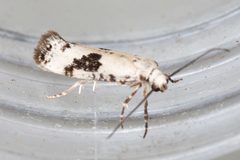
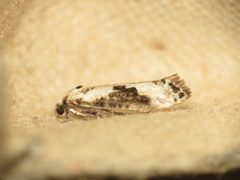
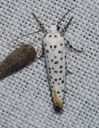
2- Prays atomocella(hop-tree ermine moth)
- Prays fraxinella(Ash Bud Moth)
Prays is a of small in the Praydidae, established by Hübner in 1825. The genus has undergone repeated taxonomic reassignment, previously placed in Plutellidae or Yponomeutidae by various authors. It contains economically significant agricultural pests, particularly specializing on olive and citrus crops. The genus is distributed across the Mediterranean basin, Middle East, and other regions with suitable plants.
Pronunciation
How to pronounce Prays: //ˈpraɪz//
These audio files are automatically generated. While they are not always 100% accurate, they are a good starting point.
Identification
Members of Prays are small that can be distinguished from related by a combination of wing venation and genitalic characters. The genus was historically confused with plutellid and yponomeutid moths due to superficial similarities in size and wing pattern. Accurate identification to level typically requires examination of genitalia or molecular analysis.
Images
Habitat
Olive orchards and citrus groves constitute primary for well-studied . Adjacent natural habitats influence , with landscape complexity affecting abundance and potential.
Distribution
Mediterranean basin, Black Sea region, Middle East, Canary Islands, and parts of Europe (records from Denmark, Norway, Sweden). Specific distribution varies by : P. oleae occurs across olive-growing regions of the Mediterranean and Middle East; P. citri is associated with citrus-growing areas.
Diet
within Prays are monophagous or oligophagous . P. oleae feeds exclusively on Olea europaea (olive). P. citri feeds on Citrus spp., especially lemon (C. limon) and lime (C. aurantifolia).
Host Associations
- Olea europaea - food plantexclusive of P. oleae
- Citrus limon - food plantprimary of P. citri
- Citrus aurantifolia - food plantprimary of P. citri
Life Cycle
P. oleae completes three with distinct feeding habits: phyllophagous generation (autumn-spring, leaf-mining), anthophagous generation (spring, flower-feeding), and carpophagous generation (summer, fruit- and seed-feeding). Larval development duration varies with temperature, ranging from approximately 65-68 days at 15°C to 27-28 days at 35°C. Development does not complete at 35°C.
Behavior
Larvae exhibit cannibalistic tendencies when reared in groups, requiring individual rearing in laboratory settings. P. oleae larvae display specialized by : leaf-mining in first generation, flower bud consumption (20-30 flowers per larva) in second generation, and fruit penetration in third generation. are and attracted to light sources.
Ecological Role
P. oleae is the second most destructive olive pest worldwide after Bactrocera oleae, causing 50-60% production loss and 40% fruit drop in years. Subject to by predatory insects including Anthocoris nemoralis. P. citri is a documented pest of citrus crops.
Human Relevance
Major agricultural pest of olive and citrus . Target of programs employing agents (Opius concolor, Chrysoperla carnea, Bacillus thuringiensis, Chelonus eleaphilus), toxic traps, and products. Thermal-based management strategies are being developed using -specific temperature thresholds.
Similar Taxa
- Plutella xylostellaFormerly classified in same (Plutellidae); similar small size and wing caused historical taxonomic confusion
- Yponomeuta spp.Previously assigned to Yponomeutidae by some authors; superficially similar in appearance as small white
More Details
Taxonomic History
The has been repeatedly reassigned among : originally Yponomeutidae, then Plutellidae, and currently Praydidae following molecular and morphological revisions. This instability reflects ongoing refinement of lepidopteran .
Thermal Biology
P. oleae exhibits optimal development and at 25-28°C. Lower thermal threshold estimated at 4.3-15°C, optimum at 28-34°C, and upper threshold at 37.8-42.9°C. High temperatures (>30°C) reduce larval mobility and fruit penetration ability; temperatures below 7°C cause mortality.
Sources and further reading
- BugGuide
- Wikipedia
- GBIF taxonomy match
- iNaturalist taxon
- NCBI Taxonomy
- Catalogue of Life
- Ever Seen a Mantidfly? | Bug Squad
- Walda: a Master of Disguise, Stealth and Ambush | Bug Squad
- Prays citri (Millière). [Distribution map].
- Influence of surroundings natural habitats in the olive pest Prays oleae
- Thermal influence on life history traits and population parameters of the olive moth, Prays oleae (Bernard) (Lepidoptera: Praydidae): implications for temperature-based pest management.