
Prays fraxinella
(Bjerkander, 1784)
Ash Bud Moth
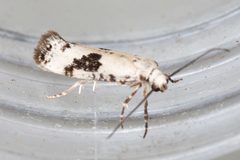
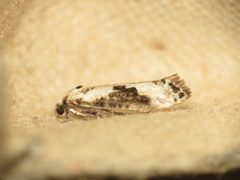
Prays fraxinella, the ash bud , is a European moth in the Praydidae. Larvae are leaf miners that feed on ash tree foliage and buds. The exhibits two color forms: a typical white and black pattern, and a melanic form formerly called f.rustica, which has been reclassified as a separate species, Prays ruficeps. are active in two per year, with periods in late spring and again in mid-summer.
Pronunciation
How to pronounce Prays fraxinella: //ˈpreɪz ˌfræksɪˈnɛlə//
These audio files are automatically generated. While they are not always 100% accurate, they are a good starting point.
Identification
Distinguished from similar small by the combination of ash tree association, the triangular blackish forewing blotch extending along the , and two black spots on the second thoracic segment of larvae. The melanic form with orange has been separated as Prays ruficeps. Smaller than most related plutellid moths; forewing pattern of strigulae and costal blotch is distinctive when present.
Images
Habitat
Associated with ash trees, specifically Fraxinus excelsior and Fraxinus ornus. Larvae mine leaves and buds, and also feed under bark. found in wooded areas and locations where ash trees occur.
Distribution
Europe. Documented presence in Belgium (including Brussels-Capital, Flemish, and Walloon regions, and Antwerp province).
Seasonality
on wing May to June and again in August, with two per year depending on location. laid June and July. Larvae present summer through early spring; pupae found May or June.
Diet
Larvae feed on leaves and buds of Fraxinus excelsior (common ash) and Fraxinus ornus (manna ash). Juveniles are leaf miners; older larvae also mine bark.
Host Associations
- Fraxinus excelsior - larval laid on twigs; larvae mine leaves and buds
- Fraxinus ornus - larval laid on twigs; larvae mine leaves and buds
Life Cycle
laid on ash twigs in June and July. Larvae develop through leaf-mining and bark-mining stages, in bark. occurs in open network cocoons in May or June. Two per year with in late spring and mid-summer.
Behavior
Larvae are miners, feeding internally in leaves and buds rather than externally grazing. are presumably or , as typical for the .
Ecological Role
Herbivore and on ash trees. linked to ash tree health and distribution.
Human Relevance
Minor pest of ash trees; leaf mining and bud feeding may cause aesthetic damage or minor stress to trees. Subject of taxonomic interest due to color and recent splitting.
Similar Taxa
- Prays ruficepsFormerly treated as melanic form f.rustica of P. fraxinella; now recognized as separate based on orange and consistent dark coloration
- Other PraydidaeSmaller size and distinctive forewing pattern with triangular costal blotch help distinguish P. fraxinella from related
More Details
Taxonomic history
Originally described as Tinea fraxinella by Bjerkander in 1784. The melanic form formerly called f.rustica, characterized by orange and dark coloration, has been elevated to rank as Prays ruficeps. placement has varied, with some sources listing Plutellidae; current classification places the in Praydidae.
Larval polymorphism
Larvae exhibit color and shifts during development: yellowish as leaf miners with black and anal plate, becoming greenish with red-brown marbling when fully fed, and whitish during bark-mining phase.