
Praydidae
Moriuti, 1977
false ermine moths
Genus Guides
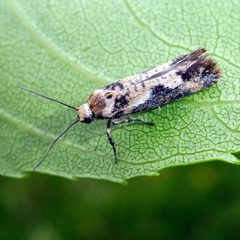
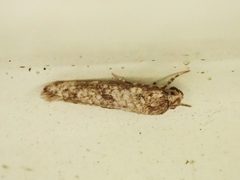
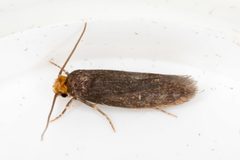
2Praydidae is a of small in the superfamily Yponomeutoidea, elevated from rank in 2013 based on molecular evidence. The family includes the economically significant Prays, notably Prays oleae (olive moth), a major agricultural pest of olive trees. Members are characterized by their association with woody plants and, in some , distinct multivoltine with -specific feeding habits.
Pronunciation
How to pronounce Praydidae: /ˈpraɪdɪˌdiː/
These audio files are automatically generated. While they are not always 100% accurate, they are a good starting point.
Identification
Praydidae can be distinguished from related in Yponomeutoidea by genitalic and molecular characters that supported their elevation to family rank. The family is small and lacks obvious external morphological synapomorphies visible without dissection; identification typically requires examination of genitalia or molecular analysis. Within the family, of Prays are recognized by their association with Oleaceae and, in P. oleae, by the presence of three distinct seasonal with different larval feeding habits.
Images
Habitat
are defined by plant availability. For Prays oleae, this comprises olive orchards and wild olive groves in Mediterranean-type climates. Other occupy temperate and subtropical regions where their host plants (woody shrubs and trees, often in Rosales and related orders) occur. The shows affinity for anthropogenic habitats where cultivated hosts are abundant.
Distribution
Recorded from Europe (Denmark, Norway, Sweden), the Mediterranean basin, Black Sea region, Middle East, and Canary Islands. Distribution is strongly correlated with plant ranges, particularly Olea europaea for Prays oleae. GBIF records indicate presence in northern Europe, though specific host associations and identities in these regions require verification.
Seasonality
In Prays oleae, activity occurs year-round with three overlapping : phyllophagous generation active autumn through spring, anthophagous generation in spring, and carpophagous generation in summer. and larval activity are temperature-dependent, with optimal development at 25–28°C. Activity ceases below 7°C and is reduced above 30°C.
Diet
Larvae feed on leaves, flowers, and fruits of woody plants. Prays oleae is monophagous on Olea europaea (olive), with larvae consuming leaf tissue (phyllophagous ), flower buds (anthophagous generation—one larva destroys 20–30 flowers), and fruit seeds (carpophagous generation). Diet of other praydid is poorly documented but appears restricted to specific woody plants.
Host Associations
- Olea europaea L. - primary plantOlive tree; sole of Prays oleae
- Opius concolor Szépl. - Hymenoptera: Braconidae; agent of Prays oleae
- Chrysoperla carnea (Stephens) - agent of Prays oleae
- Chelonus eleaphilus Silv. - Hymenoptera: Braconidae; of Prays oleae
Life Cycle
Prays oleae exhibits a complex three- cycle: (1) phyllophagous generation— laid on leaves, larvae mine leaves and overwinter within them; (2) anthophagous generation—larvae feed on flower buds during spring bloom; (3) carpophagous generation—larvae penetrate developing fruits and feed on seeds. Egg incubation ranges from 14.1 days at 15°C to 2.6 days at 35°C. Pre- development takes 64.9–68.3 days at 15°C and 27.1–27.8 days at 35°C. patterns in other praydid are not well documented.
Behavior
Prays oleae larvae show reduced mobility and fruit penetration ability above 30°C. are active at temperatures above 10°C, with slowed activity below this threshold. Larvae are solitary; has been observed in laboratory rearing, necessitating individual housing. Adults feed on sugar solutions and oviposit on olive shoots and leaves.
Ecological Role
Prays oleae functions as a major herbivore in olive agroecosystems, causing substantial yield reductions. occur approximately every three years in major production regions, with reported losses of 50–60% of production and 40% fruit drop in severe . The carpophagous is particularly damaging, causing premature fruit drop. The ranks as the second most destructive olive pest globally after the olive fruit fly (Bactrocera oleae).
Human Relevance
Prays oleae is a significant agricultural pest requiring in olive production. Temperature-based models have been developed to predict and optimize control timing. Management strategies include using (Opius concolor, Chelonus eleaphilus) and (Chrysoperla carnea), as well as microbial (Bacillus thuringiensis). Climate warming may expand suitable and alter synchrony with .
Similar Taxa
- Yponomeutidae (ermine moths)Formerly grouped together at level; Praydidae was classified as Praydinae. Distinguished by molecular and genitalic characters; externally similar small with variable patterning.
- LyonetiidaeRelated in Yponomeutoidea with leaf-mining larvae; distinguished by molecular and morphological characters, though external similarity can be substantial.
More Details
Taxonomic history
Praydidae was established as a by Moriuti in 1977, reduced to Praydinae within Yponomeutidae in later classifications, and restored to family rank in 2013 based on molecular phylogenetic analysis. This elevation has been adopted in major databases (NCBI, Catalogue of Life) but may not be reflected in all regional faunas.
Thermal biology research
Detailed thermal physiology data exist only for Prays oleae. The Brière-2 model provides the best fit for this , with lower thermal threshold 4.3–15°C, optimum 28–34°C, and upper threshold 37.8–42.9°C. These parameters inform pest management timing but require field validation.