
Tinea
Species Guides
12- Tinea apicimaculella(Dark-collared Tinea Moth)
- Tinea carnariella
- Tinea dubiella(Buff Clothes Moth)
- Tinea irrepta
- Tinea mandarinella(Mandarin Tinea Moth)
- Tinea niveocapitella
- Tinea occidentella(Western Clothes Moth)
- Tinea pallescentella(Large Pale Clothes Moth)
- Tinea pellionella(case-bearing clothes moth)
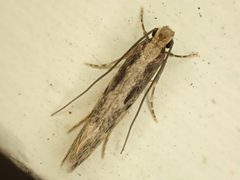
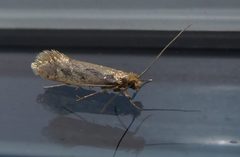
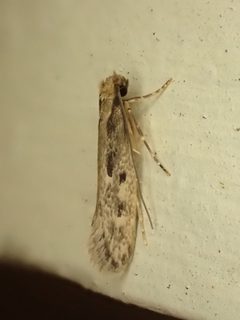
Tinea is a of fungus moths in the Tineidae, established as one of the earliest subgroups of . It is the type genus of both its family and . Historically, the genus encompassed many now placed in other genera. Species within Tinea include economically significant pests such as the casemaking clothes moth (Tinea pellionella).
Pronunciation
How to pronounce Tinea: /ˈtɪniə/
These audio files are automatically generated. While they are not always 100% accurate, they are a good starting point.
Identification
Distinguished from other Tineidae by genitalia and larval case construction . Larvae of Tinea pellionella construct portable silk tubes incorporating food debris and , carried throughout development. are small, relatively nondescript with narrow wings.
Images
Habitat
; primarily associated with human dwellings and stored products. Rarely found in natural outdoor environments. Larvae inhabit woolens, furs, feathers, and other keratinaceous materials.
Distribution
distribution due to human transport. Present across North America, Europe, Africa, Asia, Australia, and other regions. Tinea pellionella specifically has been documented from Canada to Chile, Nigeria to South Korea.
Diet
Larvae are keratinophagous, feeding on hair, wool, feathers, fur, and other materials containing keratin. Some are facultative keratinophages, able to subsist on fungi and organic detritus when keratin is unavailable.
Life Cycle
Complete : , larva, pupa, . Eggs approximately 0.3 mm diameter. Larvae spin silk and construct protective cases or cocoons incorporating substrate material. occurs within these structures. Adults are non-feeding, lack functional mouthparts, and live only a few weeks for .
Behavior
are light-averse and poor fliers, preferring to move by scurching. Larvae produce pheromonal signals that attract conspecifics to suitable feeding sites. Can metabolize water as a byproduct of keratin digestion, reducing dependence on environmental moisture. Exhibits extreme temperature , surviving temperatures from 5°F to 95°F.
Ecological Role
Decomposer of keratinaceous materials in human environments. Rarely encountered in natural due to specialization.
Human Relevance
Major economic pest of stored woolens, furs, carpets, and museum specimens. Tinea pellionella and related cause significant damage to textiles and natural history collections. Global pest control costs and material damage estimated in the billions of dollars annually.
Similar Taxa
- TineolaTineola bisselliella (webbing clothes moth) lacks the portable larval case characteristic of Tinea; larvae spin silken webs rather than carrying a constructed tube.
- NiditineaLarval case construction differs in materials and architecture; distinguished by genital .