
Tinea apicimaculella
Chambers, 1875
Dark-collared Tinea Moth
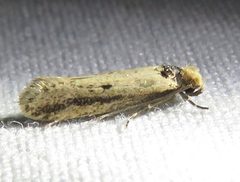
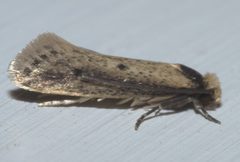
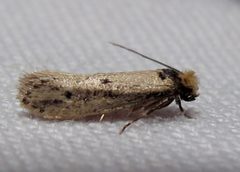
Tinea apicimaculella is a of clothes moth in the Tineidae, known as the Dark-collared Tinea . It occurs across eastern and central North America, with records from Ontario south to Alabama and west to Oklahoma and Minnesota. Like other tineids, it belongs to an ancient lineage of moths with specialized larval , though specific details for this species remain poorly documented.
Pronunciation
How to pronounce Tinea apicimaculella: //ˈtɪniə ˌæpɪsɪˌmækjʊˈlɛlə//
These audio files are automatically generated. While they are not always 100% accurate, they are a good starting point.
Identification
The "Dark-collared Tinea " suggests a dark marking at the neck region that may aid in distinguishing this from . As a member of Tinea, it likely shares the general of the : small moths with narrow, elongate wings and relatively plain coloration. Definitive identification presumably requires examination of genitalia or other microscopic features, as is typical for tineid species.
Images
Distribution
Eastern and central North America. Documented from Ontario, Canada and the United States: Alabama, Illinois, Maryland, Massachusetts, Minnesota, North Carolina, Oklahoma, Tennessee, and Virginia. Additional records from Kentucky.
Similar Taxa
- Tinea pellionellaThe casemaking clothes moth is a congeneric pest with overlapping distribution; differs in larval of constructing portable silk cases and is more strongly associated with human dwellings and stored products.
- Tineola bisselliellaThe webbing clothes moth is a related tineid pest with similar overall appearance; differs in forming silk webbing rather than portable cases, and has a more distribution linked to human commerce.
More Details
Taxonomic Note
The specific epithet 'apicimaculella' combines Latin elements suggesting a small spot (maculella) at the apex (apici), possibly referring to a wing marking. The was described by American entomologist Victor T. Chambers in 1875.
Data Limitations
Despite 2,367 iNaturalist observations, published biological information for this appears sparse. Most detailed accounts of tineid pertain to the economically important species Tineola bisselliella and Tinea pellionella, and direct extrapolation to T. apicimaculella is unwarranted without confirmation.