
Tineola bisselliella
(Hummel, 1823)
webbing clothes moth, common clothes moth, clothing moth
Tineola bisselliella is a small in the Tineidae, notable as a significant pest of stored wool and natural fibers. are 6–7 mm in body length with a 9–16 mm wingspan, characterized by pale yellowish-ochreous forewings and a distinctive red-orange tuft of hair on the . The is , now rarely found outside human dwellings. Larvae possess the unusual ability to digest keratin, enabling them to feed on wool, silk, fur, and other animal-derived materials. Adults do not feed and have atrophied mouthparts; all damage is caused by larval feeding.
Pronunciation
How to pronounce Tineola bisselliella: /tɪˈniːoʊlə bɪˌsɛliˈɛlə/
These audio files are automatically generated. While they are not always 100% accurate, they are a good starting point.
Identification
Distinguished from similar Tineidae by its yellow-brown or ochreous coloration and the red-orange tuft of hair on the . Differs from the casemaking clothes moth (Tinea pellionella) by lacking the dark spots on forewings typical of that and by larval : T. bisselliella larvae spin silk mats under which to feed, while T. pellionella larvae construct portable silk cases. are light-averse, unlike many other species that are attracted to light.
Images
Appearance
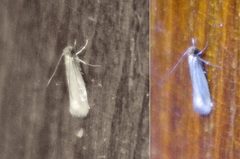
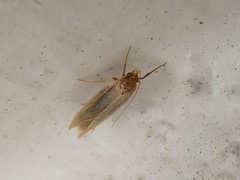
Small with body length 6–7 mm and wingspan 9–16 mm (most commonly 12–14 mm). light ferruginous ochreous, sometimes brownish-tinged, with a distinctive red-orange tuft of hair. thread-like, about four-fifths the length of the forewings. Forewings pale yellowish-ochreous with fuscous base of . Hindwings ochreous grey-whitish. Larva white, eventually almost transparent, with a brown head, living in a silk tube.
Habitat
Strictly ; almost exclusively found indoors in human dwellings, museums, wool stores, and other buildings containing stored natural fibers. Rarely occurs outdoors. Prefers dim or dark areas with low disturbance. In wool stores, larvae occur in surface layers of compressed wool or loose wool protruding through packaging. Favors areas where fibrous debris accumulates, such as under furniture, carpet edges, and along baseboards.
Distribution
Native to the western Palearctic, now due to human transport. Established in North America, Australia, and numerous other regions worldwide. Outdoor trapping in Berlin demonstrated seasonal abundance in urban areas with absence in surrounding countryside, supporting rather than natural occurrence. Presence in some European countries (France, Greece, Slovenia, Switzerland) unrecorded likely due to data gaps rather than true absence.
Seasonality
Seasonal in the wild, but year-round activity in heated buildings. In wool stores, activity peaks around dusk with greatest activity 3 hours after sunset; peak occurs earlier on cool evenings. Two to three per year typical, though can complete in one month under optimal conditions (24°C, 70–75% relative humidity) or extend to several years under unfavorable conditions.
Diet
Larvae feed on keratin-containing materials: wool, silk, fur, feathers, hair, and other animal-derived fibers. Also consume stored foods including grains, flour, semolina, bran, and biscuits. Can digest synthetic and cotton fibers if blended with wool, though these provide no nutrition. do not feed; they possess atrophied mouthparts and obtain all nutrition during the larval stage.
Life Cycle
Females lay in clusters of 30–200, adhering to surfaces with gelatinous glue. Eggs hatch in 4–10 days. Larvae pass through 5–45 instars over 1 month to 2 years depending on conditions, feeding under silk mats and partially emerging at night to acquire food. occurs in silk cocoons incorporating substrate fragments; pupal stage lasts 10–50 days. live 15–30 days, with females mating multiple times (up to 11 matings observed). from egg to egg typically 4–6 months with two per year, though highly variable.
Behavior
prefer scuttling across surfaces to flying; some individuals never fly. Both adults and larvae are strongly photophobic, seeking darkened areas. Larvae spin silk tubes or mats under which they feed, emerging partially at night to forage. Adults are attracted to potential larval such as furs and old rugs. Females exhibit with multiple matings, including repeated matings with the same male. Larvae can metabolize water as a byproduct of keratin digestion, eliminating the need for liquid water.
Ecological Role
Keratinophagous decomposer in human-modified environments. Functions as a pest in stored product . Serves as for including Trichogramma evanescens ( parasitoid) and Apanteles carpatus (larval parasitoid). Prey for spiders including Uloborus geniculatus, which can significantly suppress .
Human Relevance
Major worldwide pest of woollen products, causing up to $1 billion in damage in the United States alone. Infests clothing, carpets, upholstery, museum specimens, and stored food products. Subject to extensive control efforts including anoxic treatments, freezing, heat treatment, traps, , and using . Resistance to many control methods and ability to survive extreme conditions make difficult. Mentioned in the Bible as a destroyer of materials.
Similar Taxa
- Tinea pellionella (casemaking clothes moth)Similar size and , but T. pellionella has dark spots on forewings and larvae construct portable silk cases rather than feeding under stationary silk mats.
- Tinea translucens (large pale clothes moth)Larger size and different wing pattern; less common pest .
- Monopis spp.Related Tineidae with similar habits but distinct wing patterns and coloration.
Misconceptions
are frequently blamed for damage to clothing, but adults do not feed and possess non-functional mouthparts. All damage is caused by larval feeding. The ' "webbing " refers to larval silk production, not adult web-spinning .
More Details
Physiological specializations
Larvae can digest keratin, a protein to most enzymatic breakdown; mechanism possibly involves gut microbes. Can metabolize water from keratin digestion, surviving without liquid water. Tolerates temperatures from 5°F to 95°F and can digest toxic metals including arsenic, mercury, and lead. Can chew through soft plastics to access food sources.
Evolutionary history
Belongs to ancient fungus Tineidae that predates more recognizable moth families. Likely originated in Africa and expanded globally via 19th-century sailing ships. Associated with human ancestors since before Homo sapiens, possibly following primates using nesting materials. Now obligately , rarely found in natural outdoor .
Sources and further reading
- BugGuide
- Wikipedia
- GBIF taxonomy match
- iNaturalist taxon
- NCBI Taxonomy
- Catalogue of Life
- webbing clothes moth (Tineola bisselliella) adult - Entomology Today
- webbing clothes moth (Tineola bisselliella) adult - Entomology Today
- webbing clothes moth (Tineola bisselliella) larva - Entomology Today
- webbing clothes moth (Tineola bisselliella) larva - Entomology Today
- In Defense of Clothes Moths, Marvels of Evolution
- Tineola bisselliella Archives - Entomology Today
- Biology, behaviour and environmentally sustainable control of Tineola bisselliella (Hummel) (Lepidoptera: Tineidae)
- Studies on the Biology of the Webbing Clothes Moth (Tineola Bisselliella Hum.)
- Reproductive behavior of the webbing clothes moth (Tineola bisselliella): Polyandry and multiple mating with the same male
- Outdoor trapping and genetical characterization of populations of the webbing clothes moth Tineola bisselliella (Lepidoptera: Tineidae) in the broader area of Berlin
- Observations on the ecology of the cloths moths Tineola bisselliella (Humm) and Tinea pellionella L in a bulk wool store.
- Using parasitoid wasps in Integrated Pest Management in museums against biscuit beetle (Stegobium paniceum) and webbing clothes moth (Tineola bisselliella)
- Morphology and distribution of antennal sensilla in the female and male clothes moth, Tineola bisselliella Humm. (Lepidoptera: Tineidae)