
Monopis
Hübner, 1825
fungus moths
Species Guides
7- Monopis crocicapitella(Pale-backed clothes moth)
- Monopis dorsistrigella(skunkback monopi)
- Monopis laevigella(Skin Moth)
- Monopis longella(Pavlovski's Monopis Moth)
- Monopis marginistrigella(White-blotched Monopis Moth)
- Monopis monachella(White-blotched Clothes Moth)
- Monopis spilotella(Orange-headed monopis)
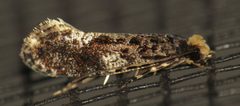
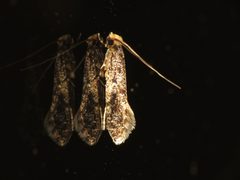
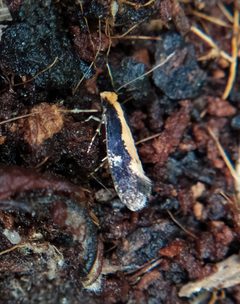
Monopis is a of fungus moths in the Tineidae. Members are characterized by a semi-transparent pale spot near the middle of the forewings, typically with contrasting white markings adjacent to it. The forewings are otherwise generally unpatterned and brown to blackish-grey. Some have specialized associations, including bird and mammal nest remnants.
Pronunciation
How to pronounce Monopis: //məˈnoʊ.pɪs//
These audio files are automatically generated. While they are not always 100% accurate, they are a good starting point.
Identification
Forewings possess a distinctive semi-transparent pale spot near the middle, with contrasting white markings adjacent to this spot. Forewings otherwise unpatterned and colored brown to blackish-grey.
Images
Habitat
Varies by . Some species inhabit nest remnants of birds and mammals; Monopis jussii has been reared from nests of the owl (Aegolius funereus), Ural owl (Strix uralensis), and Great tit (Parus major).
Distribution
Boreo-montane distribution recorded for some ; M. jussii known from northern Europe and the Alps. GBIF records include Denmark, Norway, Sweden, and Vermont (USA).
Host Associations
- Aegolius funereus - owl nest remnants used by M. jussii
- Strix uralensis - Ural owl nest remnants used by M. jussii
- Parus major - Great tit nest remnants used by M. jussii
- Apanteles carpatus - Larval of M. crocicapitella in laboratory rearing
Life Cycle
Larvae of some develop in nest remnants.
Similar Taxa
- M. laevigellaM. jussii closely related and morphologically similar, distinguished by COI barcode sequences, four nuclear loci, and forewing coloration and pattern details
Sources and further reading
- BugGuide
- Wikipedia
- GBIF taxonomy match
- iNaturalist taxon
- NCBI Taxonomy
- Catalogue of Life
- Monopis jussii, a new species (Lepidoptera, Tineidae) inhabiting nests of the Boreal owl (Aegolius funereus)
- Monopis fenestratella (Heyden, 1863) (Lepidoptera, Tineidae) - new records from Poland, with notes on species biology
- A rearing method of the larval parasitoid, Apanteles carpatus (Say) (Hymenoptera: Braconidae) on its new host Monopis crocicapitella (Clemens) (Lepidoptera: Tineidae)
- To the knowledge of the biology and distribution of Monopis crocicapitella (Clemens, 1860) (Lepidoptera: Tineidae), with remarks on cavernicolous Lepidoptera
- The complete mitochondrial genome of Monopis longella Walker, 1863 (Lepidoptera: Tineidae).