
Tinea pellionella
Linnaeus, 1758
case-bearing clothes moth, casemaking clothes moth, fur moth
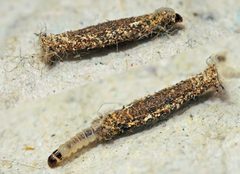
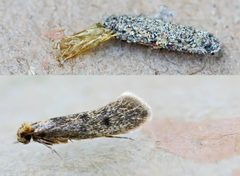
Tinea pellionella is a small tineid commonly known as the case-bearing or casemaking . It is a pest of stored woollen goods and natural keratinous materials. The is distinguished by larval : caterpillars construct portable silken cases reinforced with debris and food fibers, which they carry while feeding. are weak fliers with reduced mouthparts and do not feed. The species has become less common in modern centrally heated homes due to drier conditions.
Pronunciation
How to pronounce Tinea pellionella: /ˈtɪniə ˌpɛliəˈnɛlə/
These audio files are automatically generated. While they are not always 100% accurate, they are a good starting point.
Identification
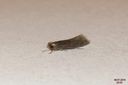
Difficult to distinguish from Tinea columbariella, Tinea dubiella, and Tinea svenssoni based on external alone. Genitalia are diagnostic. Larval cases are distinctive: portable, cylindrical, and composed of silk plus incorporated food fibers—unlike the webbing constructed by Tineola bisselliella larvae. lack the golden sheen of Tineola bisselliella and have more patterned forewings.
Images
Habitat
Primarily indoor environments: dwellings, outbuildings, warehouses, and wool stores. Associated with dark, undisturbed locations. Rarely found outdoors; restricted to temperate and cool Mediterranean climatic zones. In wool storage facilities, larvae occupy loose wool protruding through packaging breaches.
Distribution
distribution, nearly worldwide in temperate regions. Native to Europe; now established across temperate zones globally. Documented from India, Australia, North America, and throughout Europe.
Seasonality
typically encountered during summer and early autumn. In colder buildings, one per year with period April–October. In warmer buildings, multi-brooded with potential year-round activity. peaks in spring and summer in wool storage environments.
Diet
Larvae feed on fibrous keratin: wool, fur, feathers, hair. Also consumes detritus, cobwebs, bird nests (particularly domestic pigeon), stored vegetable produce, and wallpaper. Feeding experiments demonstrate larvae can only develop on foodstuffs of animal origin and metabolize cholesterol rather than phytosterols. Woollen materials impregnated with yeast support enhanced larval development.
Life Cycle
: Incubation 4–7 days depending on temperature (21.5–32.5°C); temperatures above 32.5°C lethal to eggs. Humidity does not affect . Larva: Development influenced by temperature and humidity; shortest development at 25°C and 90% relative humidity. Higher humidities shorten larval development regardless of temperature. Larvae construct and carry portable silken cases. Pupa: occurs within the larval case; pupal period 10.3–18 days depending on temperature (21.5–30°C); humidity has no effect. : Emerges from case; does not feed. Sex ratio approximately 2.6 females:1 male. Three to four per year possible under favorable conditions (26°C, 82% RH, yeast-impregnated wool).
Behavior
Larvae are strongly photophobic, avoiding direct sunlight and confined to dark situations. Damage to materials is significantly greater in continuous darkness than in alternating light and dark conditions. Larvae show no color preference in feeding, though specific dyes (Cloth fast orange G 4%) inhibit growth of newly hatched larvae. fly around dusk, with peak activity in the three hours after sunset; activity increases with temperature. Females rarely fly, typically scurrying by foot. Males are attracted to female .
Ecological Role
Human Relevance
Economic pest of woollen textiles, carpets, furs, upholstery, and natural fiber products. Control measures parallel those for Tineola bisselliella: physical removal, chemical treatment, and . Has become less common in UK homes with widespread central heating, which creates warmer, drier conditions less favorable to development.
Similar Taxa
- Tineola bisselliellaWebbing clothes moth constructs silk webbing rather than portable cases; have more uniform golden-bronze coloration without distinct forewing spotting; larvae do not carry cases.
- Tinea columbariellaExternally similar ; requires genitalia examination for definitive separation.
- Tinea dubiellaExternally similar ; requires genitalia examination for definitive separation.
- Tinea svenssoniExternally similar ; requires genitalia examination for definitive separation.
Misconceptions
The "bagworm" is sometimes applied due to the larval case, but this causes confusion with Psychidae (true bagworm moths), which construct different types of portable cases. Association with bird nests has been suggested but not substantiated in large studies.
More Details
Genome
assembly 245.3 Mb with 30 chromosomal pseudomolecules (29 + Z ) and 25.86 kb mitochondrial genome. Gene annotation identified 13,811 protein-coding genes; 94.9% BUSCO completeness.
Etymology
derived from Latin "tinea" (generic term for micromoths) and "pellionellus" (furrier), referencing association with fur products.
Sources and further reading
- BugGuide
- Wikipedia
- GBIF taxonomy match
- NCBI Taxonomy
- Catalogue of Life
- In Defense of Clothes Moths, Marvels of Evolution
- Tinea pellionella Archives - Entomology Today
- Itty bitty tiny little flies | Beetles In The Bush
- Studies on the Bionomics of the Case-bearing Clothes Moth, Tinea pellionella (L.)
- Observations on the ecology of the cloths moths Tineola bisselliella (Humm) and Tinea pellionella L in a bulk wool store.
- The genome sequence of the Case-bearing Clothes moth, Tinea pellionella (Linnaeus, 1758).