
Prays atomocella
(Dyar, 1902)
hop-tree ermine moth, Hoptree Borer Moth
Prays atomocella is a small in the Praydidae, known from the central and south-central United States. are active from spring through summer, with a single . The is notable for its specialized larval association with Ptelea trifoliata (hop-tree), where larvae feed inside new shoots before pupating in cocoons.
Pronunciation
How to pronounce Prays atomocella: /ˈpreɪz ætəˈmɔkɛlə/
These audio files are automatically generated. While they are not always 100% accurate, they are a good starting point.
Identification
This can be distinguished from other Prays species by its North American distribution and association with Ptelea trifoliata. The small size (18 mm wingspan) and spring-to-summer activity period are consistent features. Accurate identification may require examination of genitalia or molecular methods.
Images
Appearance
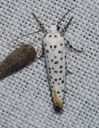
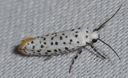
have a wingspan of approximately 18 mm. Specific coloration and pattern details are not well documented in available sources.
Habitat
Associated with supporting Ptelea trifoliata (hop-tree), which occurs in open woodlands, forest edges, and rocky slopes. The larval habitat is specifically the interior of new shoots of this plant.
Distribution
Recorded from Arkansas, Illinois, Indiana, Kentucky, Michigan, New Mexico, Ohio, Tennessee, and Texas in the United States. The range appears centered in the Midwest and south-central regions.
Seasonality
are on wing from April to August. One per year. Larvae occur in early spring.
Diet
Larvae feed internally on tissues of new shoots of Ptelea trifoliata (hop-tree). feeding habits are not documented.
Host Associations
- Ptelea trifoliata - larval Larvae feed inside new shoots
Life Cycle
(one per year). are laid on or near plant. Larvae feed inside new shoots of Ptelea trifoliata in early spring. When fully grown, larvae exit shoots and pupate within cocoons. emerge from April through August.
Behavior
Larvae are shoot-borers, feeding concealed within plant tissue. occurs in a cocoon after the larva leaves the shoot.
Ecological Role
As a herbivore, larvae act as shoot borers on Ptelea trifoliata. Their impact on plant has not been quantified. The occupies a narrow tied to this single host plant.
Human Relevance
No documented economic or agricultural significance. Not known to be a pest of cultivated plants.
Similar Taxa
- Other Prays speciesEuropean and Asian Prays (e.g., P. citri, P. nephelomima) are agricultural pests on citrus and other ; P. atomocella is distinguished by its North American range and association with Ptelea trifoliata rather than citrus or other cultivated plants.
- Other shoot-boring LepidopteraMany contain shoot borers; identification to requires association records and morphological examination, as external appearance of small moths is often nondescript.
More Details
Nomenclature note
The placement has been revised from Plutellidae to Praydidae in modern classifications (e.g., Catalogue of Life, NCBI, GBIF), though some sources still reference the older placement.
Host specificity
The strong specialization on Ptelea trifoliata suggests potential for coevolutionary relationships, though detailed studies are lacking.