
Yponomeuta
Latreille, 1796
Small Ermine Moths
Species Guides
5- Yponomeuta cagnagella(Spindle Ermine)
- Yponomeuta malinellus(Apple Ermine)
- Yponomeuta multipunctella(American Ermine Moth)
- Yponomeuta padella(orchard ermine)
- Yponomeuta plumbella(Black-tipped Ermine)
Yponomeuta is a large of small in the Yponomeutidae, comprising 103 described . Commonly known as Small Ermine Moths, members of this genus are notable for their distinctive defensive : several species emit warning clicks during to signal their unpalatability to bat . Research on Yponomeuta cagnagella has demonstrated rapid evolutionary to urban environments, with exposed to long-term light pollution showing reduced attraction to artificial light sources compared to those from dark areas.
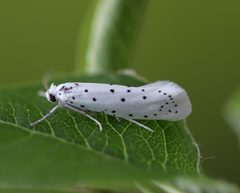
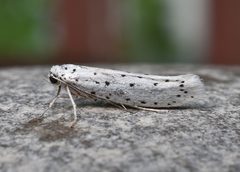
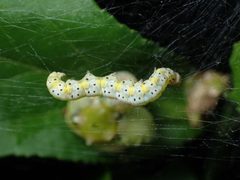
Pronunciation
How to pronounce Yponomeuta: /ˌjuːpəˈnɒmjuːtə/
These audio files are automatically generated. While they are not always 100% accurate, they are a good starting point.
Identification
Members of this can be recognized as small within the Yponomeutidae . Specific identification to level requires examination of wing pattern, genitalia, and plant associations. The genus is distinguished from related genera within the family by a combination of morphological characters including wing venation and genitalic structure.
Images
Distribution
Recorded from Denmark, Norway, Sweden, and Vermont, United States. The has a broad distribution across the Palearctic region with some extending into North America.
Behavior
Several have been observed to emit distinctive clicks during as an anti- defense against bats. These clicks are broadcast at amplitudes that avoid attracting unnecessary attention while still signaling the ' chemical unpalatability. of Yponomeuta cagnagella from urban areas with long-term light pollution show significantly reduced flight-to-light compared to rural populations, indicating evolved behavioral plasticity or genetic . In this species, female moths consistently show lower attraction to light than males regardless of population origin.
Human Relevance
Some are known as agricultural or horticultural pests, feeding on various trees and shrubs. The has become a model for studying rapid evolutionary to human-altered environments, specifically the effects of urban light pollution on .
Similar Taxa
More Details
Evolutionary Response to Light Pollution
A 2016 study published in Letters documented that Yponomeuta cagnagella from Basel, Switzerland and surrounding urban areas with heavy light pollution showed 30-50% reduction in -to-light compared to rural populations. This represents one of the first documented cases of rapid evolutionary to urbanization in , with behavioral changes observed over relatively few .