
Yponomeuta malinellus
Zeller, 1838
Apple Ermine, apple ermine moth
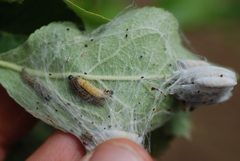
Yponomeuta malinellus, the apple ermine moth, is a small ermine moth native to Europe and Asia that has become established in North America. It is a pest of Malus (apple) , with larvae that feed gregariously within silken tents and can cause significant defoliation. The species has been extensively studied as a target for , with multiple species introduced to manage .
Pronunciation
How to pronounce Yponomeuta malinellus: //ˌɪpoʊnoʊˈmjutə ˌmælɪˈnɛləs//
These audio files are automatically generated. While they are not always 100% accurate, they are a good starting point.
Identification
Distinguished from by forewing pattern of 12–16 black dots in three irregular lines; Y. cagnagellus has fewer dots (typically 5) in different arrangement. Larval tents on apple distinguish it from other Yponomeuta on different . fly June–October in continental Europe, July–August in Britain.
Images
Habitat
Apple orchards, gardens, and wild with Malus . Larvae require living apple foliage for development.
Distribution
Native to Europe and Asia; introduced and established in North America (Pacific Northwest, Canada). In Britain, widespread in England but scarce in Scotland, Wales, and Ireland. Documented in Korea, Turkey (Çoruh Valley, Erzurum Province), Germany, Finland, and Northeast Asia.
Seasonality
fly June–October in continental Europe; July–August in Britain. Larvae active May–early June, producing silken tents. Single per year ().
Diet
Larvae feed exclusively on Malus (apple). larvae initially mine into leaves before emerging to feed gregariously within silken webbing.
Host Associations
- Malus - obligate Larval food plant; feeding causes defoliation and reduced fruit production
Life Cycle
. laid in batches on apple branches. Larvae hatch and initially burrow into leaves, then produce communal silken tents in May–early June within which they feed gregariously. Fully grown larvae pupate within tents or in leaf litter. emerge summer–autumn. Overwinters as egg.
Behavior
Larvae exhibit gregarious feeding , constructing and living within communal silken tents. This tent-building behavior facilitates attack and influences rates at the tent .
Ecological Role
Herbivore of apple; significant pest in orchards. Serves as for diverse including Ageniaspis fuscicollis, Herpestomus brunnicornis, Dolichogenidea delecta, Zenillia dolosa, Diadegma armillata, Trieces facialis, Itoplectis tunetana, and Pimpla turionellae. accounts for 25–43% of generational mortality, exceeding parasitoid impact (11–14%).
Human Relevance
Agricultural pest of apple causing defoliation and reduced fruit production; can impact yields for several years. Subject of programs in North America with introduction of European . Used in genetic studies of plant specialization and sensitivity.
Similar Taxa
- Yponomeuta cagnagellusOverlapping distribution and similar appearance; distinguished by forewing pattern (Y. cagnagellus has ~5 black dots vs. 12–16 in Y. malinellus) and plant (spindle, Euonymus vs. apple, Malus). The two hybridize in laboratory conditions.
- Yponomeuta padellusSimilar white forewings with black spotting; distinguished by association (Prunus spp., particularly bird cherry) and subtle differences in spot arrangement.
More Details
Biological Control History
Extensively studied in Europe (Germany 1993–1995) to select for introduction to Canada and the Pacific Northwest. Ageniaspis fuscicollis and Herpestomus brunnicornis were selected due to minimal and effective stage complementarity.
Parasitoid Community Structure
Stage-specific documented: Ageniaspis fuscicollis attacks and kills final instar larvae; Dolichogenidea delecta parasitizes all larval instars; Herpestomus brunnicornis attacks second instar through pupa; Zenillia dolosa parasitizes mid-larval to pupal stages. Competitive interactions exist between A. fuscicollis and other .
Sensory Biology
Larvae display specific sensitivity to apple secondary metabolites including dulcitol, phloridzin, prunasin, and sorbitol. Sensitivity traits show or semi-dominant inheritance in hybrid crosses with Y. cagnagellus, supporting genetic basis for specialization.
Sources and further reading
- BugGuide
- Wikipedia
- iNaturalist taxon
- NCBI Taxonomy
- Catalogue of Life
- Yponomeuta-cagnagella - Entomology Today
- Urban Moths Have Evolved to Avoid the Big City Lights
- Pupal Parasitoids ofYponomeuta malinellus(Lepidoptera: Yponomeutidae) in Northeast Asia
- Suitability of Yponomeuta malinellus and Y. cagnagellus (Lepidoptera: Yponomeutidae) as Hosts of Diadegma armillata (Hymenoptera: Ichneumonidae)
- Seasonal phenology and stage‐specific parasitism of the apple ermine moth, Yponomeuta malinellus Zeller, in Korea
- Parasitoids of the apple ermine moth, Yponomeuta malinellus Zeller, 1838 (Lepidoptera: Yponomeutidae), in the Çoruh Valley, Erzurum Province, Turkey
- INHERITANCE OF GUSTATORY SENSITIVITY IN F1 PROGENY OF CROSSES BETWEEN YPONOMEUTA CAGNAGELLUS AND Y. MALINELLUS (LEPIDOPTERA)
- Quantifying the impact of insect predators and parasitoids on populations of the apple ermine moth,Yponomeuta malinellus(Lepidoptera: Yponomeutidae), in Europe
- New a species as parasitoid of the apple ermine month Yponomeuta malinellus Zeller, 1838 (Lepidoptera: Yponomeutidae) in the Çoruh Valley, Erzurum Province, Türkiye
- Impact and oviposition behaviour ofAgeniaspis fuscicollis(Hymenoptera: Encyrtidae), a polyembryonic parasitoid of the apple ermine moth,Yponomeuta malinellus(Lepidoptera: Yponomeutidae)
- Introduction and establishment of parasitoids for the biological control of the apple ermine moth, Yponomeuta malinellus (Lepidoptera: Yponomeutidae), in the Pacific Northwest
- Life History and Insect Enemies ofHyponomeuta malinellus Zell.(Lep., Hyponomeutidae) in Finland