
Yponomeuta padella
(Linnaeus, 1758)
orchard ermine, cherry ermine
Yponomeuta padella is a small ermine moth native to Europe and parts of Asia, now introduced to North America. are active from July to August and are attracted to light. The is notable for forming part of a cryptic with Y. malinellus, Y. cagnagella, Y. rorella, and Y. evonymella, requiring genital examination or plant association for reliable identification. Larvae feed on Prunus and Crataegus species, and the has demonstrated potential with documented causing significant defoliation in introduced and expanded ranges.
Pronunciation
How to pronounce Yponomeuta padella: /ˌɪpəˈnɔːmjʊtə pəˈdɛlə/
These audio files are automatically generated. While they are not always 100% accurate, they are a good starting point.
Identification
Reliable identification from similar Yponomeuta requires genital examination. Y. padella has 51–57 antennal segments compared to 50–56 in Y. malinellus and 56–65 in Y. cagnagella. Greyish fringed distinguish it from Y. malinellus; greyish forewing pollination distinguishes it from Y. cagnagella. plant association provides a useful but not infallible clue: Y. padella feeds on Prunus spinosa, other Prunus spp., and Crataegus, while Y. malinellus is associated with apple (Malus).
Images
Appearance
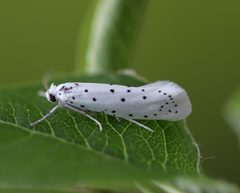
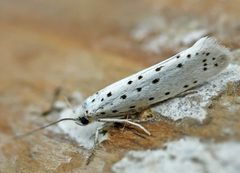
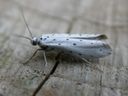
Wingspan 19–22 mm. white. Forewings light grey, sometimes suffused with white especially toward dorsum; four longitudinal series of black dots, with the first series not reaching the middle, the second beginning beyond the first, and the lowest containing 4–6 dots; additional black dots present before the termen; cilia light grey. Hindwings rather dark grey. Larva greenish-grey with black spots and black head.
Habitat
Found in all where plants occur, including orchards, hedgerows, forest edges, and transition zone forests. In its native range, occupies temperate European . In introduced ranges, has been documented in high altitudinal transition zone forests of the North Western Himalaya (India) and in Pacific Northwest North American habitats.
Distribution
Native to Europe, widespread across the continent north to the Saint Petersburg area. In Asia, distributed in Transcaucasia, southern Kazakhstan, central Asia, and more recently documented in Himachal Pradesh, India. Introduced to North America, first recorded in British Columbia and Washington State. In the British Isles, first recorded in Northern Ireland in 1972, subsequently spreading to proportions in parts of the Republic of Ireland.
Seasonality
period July to August. In India, larval damage first observed in July.
Diet
Larvae feed on leaves of Prunus spinosa (blackthorn), other Prunus , and Crataegus (hawthorn). Documented associations include Prunus cornuta (Himalayan bird cherry) in India and Crataegus monogyna in Iran.
Host Associations
- Prunus spinosa - larval blackthorn
- Prunus cornuta - larval Himalayan bird cherry; first recorded in India 2022
- Crataegus monogyna - larval common hawthorn
- Prunus spp. - larval other cherry/plum
- Crataegus spp. - larval hawthorn
Behavior
attracted to light. Larvae feed gregariously, capable of causing severe defoliation of plants. Documented with more than 90% leaf recorded on some trees. In urban environments, related show reduced -to-light behavior due to selection pressure from light pollution; this may apply to Y. padella though specific studies are lacking.
Ecological Role
Herbivore; larval feeding can cause significant defoliation of shrubs and trees. may alter local vegetation structure. Serves as prey for various .
Human Relevance
Agricultural and horticultural pest, particularly in orchards and hedgerows. Can cause severe defoliation of Prunus and Crataegus plantings. In Ireland, colonized over 600 km² within 10 years and reached proportions within 30 years. In India, on Prunus cornuta prompted calls for development. Introduced in North America subject to monitoring by agricultural extension services.
Similar Taxa
- Yponomeuta malinellusPart of cryptic ; distinguished by 50–56 antennal segments, different plant (Malus), and less greyish fringed
- Yponomeuta cagnagellaPart of cryptic ; distinguished by 56–65 antennal segments and different forewing pollination pattern
- Yponomeuta rorellaPart of cryptic ; distinguished by slightly different structure of greyish forewing pollination
- Yponomeuta evonymellaPart of same cryptic
More Details
Cryptic species complex
Y. padella is part of one of the most challenging cryptic in Lepidoptera. The five (Y. padella, Y. malinellus, Y. cagnagella, Y. rorella, Y. evonymella) are morphologically nearly identical and were historically confused. Modern identification relies on genital , antennal segment counts, and plant associations, though even these characters show overlap.
Invasive spread
The demonstrates significant capacity. In Ireland, spread from initial detection in 1972 to levels within 30 years. In India, first recorded in 2022 with severe conditions. Introduction to North America appears more recent and localized, with established in British Columbia and Washington.
Taxonomic history
Yponomeuta diffluellus Heinemann, 1870 and Yponomeuta rhamnellus Gershenson, 1974 have been treated as valid by some authors but are generally regarded as synonyms of Y. padella.
Sources and further reading
- BugGuide
- Wikipedia
- GBIF taxonomy match
- iNaturalist taxon
- NCBI Taxonomy
- Catalogue of Life
- Yponomeuta-cagnagella - Entomology Today
- Urban Moths Have Evolved to Avoid the Big City Lights
- AN OUTBREAK OF Yponomeuta padella (LINNAEUS, 1758) ON Prunus cornuta (HIMALAYAN BIRD CHERRY) IN KULLU DISTRICT, HIMACHAL PRADESH, INDIA
- Study of Spatial Distribution of the Hawthorn (Crataegus monogyna) Trees Attacked by Orchard Ermine (Yponomeuta padella) in Bazoft Forests of Chaharmahal and Bakhtiari Province